Wayground logo

Free Printable Worksheets

Font size

S
M
L
XL
Worksheets

Human Population

Total questions: 55

Worksheet time: 34mins

Name
Class
Date
1.

the study of characteristics of populations, especially human populations.

a)

demography

b)

urbanization

c)

life expectancy

d)

migration

2.

the average number of children a woman of childbearing years would have in her lifetime, if she had children at the current rate for her country.

a)

fertility rate

b)

survivorship

c)

infrastructure

d)

life expectancy

3.
the basic facilities of a country or region, such as roads, bridges, and sewers.
a)
infrastructure
b)
rate of natural increase
c)
demographics
d)
human development index
4.
the average length of time an individual is expected to live.
a)
life expectancy
b)
migration
c)
human development index
d)
infastructure
5.
in general, any movement of individuals or populations from one location to another; a periodic group movement that is characteristic of a given population or species.
a)
migration
b)
mortality rate
c)
urbanization
d)
life expectancy
6.
the percentage of newborn individuals in a population that can be expected to survive to a given age.
a)
survivorship
b)
life expectancy
c)
mortality rate
d)
demogrpahics
7.
an increase in the ratio or density of people living in urban areas, rather than rural areas.
a)
urbanization
b)
infastructure
c)
rate of natural increase
d)
mortality rate
8.
The number of deaths per year, typically reported as deaths per 100,000 in a population.
a)
mortality rate
b)
human development index
c)
survivorship
d)
rate of natural increase
9.
a summary measure of the average achievement in key areas of  human development: a long and healthy life, knowledge, and acceptable standard of living.
a)

human development index

b)
fertility rate
c)
migration
d)
survivorship
10.
a measure of how quickly a population is growing or declining solely by the difference between birth and death rates in a region.
a)

rate of natural increase

b)
demographics
c)
fertility rate
d)
urbanization
11.

The size of the human population began to increase exponentially after the

a)

bubonic plague

b)

development of plowing and irrigation

c)

Industrial Revolution

d)

development of the first cities.

12.

Which of the following is NOT a potential limiting factor of human population growth?

a)

disease

b)

war

c)

medicine

d)

famine

13.

After the demographic transition is complete, a population

a)

grows rapidly

b)

grows slowly

c)

begins a period of rapid decline

d)

stays about the same size as time passes.

14.

Since the mid-1960s, the average annual growth rate of the human population has

a)

remained about the same

b)

failed to show a consistent pattern.

c)

increased

d)

decreased

15.

The size of the human population began to increase exponentially after the

a)

bubonic plague

b)

development of plowing and irrigation

c)

Industrial Revolution

d)

development of the first cities.

16.

Which of the following is NOT a potential limiting factor of human population growth?

a)

disease

b)

war

c)

medicine

d)

famine

17.

After the demographic transition is complete,

a)

grows rapidly

b)

grows slowly

c)

begins a period of rapid decline

d)

stays about the same size as time passes.

18.

Since the mid-1960s, the average annual growth rate of the human population has

a)

remained about the same

b)

failed to show a consistent pattern.

c)

increased

d)

decreased

19.

Name the type of pyramid in the picture.

a)

slow growth

b)

rapid growth

c)

zero growth

d)

negative growth

20.
Why has the world population dramatically increased?
a)
Better medicine
b)
Better sanitation
c)
Better technology
d)
All of the above
21.
Number of Individuals per unit area
a)
density-dependent factors
b)
carrying capacity
c)
renewable resource
d)
population density
22.
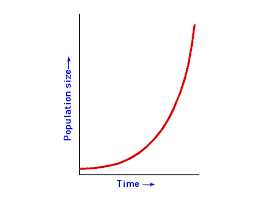
What type of growth is shown in the diagram?
a)
exponential growth
b)
logistic growth 
c)
predator-prey cycle
d)
boom-bust curve
23.
Demography is the scientific study of
a)
parasitism and disease.
b)
modernized countries.
c)
human populations.
d)
none of these
24.
Demographic transition is change from high birthrates and high death rates to
a)
exponential growth.
b)
low birthrates and low death rates.
c)
low birthrates and high death rates.
d)
indefinite growth.
25.
In Rwanda, there are more young children than teenagers, and more teenagers than adults. This age structure indicates a population that
a)
has stopped growing.
b)
will double in 30 years.
c)
has a steady growth rate.
d)
will decrease in 30 years.
26.
Most of the worldwide human population is growing exponentially because
a)
human populations have not reached their exponential curve.
b)
most countries have not yet completed the demographic transition.
c)
human populations do not conform to the logistic model.
d)
the food supply is limitless.
27.
What three factors can affect ANY population's growth rate?
a)
Birthrate, death rate, migration
b)
disease, predation, migration
c)
medicine, agriculture, industry
d)
life expectancy, sanitation, vaccines
28.
Which of the following would most likely occur if a population exceeded the carry capacity of the environment?
a)
The birth rate would likely increase.
b)
Birth rate would be equal to the death rate.
c)
The death rate would increase.
d)
Immigration would increase.
29.
The percentages of individuals found at different age levels make up the ______ of the population.
a)
carrying capacity
b)
age structure
c)
survivorship
d)
birthrate
30.

What does the term carrying capacity describe?

a)

The maximum number of birth rates for a population.

b)

The ability of a population to accept new immigrants.

c)

The ratio of birth rates to death rates in a population.

d)

The population size that the environment can sustain.

31.

A Density Independent Limiting Factor is a limiting factor of a population that can affect population growth no matter what the population density. What is a density independent limiting factor that can affect the human population growth of North Carolina?

a)

disease

b)

hurricanes

c)

food supply

d)

water supply

32.
What is the carrying capacity of the following graph?
a)
1000
b)
8000
c)
800
d)
600
33.
What type of growth is shown in the diagram?
a)
exponential growth
b)
logistic growth 
c)
predator-prey cycle
d)
boom-bust curve
34.

Which of the following is a density-dependent limiting factor?

a)

human activities

b)

unusual weather

c)

competition

d)

natural disaster

35.
If the number of births in a population is the same as the number of deaths in a population, what will happen to the growth of the population?
a)
It will increase.
b)
It will decrease.
c)
It will stay the same.
d)
It will fluctuate.
36.
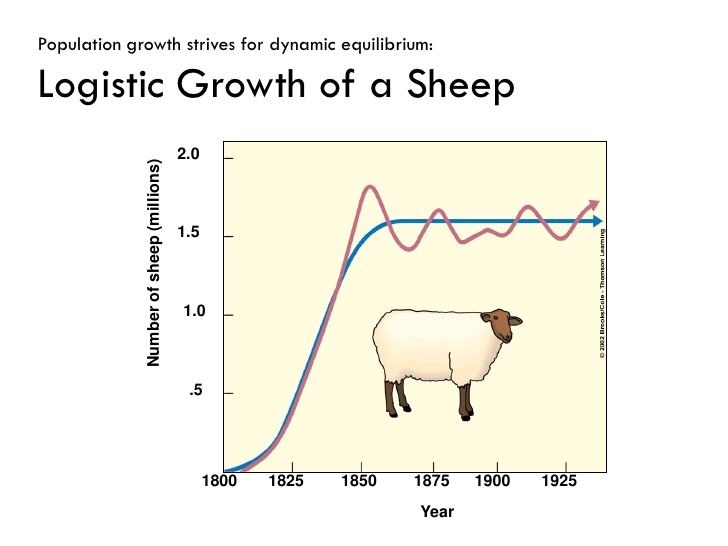
What is the carrying capacity for this sheep population?
a)
1.8 million
b)
1.25 million
c)
1.6 million
d)
1.o million
37.

An environmental factor such as predation, disease, and competition that depends on the number of members in a population per unit (or area) is called ___________.

a)

dispersion

b)

density- independent factor

c)

density- dependent factor

d)

Scattered points

38.
If the number of births is greater than the number of deaths in a population, what will happen to the growth of the population?
a)
It will increase.
b)
It will decrease.
c)
It will stay the same.
d)
It will fluctuate.
39.
When a population grows past the ecosystem's carrying capacity, what happens to the population?
a)
Continues to grow
b)
The population starts to die off to return to carrying capcity
c)
The population will go extinct due to lack of resources
d)
The population grows then finds a new carrying capacity
40.
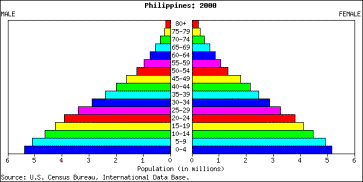
According to the population pyramid of this country, its population is most likely...
a)
growing slowly.
b)
growing rapidly.
c)
decreasing.
d)
not changing.
41.
According to the United Nations, at what number is world population expected to plateau?
a)
9-11 billion
b)
13-15 billion
c)
20-25 billion
d)
never
42.
Which has NOT been a major cause of the population explosion?
a)
modern preventive medicine
b)
increase in life expectancy
c)
improved sanitation
d)
increase in birth rates
43.
Which of the following is likely to be affected by a population of 7 billion?
a)
amount of land for agriculture
b)
amount of clean water
c)
number of people who are unemployed
d)
all of the above
44.
The number of live births per 1000 people is called the...
a)
growth rate.
b)
infant rate.
c)
baby total.
d)
birth rate.
45.
All of the following are demographic figures used in determining the total population of a country EXCEPT...
a)
immigration.
b)
birth rate.
c)
death rate.
d)
marriage rate.
46.
If a country has a death rate of 30 and a birth rate of 45 the natural rate of increase would show the population is ______.
a)
Increasing
b)
Decreasing
c)
Staying the same
d)
Fluctuating too much
47.
The maximum population size of a species that the environment can sustain indefinitely, given the food, habitat, water and other necessities available in the environment.
a)
sparse population
b)
environmental
c)
carrying capacity
d)
dense population
48.
One reason for a rapid population growth is...
a)
an increase in pull factors.
b)
declining death rates. 
c)
a sparse population density. 
d)
internal migration.
49.

Which of the following occurred alongside the Industrial Revolution that led to rapid human population growth? Select all that apply.

a)

reliable food supplies

b)

improvements in sanitation

c)

the Bubonic Plague

d)

improvements in health and medicine

50.

The scientific study of human populations is called ___.

a)

ecology

b)

biology

c)

dynamics

d)

demography

51.

Which of the following age structure diagrams demonstrates little to no growth in the population?

a)
b)
c)
d)

none of the above

52.

Which of the following age structure diagrams demonstrates NEGATIVE growth in the population?

a)
b)
c)
d)

none of the above

53.

Which of the following age structure diagrams demonstrates POSITIVE, RAPID growth in the population?

a)
b)
c)
d)

none of the above

54.

Wealthy, old, low birth and death rates, Industrialized, slow growth

a)

Developed Nation

b)

Developing Nation

55.

Poor, Young, High Birth and Death Rates, Population Increasing rapidly, Agricultural

a)

Developed Nation

b)

Developing Nation