wayground logo

Free Printable Worksheets

Font size

S
M
L
XL
Worksheets

science 7

Total questions: 32

Worksheet time: 11mins

Name
Class
Date
1.
Which of the following is the smallest unit of life that can carry out all life functions?
a)
the mitochondria
b)
the vacuoles
c)
the nucleus
d)
the cell
2.
Which structures are found in every living cell?
a)
cell membrane and cytoplasm
b)
chloroplasts and mitochondria
c)
a cell wall and nucleus
d)
chloroplasts and cell wall
3.
Which cell structure is found in plant and animals cells and controls what can come into or leave a cell?
a)
cell membrane
b)
cytoplasm
c)
nucleus
d)
vacuole
4.
Chloroplasts in plant cells allow the plant to perform a function that animal cells cannot do.  What is the main function of the chloroplasts found in plant cells?
a)
to absorb light energy and manufacture food
b)
to remove waste materials by active transport
c)
to manufacture chemical energy from food
d)
to control the shape of the cell
5.
In what part of the plant cell does the process of photosynthesis take place?
a)
nucleus
b)
mitochondria
c)
chloroplasts
d)
vacuoles
6.
Who was the first  person to see cells under the microscope and give them their name?
a)
Mattias Schleiden
b)
Robert Hooke
c)
Theordor Schwann
d)
Anton van Leeuwenhoek
7.
The basic unit of structure and function in a living things.
a)
chloroplast
b)
nucleus
c)
cell
d)
cell membrane
8.

Your heart pumps blood through the body. This process is called....

a)

a heartbeat

b)

circulation

c)

pulsing

9.

The heart is part of the ________________ system.

a)

circulatory

b)

excretory

c)

respiratory

d)

digestive

10.

The circulatory system is made up of the...

a)

heart only

b)

heart and blood vessels

c)

heart, blood vessels and blood

11.

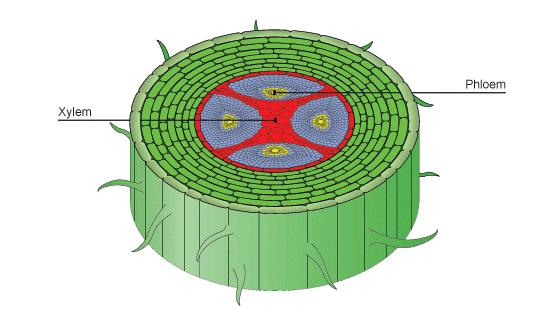
Specific type of plant tissue that transports water and minerals from the roots, through the stems, to leaves

a)

vascular plant

b)

nonvascular plant

c)

xylem

d)

phloem

12.
What is a tissue
a)
A group of cells that share a common goal
b)
a tissue that has a function
c)
A group of cells that share a common function, structure or both
d)
A group of cells
13.

Ink can be separated by a method of -----------------------------------------------

a)

distillation

b)

filtration

c)

chromatography

d)

sedimentation

14.

What is chromatography?

a)

A way to see pretty colors

b)

A laboratory technique used to separate a mixture.

c)

A form of distillation

15.

Which of the following mixture/s is/are separated by chromatography?

a)

Pigments from natural colours

b)

Colours in a dye

c)

Colours of flowers extracts

d)

All the above

16.

Name the method of separation

a)

Fractional distillation

b)

Chromatography

c)

Condensation

d)

Evaporation

17.
Distillation uses two changes of state. what are they?
a)
Evaporation and condensation
b)
Evaporation and freezing
c)
melting and boiling
d)
sublimation and condensation
18.
A combination of rocks and water is an example of
a)
A mixture
b)
A solution 
c)
Dissovling
19.
Which substance is SOLUBLE in water?
a)
sand
b)
oil
c)
salt (sodium chloride)
d)
sulfur
20.
Solutions are composed of __________ .
a)
salts and solutes
b)
solvents and salts
c)
solutes and alloys
d)
solutes and solvents
21.
3 states of water found on earth
a)
solid, liquid & gas
b)
oceans, lakes & streams
c)
evaporation, transpiration
d)
rain, sleet & hail
22.
the change of state from a liquid to a gas
a)
water cycle
b)
evaporation
c)
precipitation
d)
condensation
23.
Evaporation occurs when water changes into 
a)
transpiration
b)
snow
c)
solid
d)
vapor
24.
When a liquid reaches the temperatures of its ___, it can become a gas.
a)
melting point
b)
freezing point
c)
boiling point
d)
density
25.
What is the boiling point of water
a)
0 C
b)
100 F
c)
50 C
d)
100 C
26.

Energy can't be created or destroyed. It can only be transfered

a)

True

b)

False

27.

The energy associated with movement is called...

a)

Chemical energy

b)

Thermal energy

c)

Sound energy

d)

Kinetic energy

28.

Energy that does not run out of its supply is called...

a)

Renewable Energy

b)

Nonrenewable Energy

c)

Recycled Energy

d)

Potential Energy

29.

What happens to fossil fuels to create electricity?

a)

They are stored

b)

They are burned

c)

They are melted

d)

They are frozen

30.

Fossil Fuels are

a)

pieces of rock that have been compacted many times

b)

rock that contains 50% plant and animal remains

c)

metamorphic rock

d)

fuels that form from the remains of plant and other organisms that were buried and altered over million of years

31.
These fuels are made from living things such as leaves, food wastes, and manure.
a)
geothermal fuels
b)
hydrogen fuels
c)
biomass fuels
32.
Solar energy is 
a)
Energy from the uneven heating of the earth.
b)
Energy from burning fossil fuels.
c)
Energy from the sun.
d)
Energy from turbines.