
 Worksheets
Chapter 8 Solid Liquid Gas Review
Total questions: 56
Worksheet time: 56mins
What is the most common state of matter in the universe?
Solid
Liquid
Gas
Plasma
As we heat matter, what happens to the speed of the particles?
Slow down
Nothing
Speed up
What determines the state of matter?
the amount of energy of the particles
The amount of particles
the shape of the particles
What happens to the forces holding the molecules together if the phase is changing form liquid to gas?
They must get stronger
They must get weaker
They must stay the same
There are no forces holding a liquid together.
In what state of matter is there a definite pattern of particles?
Solid
Liquid
Gas
Plasma
Which states of matter takes the shape of their container?
Solid
Liquid
Gas
Plasma
How do particles move in a solid compared to a liquid or gas?
Faster
Slower
Same
Most matter does this when heated
Expand
Contract
The energy of movement is ___.
potential energy
kinetic energy
mechanical energy
The more energy that particles have, the ___ they move.
slower
faster

These properties describe a ___.
solid
liquid
gas

These properties describe a ___.
solid
liquid
gas

These properties describe a ___.
solid
liquid
gas
The particles of ___ generally have the least amount of energy.
solids
liquids
gases
According to the Kinetic Molecular Theory a liquid's (SELECT ALL THAT APPLY)
particles are held close together by intermolecular forces
particles are in constant motion
particles are vibrating in place and closely packed
particles are not moving
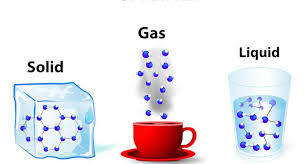

Which of the following is not a physical property of gases?
absence of definite volume
large density
high compressibility
fluidity
Which states of matter are fluid?
gases and liquids
liquids and solids
gases only
liquids only
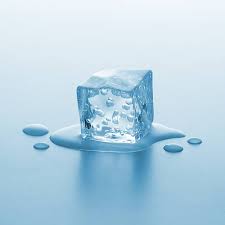
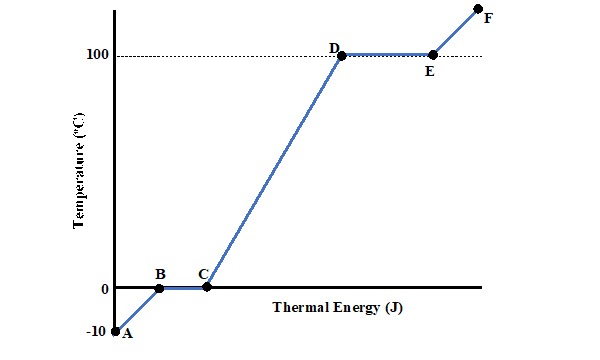
Between which two points is the solid cooling?
A <---- B
B <----> C
C <---- D
D <----> E
E <---- F
Between which two points is the gas heating up?
A ----> B
B <---- C
C ----> D
D ----> E
E ----> F


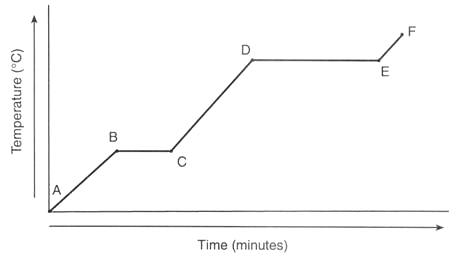
What is happening to the particles in the substance between points A and B?
Melting
Freezing
Speeding Up
Slowing Down

We can prevent water pollution by:
Reduce the use of plastic.
Properly dispose of chemicals.
Clean up after your animals.
All of the above
What are the main sources of water pollution?
Plastic, Paper, and Metal
Snails in water
Help, there is a boot with a snake inside of it that somehow in the nearby lake.
Agriculture, Industry, and Community
The heat absorbed while a solid is melting is known as....
heat of fusion
heat of solid
heat of liquid
heat of vaporization
Heat always flows from a __________________ to a cooler object.
warmer
cooler
liquid
gas

The pressure inside the balloon will:
Decrease
Increase
Remain the same
Not enough information to formulate an answer
IF we are using Boyles' law and our Pressure goes UP, what must our volume do?
Go UP
Go DOWN
Stay the same
Wrong law.
5. According to Charles Law, if Temperature of a gas increases Volume will also....
Increases
Stays the same
Decreases
What happens at absolute zero?
All Motions cease
everything turns to a solid
everything dies
who knows?
The expanding of matter when it is heated is known as
condensation
evaporation
thermal expansion
vaporization
What is the greatest benefit of using hydraulics?
The multiplication of speed
The multiplication of operating time
The multiplication of fuel efficiency
The multiplication of force

When an object is less dense than the fluid its in, it will
Sink
Float
Suspend

When fluids flow faster when forced through a narrow space
Pascal's Princi
Boyle's Law
Venturi Effect
Bernoulli's Principle

The faster a fluid moves, the lower the pressure is in the moving fluid compared to the fluid not moving as fast. This is called
Newton's Laws
Bernoulli's Principle
Wright Brothers Priciple

