
 Worksheets
Waves
Total questions: 25
Worksheet time: 26mins
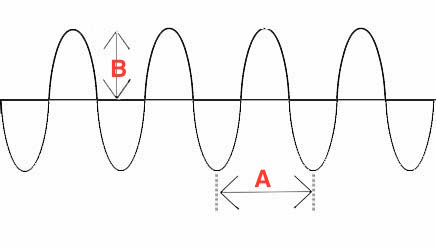
What property of this wave is represented by the letter "A"
amplitude
crest
trough
wavelength
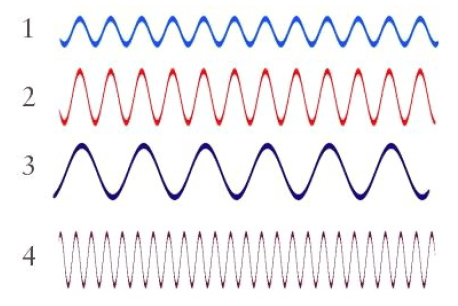

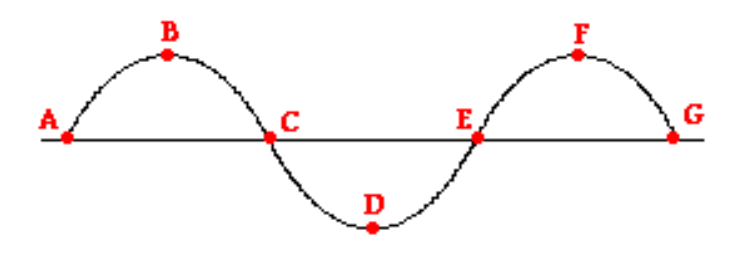
The _______ is the size or height of a wave, measured from the equilibrium to the crest or trough.
Amplitude
Wavelength
Frequency
Frequency is how many waves pass a point in 1 second. If 100 waves pass a given point in 4 seconds, what is the wave's frequency?
25 Hz
100 Hz
4 Hz
400 Hz
The formula for period is __________.
p=1/f
p=f/1
f=1/p
λ = v/f

Which is true about reflection?
The angle of incidence is bigger than the angle of reflection.
The angle of incidence is smaller than the angle of reflection
The angle of incidence = the angle of reflection

Fig. shows a view from above of waves on the surface of water in a water tank. The wavefront AB is travelling in region P towards region Q, where the water is shallower and the waves travel more slowly. Some time later, the wavefront has moved into region Q.
Which is the correct new position of the wavefront?
CD
CE
CF
None of the above

A wave enters from Region P to Q with the new wavefront as CD. What can we say about the regions P and Q
P is deeper than Q
Q is deeper than P
P and Q are of the same depth
None of the above
The waves approaching the barrier have a wavelength of 1.4cm and travel at a speed of 12cm/s. Calculate the frequency of the waves.
8.57 Hz
85.7 Hz
1.16 Hz
11.66 Hz

What is the name given to the effect that allows the wavefronts to reach point X, shown on the diagram?
Reflection
Rarefaction
Refraction
Diffraction

Two graphs are about the same wave. Calculate the speed of this wave.
0.25 m/s
2.5 m/s
0.4 m/s
0.04 m/s
From a Displacement-distance graph you can calculate the ________ of a wave.
Wavelength
Time Period
Frequency
Speed
The technical term for representing ripples through lines is ______________
Wavefronts
Frequency
Crests
wavelength

Fig. shows the displacement-time graph of a wave. What is the frequency of this wave?
0.3 Hz
0.6 Hz
0.33 Hz
1.66 Hz

