
 Worksheets
Expected value and Standard Deviation of a PDF
Total questions: 20
Worksheet time: 39mins
X 50 20 5
P(X) 0.1 0.3 0.6
Eva flips a coin. If she gets heads, she wins $4. If she gets tails, she loses $3. What is her expected value of a coin flip?
$1
$0.50
-$0.50
$0

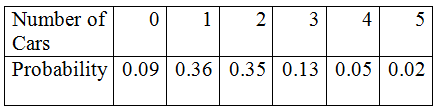
Find the mean (expected value) of the probability distribution.
85
83.2
87.1
84.4

A fair, 6-sided dice is thrown 120 times.
Roughly how many times would you expect the number 5 to come up?
6
10
12
20
Sam’s pencil case contains 3 red, 2 blue and 5 black pens.
He takes a pen out without looking then puts it back 500 times.
Roughly how many times would you expect him to pick up a blue pen?
50
100
200

The table shows the probability distribution of a fair six-sided die. Determine 𝐸(𝑋).
give your answer to 1 decimal place.
(a)
You roll a standard die. You win $12 if you roll a six, $6 if you roll a one, and $0 if you roll anything else. What is the expected value of a single roll?
$3
$18
$9
$2

Calculate the standard deviation given the distribution in the picture;
(a)
You are playing a game by drawing a card from a standard deck and replacing it. If the card is a face card, you win $30. If it is not a face card, you pay $2. There are 12 face cards in a deck of 52 cards. What is the expected value of playing the game?
Write your answer to 2 decimal places. leave out the $
(a)

The function in the given table is a probability function of a discrete random variable 𝑋. Find the standard deviation of 𝑋. Give your answer to two decimal places.
(a)

The function in the given table is a probability function of a discrete random variable 𝑋. Given that the expected value of 𝑋 is 6.5, find the value of A.
(a)
13 students took an exam; 8 students got 6 marks, 3 students got 10 marks, and 2 students got 2 marks. Given that 𝑋 denotes the number of marks received, find the expected value of x. Write your answer to 2 decimal places.
(a)
13 students took an exam; 8 students got 6 marks, 3 students got 10 marks, and 2 students got 2 marks. Given that 𝑋 denotes the number of marks received, find the standard deviation of x. Write your answer to 2 decimal places.
(a)
Your friend shuffles a standard deck of cards and says to pick one. If you pick a face card (Jack, Queen, King of each suit) your friend will give you $10. If you pick anything else, you owe your friend $5. How much should you expect to win or lose by playing this game?
(Write the figure only to 2 decimal places, leave out the $)
(a)
A box contains 12 red, 20 green and 8 yellow sweets.
One is picked out at random then placed back 80 times.
Roughly how many times would you expect him to pick up a yellow sweet?
8
12
16
24

Is this a probability distribution?
No, the sum of p(x) does not equal 1.
Yes, all p(x) are between 0 and 1.
No, all p(x) are not between 0 and 1.
Yes, the sum p(x) is 1.

