
 Worksheets
WHAP Unit 3 Gunpowder Empires
Total questions: 60
Worksheet time: 30mins
What religion did the Ottoman Empire help spread throughout their empire?
Buddhism
Christianity
Shintoism
Islam
What city did the Ottoman Empire conquer in 1453 putting an end to the Byzantium Empire?
Rome
Constantinople
Athens
Vienna
____ were an elite guard of Ottoman soldiers.
sinans
ulema
pashas
janissaries
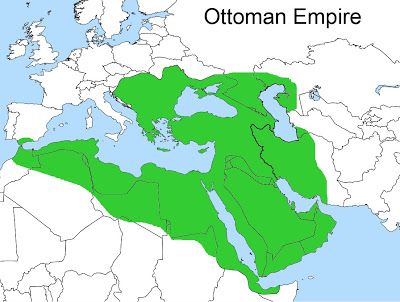
Which continents did the Ottoman Empire have some control over? Click all that apply.
Europe
Asia
Africa
North America
South America
Which technology, first developed by the Chinese, enabled the Ottoman Empire to expand militarily into western Asia, Europe, and northern Africa?
woodblock printing
wheelbarrow
gunpowder
magnetic compass
Which of the following was a system in which the Ottomans took Christian boys, converted them to Islam, and had them work in the military and government?
Millet System
Sultan System
Vizier System
Devshirme System


Who was the founder of the Mughal Empire ?
Babur
Akbar
Humayun
Jahangir
The greatest mughal emperor was __________---
Jahangir
Akbar
Shah Alam
None
Akbar was interested in religion and social customs of different people
True
False
The Mughal Empire originated in the region of ___________________
India
Africa
China
Russia
The Mughal Empire was situated in what modern nation?
Iran
India
Saudi Arabia
Turkey
Q1. Mughal means ____________?
muslim
mongol
Ghenghis Khan
Empire


Russian Tsar that greatly expanded and centralize the Russian state, modeled it after Louis XIV of France & built Winter Palace
Ivan the Great
St. Peter
Peter the Great
Philip II

What city was built in a swamp connected to the Baltic Sea, that became the "New" Capital of Russia in 1703-1917. Also know as "The City built on Bones."
Moscow
Amsterdam
London
St. Petersburg

Who is this "Great" Tsar in Russian History?
St. Peter
Peter I
Ivan IV (Ivan the Terrible)
Henry VIII

Which of the following was NOT an issue with Russia in the 1600s?
No warm water sea ports
Uneducated/miss out on the enlightenment
Primitive towns with little infrastructure
A lack of Land

Which of the following is the best definition of Westernization?
A transition of dress and customs to that of American Cowboys
Expanding a countries borders
Converting to the customs and practices of Western European civilization.
Focusing a countries attention more toward farming and cattle herding

Which of the following is NOT something "Great" Peter I did for Russia in the early 1700s.
Built Schools, Museums, Newspapers
Established a Strong Russian Navy/Army
Built the great city of St. Petersburg
Overtook the French and British using cunning skill
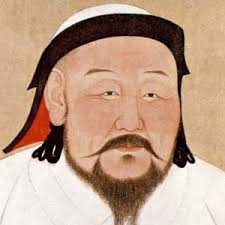
The Ottomans controlled trade because:
They owned major port and land trade routes
They were technologically advanced
They conquered anyone who opposed them
Suleiman The Magnificent was loved by many people
The Ottoman army included 30,000 elite soldiers called ________ who were slaves that were trained to be loyal to the government.
Janissaries
Jizyas
Slavs
None of the Above
In 1494, ___________ became king of the Mughals, expanded the army, & began invasions into India to create his empire
Babur
Sulaman
Suleyman
Shah
In 1556, Babur’s grandson Akbar became king of the Mughal Empire & expanded the empire into almost all of ___________.
Spain
Israel
China
India
The best example of Akbar’s tolerance was his creation of a new religion called the ___________, which blended ideas from a number of big religions (Islam, Hindu, Christianity).
Absolute Religion
New Religion
Divine Faith
Old Religion
Istanbul became the new Ottoman capital. It was known before as:
Rome
Athens
Constantinople
Jerusalem
During his rule of Mughal India, Akbar instituted reforms that aimed to...
alleviate tensions between Hindus and Muslims
redistribute land to elite Muslim soldiers
eliminate Sufism and Sikhism
establish Islam as the sole religion in the Mughal state
In order to supply recruits to serve in its elite Janissary fighting force, the Turks
relied on loyal families to train their second sons to be soldiers.
conscripted Christian children to be trained to serve in this role
imported trained mercenaries and captured elite soldiers
relied on poor Muslim boys to volunteer to train to serve.

What are sun spots?
Black spots on the sun that are more cool

When was the Little Ice Age?
1000 to 1500
1700 to 1950 BC
1300 to 1800
1600 to 1700 BC

How did Little Ice Age affect the Seasons?
Longer Summers and Shorter Winters
Longer Winters and shorter Summers
Longer Fall and Longer Spring
Shorter Fall and Longer Spring
What is a famine?
A widespread food shortage

What caused the Little Ice Age?
Increased Volcanic activities and Decreased Sun Spots

How did the Little Ice Age affect crops?

How did crop failures affect Europe?
Crop failures led to higher prices, and people starving.

How did Volcanoes contribute to the Ice Age?
It didn't contribute
Their ash reflected solar radiation back to space
The Eruptions made earth Warmer
The ash trapped solar radiation on earth
What was a key feature of Akbar’s policies that contributed to stability in the Mughal Empire?
Implementation of harsh religious laws
Religious tolerance and inclusion of Hindus in government
Complete exclusion of non-Muslims from administration
Forced conversion of Hindus to Islam
How did Mughal culture under Akbar’s reign help to foster unity?
By imposing a single cultural standard across the empire
By promoting Persian culture exclusively
By blending Persian, Indian, and Central Asian influences
By rejecting all foreign cultural influences

What famous building is seen here?
The Grand Mosque
Akbar Red Architecture
Taj Mahal
Notre Dame
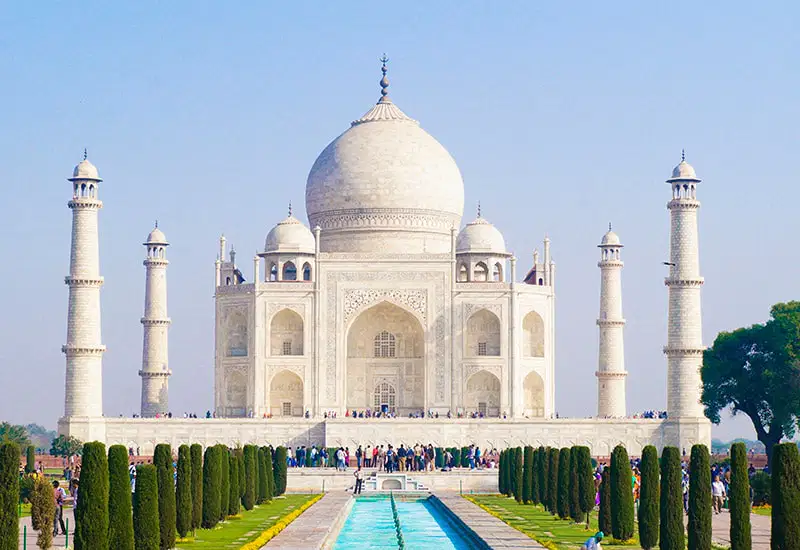
Mughal Empire Notes: Why did Shah Jahan built the Taj Mahal?
For his wife who passed away
Because he wanted a holy temple
Because he was bored
For his son who passed away

The Taj Mahal features a variety of art styles, including Persian, Indian, ____, and European artwork.
Buddhist
Christian
Islamic
Which ruler of the Russian Empire is known for his efforts to modernize and westernize Russia?
Peter the Great
Catherine the Great
Nicholas II
Ivan the Terrible
How did the Russian Empire's expansion into Siberia during the 16th to 18th centuries contribute to the spread of diseases among indigenous populations?
Through the establishment of trade routes
By the relocation of populations
Due to the introduction of new livestock
Through military campaigns
The Russians were forced to give obedience and pay tribute to the...
Huns.
Mongols.
Vikings.
Byzantines.

Why was Constantinople such a prosperous city?
Trade hub for Europe, Asia, and Africa
Great architecture
Autocratic rulers
The pope lives there
Why did Peter the Great spend time in Western Europe?
to prepare for war
to find a wife
to avoid his duties in Russia
to study western technology

What was the great symbol of Peter's desire to forge a modern Russia?
St. Petersburg
Moscow
the Russian Orthodox Church
the partition of Poland
Peter the Great forced Russians to accept reforms that would make their culture more like ____.
Native Americans
Chinese
Ottoman Turks
Western Europeans

What country is this?
France
Germany
Russia
Ukraine

Which of the following is the best definition of Westernization?
A transition of dress and customs to that of American Cowboys
Expanding a countries borders
Converting to the customs and practices of Western European civilization.
Focusing a countries attention more toward farming and cattle herding

Peter The Great led Russia in a war with ______ that won territory along the Baltic Sea?
Sweden
Norway
France
Prussia

