
NEW
Font size
S
M
L
XL
 Worksheets
Heat
Total questions: 40
Worksheet time: 1hrs 11mins
Name
Class
Date
1.

If an object has greater mass, it has greater
a)
Temperature
b)
Thermal Energy
c)
Heat
d)
All of the above
2.

It is cooler outside than inside of my house. Is an example for which concept?
a)
Thermal Energy
b)
Heat
c)
Temperature
3.

My hands feel warm because
a)
The temperature is cold outside
b)
The molecules are moving
c)
The heat is transferring
4.

Sum of the kinetic and potential energy of the particles
a)
Thermal Energy
b)
Temperature
c)
Heat
5.

Average of kinetic energy
a)
Thermal Energy
b)
Temperature
c)
Heat
6.

Movement of thermal energy
a)
Thermal Energy
b)
Temperature
c)
Heat
7.

Heat
a)
Moves from hot to cold
b)
Moves from cold to hot
c)
Always rises up
d)
It depends on the molecules
8.

When heat transfers from warmer to cooler, the molecules
a)
move closer and slow down
b)
move closer and speed up
c)
spread out and slow down
d)
spread out and speed up
9.
A 15.75-g piece of iron absorbs 1086.75 joules of heat energy, and its temperature changes from 25°C to 175°C. Calculate the specific heat capacity of iron.
a)
0.46 J/gxoC
b)
1.654 J/gxoC
c)
2,567,446.875 J/gxoC
10.
How many joules of heat are needed to raise the temperature of 10.0 g of aluminum from 22°C to 55°C, if the specific heat of aluminum is 0.90 J/gx°C?
a)
297 Joules
b)
0.003 Joules
c)
297 J/gx°C
d)
0.003 J/gx°C
11.
A 0.3 g piece of copper is heated and fashioned into a bracelet. The amount of energy transferred by heat to the copper is 66,300 J. If the specific heat of copper is 390 J/g 0C, what Is the change of the copper's temperature?
a)
566.7 °C
b)
77,571,000 Joules
12.
When a piece of aluminum foil is taken out of the oven and cools from 100° to 50°, What is the change in temperature?
a)
50°
b)
0°
c)
100°
d)
150°
13.
The symbol for specific heat is .......
a)
c
b)
Q
c)
m
d)
t
14.
What is the formula to calculate heat energy required to raise the temperature of any substance?
a)
Q=mc∆t
b)
Q=mc
c)
Q= ½mv
d)
m=QC
15.
Specific heat is....
a)
The measure of kinetic energy of an objects particles
b)
A measure of the energy needed to increase the average kinetic energy of the particles
c)
The heating caused by the motion of flluid due to temperature difference
d)
The transfer of energy by electromagnetic radiation
16.
A high specific heat means...
a)
It heats up quickly with energy added
b)
It requires more energy to change temperature
17.

How many Joules of energy are required to change 10 gram of liquidwater from 20 C to 90 C?
a)
1400 J
b)
2800 J
c)
210,000 J
d)
1,400,000 J
18.
The specific heat of aluminum is 0.21 J/g°C. How much heat(Q) is released when a 10 g piece of aluminum foil is taken out of the oven and cools from 100° to 50°?
a)
105 J
b)
10.5 J
c)
1.05 J
19.
For a skillet, used for cooking, do you want a high or low specific heat
a)
High, so that it will need more energy to heat up
b)
Low, so that it will change temperature quickly
20.
20 g of water. specific heat of water is 4.18 J/x°C. temperature changes from 25° C to 20° C, how much heat energy (Q) moves from the water to the surroundings?
a)
418 Joules
b)
209 J
c)
83 J
d)
4.18 J
21.
If 200 grams of water is to be heated from 24.0° C to 100.0° C to make a cup of tea, what is the mass and what is the change in temperature?
a)
m=200g
∆t= 66
∆t= 66
b)
m=200g
∆t=124
∆t=124
c)
m=200
∆t=100
∆t=100
d)
m=200g
∆t=76
∆t=76
22.
The specific heat(c) of copper is 0.39 J/g °C. What is the temperature change(∆t) when 100 Joules of heat(Q) is added to 20 grams?
a)
12.82 °C
b)
24.12°C
c)
351 °C
23.

Which of the following is NOT true about heat?
a)
Heat moves from hot to cold
b)
Heat is a form of energy
c)
Heat cannot be transferred
d)
Heat makes molecules speed up
24.
Boyle's Law shows the relationship between between which two factors of a gas?
a)
volume and pressure
b)
temperature and pressure
c)
pressure and temperature
d)
Volume and mass
25.
Charles's law shows the relationship between which two factors of a gas ?
a)
volume and temperature
b)
volume and pressure
c)
pressure and volume
d)
volume and mass
26.
Directly proportional means that as one value increases ....................
a)
the other stays the same
b)
the other increases as well
c)
the other decereases
d)
the other goes to zero
27.
The word inverse means.......
a)
the same
b)
opposite
28.
Temperature describes the ______________ of particles.
a)
volume
b)
mass
c)
motion
d)
conductivity
29.
Gas Laws involve what three terms?
a)
Solid Liquid Gas
b)
Speed Velocity Acceleration
c)
Elements Compounds Mixtures
d)
Pressure Temperature Volume
30.

Which law?
a)
Charles
b)
Boyle
c)
Hunsecker
d)
Newton
31.

Whose law explains why our ears pop in an airplane?
a)
Boyle
b)
Charles
c)
Aglow
d)
Zampelli
32.
What is the formula for Boyle's Law?
a)
P1V1=P2V2
b)
P1V1/P2V2
c)
P1V2=P2V1
d)
P1/V1=P2/V2
33.
When Volume increases then Pressure must...
a)
Increase
b)
Decrease
34.
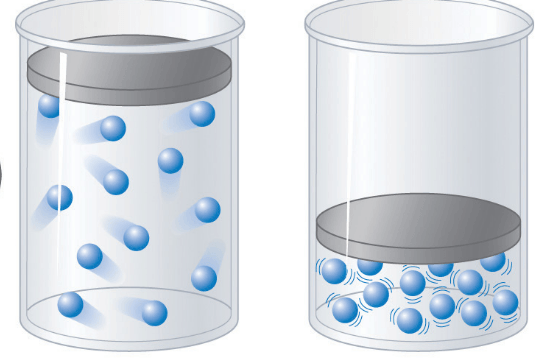
Which container will have a lower pressure?
a)
left
b)
right
c)
they both have the same pressure
d)
I don't know
35.
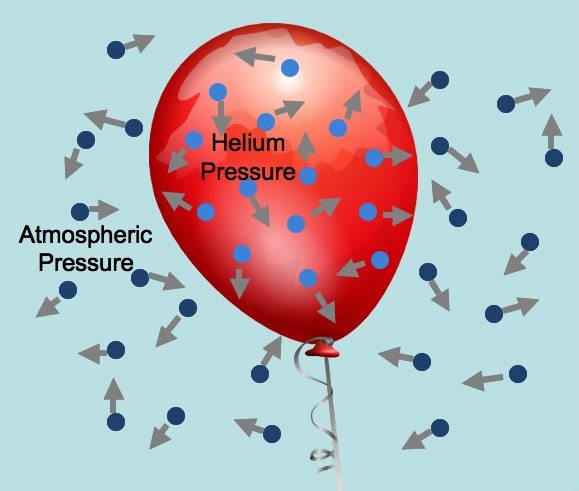
What causes pressure?
a)
The walls of the container
b)
The vacuum in the container
c)
The collisions of the particles
d)
Atmospheric pressure acting on the outside walls
36.
How do gas molecules move?
a)
in an orderly fashion
b)
constantly and randomly
c)
in straight line paths
d)
in a circular motion
37.
When the temperature of matter increases the particles...
a)
speed up and move closer
b)
speed up and move farther apart
c)
slow down and move closer together
d)
slow down and move farther apart
38.
True or False: Gases can be compressed.
a)
True
b)
False
39.

If a balloon is cooled what will happen to the volume?
a)
Volume will increase
b)
Volume will decrease
c)
Volume will not change
d)
Balloon freezes to death
40.
Which of the following would increase the (gas) pressure of a system?
a)
Increase the Temperature
b)
Pump in more gas
c)
Decrease the volume
d)
All of these
Reset

