
 Worksheets
SES5c Bell Ringer 1
Total questions: 13
Worksheet time: 8mins
Name
Class
Date
1.
How do we characterize an air mass that forms over land?
a)
Dry
b)
Wet
c)
Cold
d)
Warm
2.
How do we characterize an air mass that forms near the poles?
a)
Dry
b)
Wet
c)
Warm
d)
Cold
3.
How do we characterize an air mass that forms over the ocean?
a)
Dry
b)
Wet
c)
Cold
d)
Warm
4.
What types of air masses form over oceans?
a)
Maritime
b)
Continental
c)
Polar
d)
Tropical
5.
What types of air masses form over land?
a)
Maritime
b)
Continental
c)
Polar
d)
Tropical
6.

Cold dense air slides underneath warm air. The warm air is forced up, cools, and condenses.
a)
Cold Front
b)
Warm Front
c)
Stationary Front
d)
Occluded Front
7.
A front is
a)
where warm air is cooling at earth's surface
b)
a line where hot and cold air are separating
c)
a line where two different air masses meet
d)
where cold air is rising and forming rain clouds
8.
If an air mass is rising, it must be
a)
cold and less dense
b)
cold and more dense
c)
warm and more dense
d)
warm and less dense
9.
When two air masses meet, what happens?
a)
The weather changes and precipitation usually occurs.
b)
wind
c)
water
d)
volcano
10.
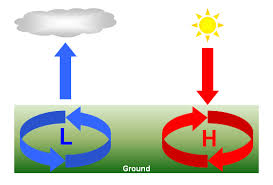
Which system results in drier, fairer weather?
a)
high pressure
b)
low pressure
c)
hurricane
d)
weather system
11.
If an air mass is sinking, it must be
a)
cold and less dense
b)
cold and more dense
c)
warm and more dense
d)
warm and less dense
12.
Air masses are different in many ways. Which of these is NOT different?
a)
moisture contents
b)
ratio of oxygen/nitrogen
c)
atmospheric pressure
d)
temperature
13.
Winds are caused by differences in
a)
precipitation
b)
humidity
c)
air pressure
d)
turbulance
100 %

