Wayground logo

Free Printable Worksheets

Font size

S
M
L
XL
Worksheets

I.7 Nuclear Reactions and Chemical Reactions

Total questions: 31

Worksheet time: 23mins

Name
Class
Date
1.
Takes two small nuclei and combines them into a larger nucleus
a)
fission
b)
fusion
2.
The splitting of a nucleus into smaller nuclei is
a)
fusion
b)
fission
c)
half-life
d)
gamma radiation
3.
How is nuclear fusion different from nuclear fission?
a)
In fusion, the product is a larger atomic nucleus.
b)
Fission produces energy but fusion does not.
c)
Fusion produces energy but fission does not.
d)
In fission, the product is a larger atomic nucleus.
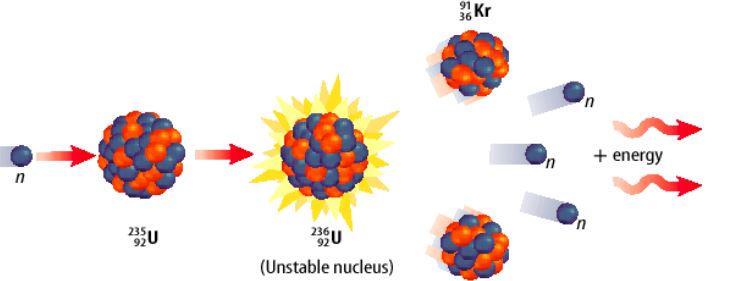
4.
This is an example of ---
a)
Radioactive Decay
b)
Nuclear Fission
c)
Nuclear Fusion
d)
Fossil fuel reaction
5.
Which of the following statements BEST describes nuclear fusion?
a)
Nuclear fusion is a common source of energy
b)
Nuclear fusion usually requires freezing temperatures
c)
Nuclear fusion usually requires a high-temperature environment
d)
Nuclear fusion releases a small amount of energy compared to most chemical reactions
6.

During nuclear fission, a nucleus _________.

a)

grows

b)

divides

c)

shrinks

d)

combines with another

7.

A high temperature is required for which to occur?

a)

alpha decay

b)

beta decay

c)

nuclear fission

d)

nuclear fusion

8.

Nuclear fission of uranium-235 can start a chain reaction by

a)

releasing enough thermal energy to start nuclear fission in neighboring atoms

b)

producing two smaller atoms that can then strike and split neighboring atoms

c)

producing neutrons that can then strike and split neighboring atoms

d)

combining two atoms with low mass to form one large atom
9.
Nuclear power uses ____ for fuel.
a)
steel
b)
coal
c)
uranium
d)
hydrogen
10.
The splitting of a nucleus into smaller nuclei is
a)
fusion
b)
fission
c)
decay
d)
gamma radiation
11.
What is a chain reaction?
a)
When electrons are emitted causing electricity
b)
When a nuclear fission reaction occurs, the protons emitted can strike other nuclei in the sample, and cause them to split
c)
When a nuclear fission reaction occurs, the neutrons emitted can strike other nuclei in the sample, and cause them to split
d)
When a nuclear fission reaction occurs, the electrons emitted can strike other nuclei in the sample, and cause them to split
12.
An example of an uncontrolled fission reaction is _______________
a)
Nuclear power plants
b)
Radio active decay
c)
Atomic Bomb
d)
On the surface of the sun
13.
Where does fusion occur naturally?
a)
Underwater
b)
All around us
c)
In the radioactive waste
d)
On the sun
14.
Nuclear energy uses _____ to turn turbines to power a generator.
a)
wind
b)
water
c)
steam
d)
solar
15.
One disadvantage of nuclear energy is ___.
a)
it is a fossil fuel
b)
it leaves behind radioactive waste
c)
it emits large amounts of pollution into the atmosphere
d)
there are no disadvantages
16.
This is an example of...
a)
Fission  reaction
b)
Fusion reaction
c)
Decomposition reaction
d)
Decay
17.
The splitting of a nucleus into smaller nuclei is
a)
fusion
b)
fission
c)
half-life
d)
gamma radiation
18.
Why do scientists most want to learn more about fusion?
a)
To win the Nobel prize
b)
To make energy for people to use
c)
To destroy the world
d)
To know more about stars
19.
Which of the following is true about nuclear fusion?
a)
It is easy to implement.
b)
It produces less energy than nuclear fission.
c)
It produces more energy than nuclear fission.
d)
It has the ability to occur easily in everyday life.
20.
All of the following are problems of nuclear energy except ---
a)
storage of radioactive fuel
b)
pollution
c)
security concerns
d)
natural disasters (tsunamis, earthquakes, etc.)
21.

Choose THREE benefits of using nuclear power

a)

no CO2 emitted to the atmosphere to cause global warming

b)

no fossil fuels are burned

c)

there is no waste with nuclear power

d)

it provides a large amount of electricity

e)

the waste stays radioactive for thousands of years

22.
Exothermic reactions...
a)
Absorb energy
b)
Release energy
c)
Release Color
d)
Absorb Color
23.
In an endothermic reaction, heat is ...
a)
taken in or absorbed
b)
given out or released 
24.

What type of reaction is this?

a)

Exothermic

b)

Endothermic

c)

Energy Producing

d)

No way to tell

25.

____ reactions usually feel cold.

a)

endothermic

b)

exothermic

26.

The graph above is from which type of reaction?

a)

Endothermic reaction

b)

Exothermic Reaction

27.

The graph above is from which type of reaction?

a)

Endothermic reaction

b)

Exothermic reaction

28.

When barium hydroxide and ammonium chloride react, the temperature of the mixture decreases. What kind of reaction is this?

a)

Endothermic

b)

Decomposition

c)

Exothermic

d)

Indothermic

29.

What term is given to a reaction which transfers heat energy to the surroundings?

a)

Endothermic

b)

Reversible

c)

Exothermic

d)

Exotermic

30.

When calcium reacts with water, the temperature changes from 18°C to 39°C. Which statement is correct?

a)

The solution at the end is acidic

b)

The reaction is reversible

c)

The reaction is exothermic

d)

The reaction is endothermic

31.

When a candle is lit hydrocarbons are combusting. An exothermic reaction is occuring. Energy is being _________________ .

a)

absorbed

b)

frozen

c)

destroyed

d)

released