
 Worksheets
Principles, Description and Nomenclature
Total questions: 10
Worksheet time: 8mins
Name
Class
Date
1.
BASIC UNIT OF CLASSIFICATION
a)
GENUS
b)
FAMILY
c)
KEY
d)
SPECIES
2.
BIOLOGICAL SPECIES CONCEPT WAS GIVEN BY
a)
JOHN RAY
b)
MILLER
c)
LAMARCK
d)
LINNAEUS
3.
TAXONOMIC HIERARCHY MEANS
a)
DIVISON- CLASSS-SPECIES-ORDER-PHYLLUM-KINGDOM
b)
SPECIES-KINDOM-FAMILY -GENUS-CLASS-PHYLLUM
c)
SPECIES-GENUS-FAMILY-ORDER-CLASS-PHYLLUM-KINGDOM
d)
NONE OF THESE
4.
Who first proposed binomial nomenclature as a way of classifying organisms?
a)
Carl Linnaeus
b)
Carl's Jr.
c)
Charles Darwin
d)
Henry Groseclose
5.
The science of describing, classifying, and naming living things is called:
a)
Geology
b)
Biology
c)
Taxonomy
d)
Chemistry
6.
The scientific name for an organism is made from the:
a)
class and family name
b)
genus and species name
c)
domain and kingdom name
d)
kingdom and phylum name
7.
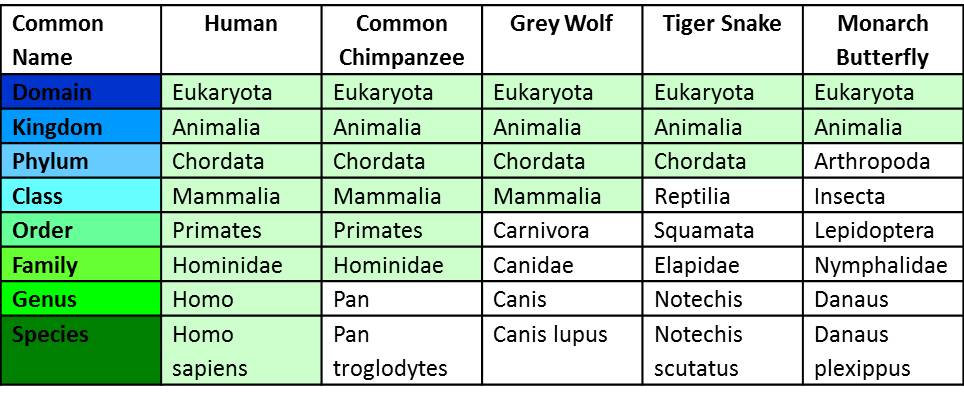
Which organism in the table is least closely related to the chimpanzee?
a)
human
b)
grey wolf
c)
tiger snake
d)
monarch butterfly
8.
What is the purpose of a dichotomous key?
a)
to find a common ancestor
b)
to show the evolution of organisms
c)
to show relationships between organisms
d)
to identify organisms
9.
When using a dichotomous key to identify organisms, what do we look at?
a)
physical features
b)
weather patterns
c)
environment
d)
diet
10.
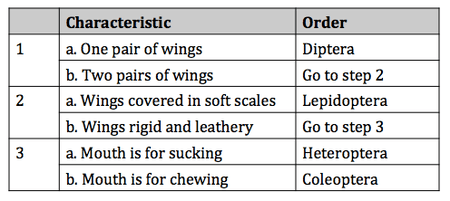
A dichotomous key for insects is given. To what order does an insect with two pairs of scaly wings belong?
a)
Coleoptera
b)
Heteroptera
c)
Diptera
d)
Lepidoptera
100 %

