
 Worksheets
Geom Chapter 4 Review
Total questions: 57
Worksheet time: 57mins
Name
Class
Date
1.

JK ≅ ?
a)
KX
b)
JK
c)
XJ
d)
KI
2.
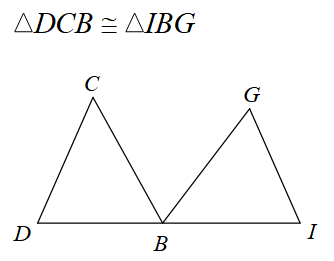
CB ≅ ?
a)
∠I
b)
GI
c)
IB
d)
BG
3.

ML ≅ ?
a)
CL
b)
LD
c)
DC
d)
NL
4.

∠D ≅ ?
a)
∠X
b)
∠W
c)
∠Y
d)
∠C
5.

∠NLM ≅ ?
a)
∠DLC
b)
∠D
c)
∠N
d)
∠C
6.

Write a congruence statement for the triangles.
a)
ΔTUV≅ΔLJV
b)
ΔTUV≅ΔJVL
c)
ΔUTV≅ΔLVJ
d)
ΔUTV≅ΔJVL
7.

Write a congruence statement for the triangles.
a)
ΔIHG≅ΔQRP
b)
ΔHIG≅ΔQPR
c)
ΔIHG≅ΔRQP
d)
ΔGHI≅ΔQPR
8.

Name the postulate, if possible, that makes the triangles congruent.
a)
SSS
b)
SAS
c)
ASA
d)
Not Possible
9.
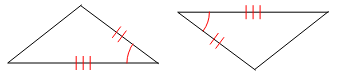
State if the two triangles are congruent. If they are, state which theorem you would use.
a)
Yes, SAS
b)
Yes, SSS
c)
Yes, HL
d)
No
10.

Name the postulate, if possible, that makes the triangles congruent.
a)
SAS
b)
ASA
c)
SSS
d)
Not Possible
11.
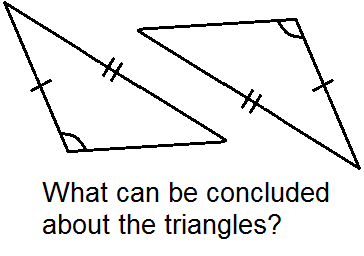
a)
Congruent by HL
b)
Congruent by SAS
c)
Congruent by SSS
d)
Not Necessarily Congruent
12.
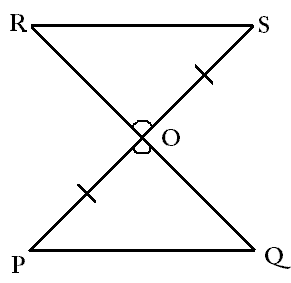
Are the two triangles congruent?
a)
Not enough information
b)
Yes, by SSA
c)
Yes by AAS
d)
Yes By ASA
13.

Are the triangles congruent, if yes, why?
a)
SAS
b)
ASA
c)
SSS
d)
Not Congruent
14.

Are the triangles congruent, if yes, why?
a)
SSS
b)
ASA
c)
AAA
d)
Not Congruent
15.

Are the triangles congruent, if yes, why?
a)
SSS
b)
SAS
c)
ASA
d)
Not Congruent
16.

State if the two triangles are congruent. If they are, state how you know.
a)
A
b)
B
c)
C
d)
D
17.

State if the two triangles are congruent. If they are, state how you know.
a)
A
b)
B
c)
C
d)
D
18.
Which of the following is not a valid reason to prove congruent triangles?
a)
SSA
b)
AAS
c)
SAS
d)
SSS
19.
Which of the following is not a valid reason to prove congruent triangles?
a)
ASA
b)
SAS
c)
SSS
d)
AAA
20.

State if the two triangles are congruent. If they are, state how you know.
a)
A
b)
B
c)
C
d)
D
21.

Name the postulate, if possible, that makes the triangles congruent.
a)
SAS
b)
ASA
c)
AAS
d)
Not enough information
22.
The hypotenuse of a triangle is...
a)
Invisible
b)
A myth
c)
The side opposite the right angle in a right triangle
23.

What missing piece of information is needed to prove the triangles congruent using SAS?
a)
∠F≅∠Q
b)
∠G≅∠R
c)
∠H≅∠S
d)
FH = QS
24.

What missing piece of information is needed to prove the triangles congruent using ASA?
a)
GC = CD
b)
CE = CD
c)
∠GCE≅∠BCE
d)
BD = GE
25.

What missing piece of information is needed to prove the triangles congruent using SAS?
a)
NM = AM
b)
NL = CA
c)
∠M≅∠B
d)
∠N≅∠C
26.
What does CPCTC stand for?
a)
Congruent parts of congruent triangles are congruent
b)
Corresponding parts of congruent triangles are congruent
c)
Corresponding parts of corresponding triangles are corresponding
d)
Corresponding parts of congruent triangles are Canadian.
27.
When do you use "CPCTC in a proof?
a)
ALWAYS at the beginning
b)
ALWAYS at the end
c)
It's optional
d)
NEver
28.

Fill in the blank.
a)
Given
b)
Reflexive Property
c)
Transitive Property
d)
They're the same side!!!!!!
29.

What is the reason?
a)
Definition of Angle
b)
Definition of Congruence
c)
Definition of bisects
d)
Definition of midpoint
30.
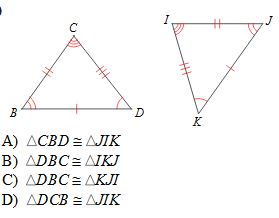
Which is a correct congruence statement.
a)
A
b)
B
c)
C
d)
D
31.
When does one use CPCTC?
a)
Before triangles are congruent
b)
After triangles are congruent
c)
Whenever one wants, there are no restrictions
d)
There is no such thing as CPCTC
32.

What is the correct choice for Statement 4?
a)
⊿GHI ≅ ⊿JKL
b)
⊿GHI ≅ ⊿KLJ
c)
⊿GHI ≅ ⊿LJK
d)
⊿GHI ≅ ⊿LKJ
33.
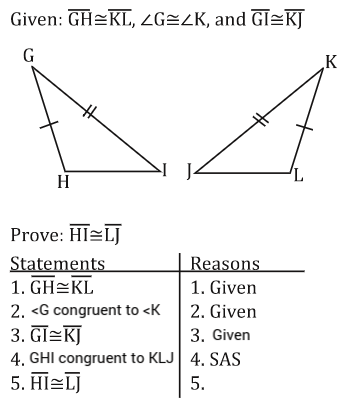
What is the correct choice for Reason 5?
a)
SAS
b)
Definition of Congruence
c)
Prove
d)
CPCTC
34.

What is the
m∠U ?
(a)
35.
What is the
m∠T ?
(a)
36.

What is the measure of
EF ?
(a)
37.
What is
m∠F ?
(a)
38.

Find the value of x
(a)
39.

Find the value of x.
(a)
40.

Find the value of x
(a)
41.
Which is NOT a criteria for triangles to be congruent by the HL Theorem?
a)
Right triangles
b)
congruent hypotenuses
c)
Two pairs of congruent legs
d)
One pair of congruent legs
42.
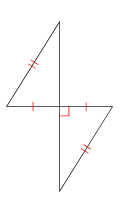
How are the triangles congruent?
a)
SAS
b)
ASA
c)
HL
d)
SSS
43.
When can we use the HL Congruence Theorem?
a)
Right Triangles
b)
Isosceles Triangles
c)
When we have a reflexive side
d)
SSA
44.

Can the HL Congruence Theorem be used to prove the triangles congruent? If so, write a congruence statement.
a)
Yes, △ABC≅△YXW
b)
Yes, △CBA≅△WXY
c)
Yes, △BCA≅△XYW
d)
No
45.

What additional information is required in order to know that the triangles are congruent by HL Theorem?
a)
∠G ≅ ∠X
b)
∠H ≅ ∠V
c)
GI ≅ XV
d)
GH ≅ XW
46.

If AC≅PR what other piece of information do you need to prove the triangles are ≅ by HL Theorem?
a)
AC≅PR
b)
BC≅QR
c)
<A≅<P
d)
<C≅<R
47.

Identify any common angles or sides
a)
JK
b)
Angle MJK
c)
LK
d)
Angle MKJ
48.

Identify common angles or sides
a)
Angle E
b)
Angle D
c)
Angle F
d)
Angle DGF
49.

The red (ΔKNM) and blue (ΔPLM) triangles are congruent. Identify a common side or angle.
a)
Angle M
b)
Angle P
c)
Angle K
d)
Angle MLP
50.

Name the side or angle that is overlapping.
a)
UX
b)
UV
c)
VW
d)
XW
51.

What statement should go in Step 3?
a)
Angle B=Angle B
b)
AB=BC
c)
AD=DC
d)
Angle 1=Angle 3
52.

What is the reason for Step 4?
a)
Substitution
b)
Angle Addition
c)
Segment Addition
d)
Triangle Sum Property
53.

What is the statement for Step 5?
a)
ED+DC=EC
b)
AD=EC
c)
AE+DC=ED
d)
AE+ED=ED+DC
54.

What is the reason for Step 8?
a)
SSS
b)
SAS
c)
ASA
d)
AAS
55.

What is the reason for Step 3?
a)
Angle Addition
b)
Statement Addition
c)
Vertical Angles
d)
Substitution
56.

What is the statement for Step 7?
a)
Angle R=Angle T
b)
ST=RU
c)
SU=SU
d)
Angle TUR=Angle RST
57.

What is the reason for Step 8?
a)
ASA
b)
SAS
c)
SSS
d)
AAS
100 %

