Worksheets
American Society in Transition - U.S. History EOC Review
Total questions: 20
Worksheet time: 40mins

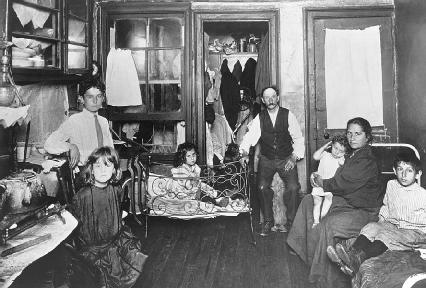
What is the main idea of the passage?
Tenement living had improved through the Gilded Age
Urban poor faced crowded and unhealthy conditions in tenement housing
The total number of immigrants in tenement housing was declining
Politicians were working to improve conditions of tenements
Nativists favored-
Americans over immigrants; America for Americans only!
The assimilation of immigrants into American society
The support of Native Americans
Open borders and allowing ALL immigrants into the United States
What would be a prime example of Americanization?
The Dawes Act selling Native American lands
The Homestead Act providing lands to settlers
The Chinese Exclusion Act prohibiting Chinese immigration
The children of immigrants learning English in school

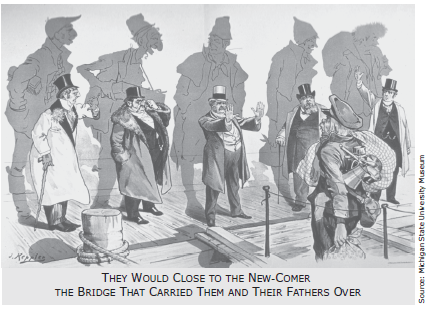
The political cartoon is referencing-
Labor unions
Monopolies and trusts
Municipal corruption
Immigration quotas

Using the table, what was the most important impact of industrialization in the United States?
People moved from cities to rural areas.
The number of people living in cities continuously increased.
The urban population decreased.
Railroad mileage increased.
During the late 1800s, political bosses often-
participated in graft
denied voting rights to poor people
wasted money on building railroads
discriminated against the urban poor
What was a major impact of the Transcontinental Railroad?
It protected Native American rights and tribal lands
It only impacted a small strip of land in the American West
It led to the destruction of buffalo and the opening of the Great Plains to American settlers
It led to the Klondike Gold Rush

Which statement best completes the diagram?
The Chinese Exclusion Act was passed
Immigration quotas were instituted
Irish families immigrated to the United States
Political machines were instituted in urban areas

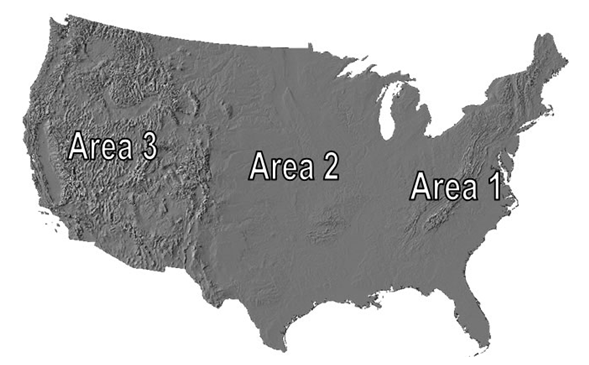
Why were these immigrants relieved to see the type of land they had expected?
They hoped to mine for gold
They wanted to work on the railroad
They planned on working in factories
They hoped to establish farms
In the late nineteenth century, the "bosses" of urban political machines often--
denied voting rights to the poor
accepted bribed in return for favors
wasted money on military spending
discriminated against migrant workers
During the late 1800s and early 1900s, prejudice against "New Immigrants" increased because these immigrants--
had job skills superior to those of most American workers
formed their own labor unions in order to receive higher wages
came from cultural background different from those of the majority of Americans
tried to replace American democracy with other forms of government
Nativists in California in the 1800s would most likely have supported the-
creation of settlement houses to aid new immigrants.
passage of the Chinese Exclusion Act.
continuation of the contract labor system.
assimilation of Native American Indians into mainstream culture.

Based on the graph, why did immigration increase between 1895 and 1905?
The Panic of 1893 had occurred.
Expanding industries provided jobs for immigrants.
Immigrants came in search of cheap land in the West.
World War I ended.

Based on the information on the graph, which statement is most accurate?
People who lived in urban areas were poor.
The percentage of urban population increased between 1850 and 1900.
By 1900, 30% of the population lived in rural areas.
Industrialization led to an increase in rural population in the late 1800s.

Based on the poster, which is an accurate statement?
Immigrants were encouraged to learn and speak English.
Granite City had laws prohibiting immigrants from moving there.
The people in the poster were native-born Americans.
Granite City encouraged diversity in its immigrant population.