
 Worksheets
Recount
Total questions: 43
Worksheet time: 23mins
On Saturday night, we went to the Town Hall. It was the last day of the year and a large crowd of people had gathered under the Town Hall clock. It would strike twelve in twenty minutes’ time. Fifteen minutes passed and then, at five to twelve, the clock stopped. The big minute hand did not move. We waited and waited, but nothing happened. Suddenly someone shouted,”It’s two minutes past twelve! The clock has stopped!”
I looked at my watch. It was true. The big clock refused to welcome the New Year. At that moment, everybody began to laugh and sing.
Based on the text, where was the writer?
At the center of the town
At home
At the market
Last holiday I went to Paris. I visited museums and sat in public gardens. A friendly waiter taught me a few words of French. Then he lent me a book. I read a few lines, but I did not understand a word. Every day, I thought about postcards. My holidays passed quickly, but I did not send any cards to my friends. On the last day I made a big decision, I got up early and bought thirty seven cards. I spent the whole day in my room, but I did not write a single card!
Whom did the writer meet in Paris?
A man that take him to French
A man that gave him thirty seven cards
A man that lent him a book
Social function of recount text is...
To give an information
To telling about the story
To retell past experiences
What is the tense used in recount text?
Simple Present Tense
Present Continuous Tense
Simple Past Tense
What is the tense used in recount text?
Simple Present Tense
Present Continuous Tense
Simple Past Tense
What is Recount Text ?
is a story with complication or problematic events and it tries to find the resolutions to solve the problems
is a text which retells events or experiences in the past
is a text which informs readers about events of the day

The event of the text is.....
Last Monday was a busy day for me. I spent my time to do a lot of activities from college to my home.
First, at the morning, I did my presentation assignment with my partner, she was Nurhidayah.
Those activities made my day busy.
What are generic structure of the text ?
Description, Identification
Orientation, Steps, Reorientation
Reorientation, thesis, Description
Orientation, Events, Reorientation

What is the main idea of the paragraph?
Invitation of writer’s International Day
Invitation of Grandparents’ International Day
Celebration of Sue’s International Day
Celebration of Grandparents’ International Day
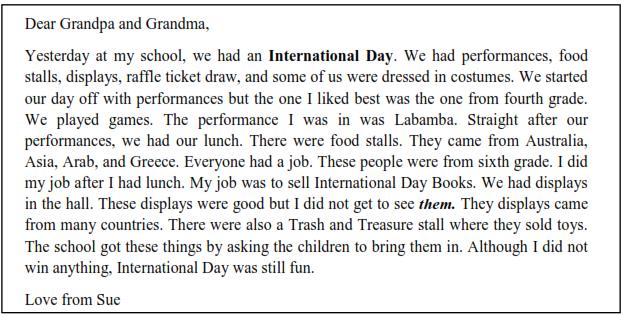
What is the purpose of the text?
To describe The International Day
To announce The International Day
To report The International Day
To tell The International Day
My Holiday
Last week I went to Mount Bromo. I stayed at my friend's house in Probolinggo, East Java. The house has a big garden with colourful flowers and a small pool.
In the morning, my friend and I saw Mount Batok. The scenery was very beautiful. We rode on horseback. It was scary, but it was fun. Then, we went to get a closer look at the mountain. We took pictures of the beautiful scenery there. After that, we took a rest and had lunch under a big tree. Before we got home, we went to the zoo at Wonokromo. We went home in the afternoon.
We were very tired. However, I think it was really fun to have a holiday like this. I hope my next holiday will be more interesting.
What is the purpose of the text?
To show how to spend the holiday.
To persuade someone to have a holiday.
To inform someone’s the holiday.
To tell someone’s experince.
My Holiday
Last week I went to Mount Bromo. I stayed at my friend's house in Probolinggo, East Java. The house has a big garden with colourful flowers and a small pool.
In the morning, my friend and I saw Mount Batok. The scenery was very beautiful. We rode on horseback. It was scary, but it was fun. Then, we went to get a closer look at the mountain. We took pictures of the beautiful scenery there. After that, we took a rest and had lunch under a big tree. Before we got home, we went to the zoo at Wonokromo. We went home in the afternoon.
We were very tired. However, I think it was really fun to have a holiday like this. I hope my next holiday will be more interesting.
From the text we can conclude that ....
The writer went to Mount Bromo for a week.
The writer got happy after the holiday in Mt. Bromo.
They took a rest and had lunch near the beach.
The scenery in Mount Batok is not so beautiful.
Last Friday, a friend of mine asked me to accompany him to buy a new shirt at a department store. We left home at 03.00 p.m. by motorcycle. As soon as we arrived there, we went to the clothes section. I let him choose one. An hour later, I got bored watching him confused in choosing a shirt. So I left him and went to the cassette counter. Thirty minutes later, I went back to the clothes section but I couldn’t find him there. My cell phone was broken so I couldn’t call him. I went to the parking area. I saw his motorcycle was there but I couldn’t find him. I waited for him for a few moments then finally I gave up and decided to go home.
When I arrived home, my mother told me that my friend called. She said that he was in the department store looking for me. My mother asked me to come back to the department store. Reluctantly, I walked to the department store and you know what? When I arrived there his motorcycle was not in the parking area. He just went home. I was very tired. There was no other choice; I had to walk home again. When I arrived home, I was so tired. I was very angry but when I saw my friend’s broad smile greet me in front of the door, I just could not help laughing.
The writer couldn’t contact his friend because …
He was in the parking area.
His cell phone was broken.
He went home alone.
His friend was still choosing a shirt.
Last Friday, a friend of mine asked me to accompany him to buy a new shirt at a department store. We left home at 03.00 p.m. by motorcycle. As soon as we arrived there, we went to the clothes section. I let him choose one. An hour later, I got bored watching him confused in choosing a shirt. So I left him and went to the cassette counter. Thirty minutes later, I went back to the clothes section but I couldn’t find him there. My cell phone was broken so I couldn’t call him. I went to the parking area. I saw his motorcycle was there but I couldn’t find him. I waited for him for a few moments then finally I gave up and decided to go home.
When I arrived home, my mother told me that my friend called. She said that he was in the department store looking for me. My mother asked me to come back to the department store. Reluctantly, I walked to the department store and you know what? When I arrived there his motorcycle was not in the parking area. He just went home. I was very tired. There was no other choice; I had to walk home again. When I arrived home, I was so tired. I was very angry but when I saw my friend’s broad smile greet me in front of the door, I just could not help laughing.
From the story above we can conclude that there was a problem because …
The writer’s friend was in the clothes section.
The writer and his friend couldn’t ride the motorcycle.
The writer couldn’t contact his friend.
The writer and his friend decided to go to the department store.
My family and I live in a big city. So when my uncle invited me to spend the holiday in his village I felt very excited.
I left the city by bus in the late afternoon and arrived at the village in the morning. My uncle took me to his house by his jeep. The location of his house is in the deep village near the forest. Finally, after a long journey I met my aunt and my cousin.
After taking a rest for a while, my cousin took me to the farm well to have a bath. I bathed in the open air for the first time. It was strange but fun. It was a hot day. I enjoyed the cold water very much. Then we went to the mango orchard. There I plucked mangoes with my own hands. After that we took lunch. It was a very simple meal of rice, fish, bean cake and vegetables but it was very delicious. In the afternoon, I and my cousin visited the farm. My uncle was watering the crops. I helped him by milking the cow. It was the first time in my life I do it so it was very awkward at first, but then my cousin taught me to do it. It was fun actually.
I spent the night in the village for fifteen days doing many exciting things with my cousin. When I returned home, many people came to see me off. I was very impressed by the simple living of the village people.
What is the main idea of the third paragraph?
Living in the farm was not easy.
The writer took a bath in open air for the first time.
The writer enjoyed the country life in his uncle’s village.
Doing many activities in the village made the rwiter awkward.
My family and I live in a big city. So when my uncle invited me to spend the holiday in his village I felt very excited.
I left the city by bus in the late afternoon and arrived at the village in the morning. My uncle took me to his house by his jeep. The location of his house is in the deep village near the forest. Finally, after a long journey I met my aunt and my cousin.
After taking a rest for a while, my cousin took me to the farm well to have a bath. I bathed in the open air for the first time. It was strange but fun. It was a hot day. I enjoyed the cold water very much. Then we went to the mango orchard. There I plucked mangoes with my own hands. After that we took lunch. It was a very simple meal of rice, fish, bean cake and vegetables but it was very delicious. In the afternoon, I and my cousin visited the farm. My uncle was watering the crops. I helped him by milking the cow. It was the first time in my life I do it so it was very awkward at first, but then my cousin taught me to do it. It was fun actually.
I spent the night in the village for fifteen days doing many exciting things with my cousin. When I returned home, many people came to see me off. I was very impressed by the simple living of the village people.
“It was the first time in my life I do it so...” (paragraph 3)
The underlined word refers to ….
plucking the mangoes
milking the cow
taking a bath
watering the crops
Mohammad Hatta
Every year has its great men and women who are remembered for what they have done for their country. One of Indonesia’s great men is Dr. Mohammad Hatta. He was a man with a deep love for his country and people.
Dr. Mohammad Hatta was born in Bukittinggi on August 12th, 1902. While still in junior high school in Bukittinggi, he became interested in politics and joined the League of Young Sumatrans.
He left Bukittinggi to study in Batavia. Then he went to the Netherlands. He studied economics and gained a doctorate degree there. During his stay there he was active in the national movement. Because of his activities, he was arrested.
In 1923 Hatta returned to Indonesia. He joined a political organization called “Pendidikan Nasional Indonesia”. One of its goals was to develop political awareness among the Indonesian people. His activities again led to his arrest. The colonial government exiled him to Boven Digul, and later to Banda Naira. Shortly before the Japanese invasion. He was brought back to Java.
When the Japanese surrendered in August 1945, Soekarno and Hatta proclaimed Indonesia’s Independence. Hatta became the first vice-president of the Republic of Indonesia.
In 1956 Hatta resigned as vice-president and devoted himself to writing. On march 14, 1981, Dr. Mohammad Hatta passed away in Jakarta.
Nowadays, he is no longer living among us. However, his spirit of loving the country and nation is one of the reason why he is well remembered.
What is the text written for?
To describe Dr. Mohammad Hatta’s life.
To retell Dr. Mohammad Hatta’s biography.
To tell Hatta’s education and political activities.
To inform the first vice-president of the Republic of Indonesia.
Mohammad Hatta
Every year has its great men and women who are remembered for what they have done for their country. One of Indonesia’s great men is Dr. Mohammad Hatta. He was a man with a deep love for his country and people.
Dr. Mohammad Hatta was born in Bukittinggi on August 12th, 1902. While still in junior high school in Bukittinggi, he became interested in politics and joined the League of Young Sumatrans.
He left Bukittinggi to study in Batavia. Then he went to the Netherlands. He studied economics and gained a doctorate degree there. During his stay there he was active in the national movement. Because of his activities, he was arrested.
In 1923 Hatta returned to Indonesia. He joined a political organization called “Pendidikan Nasional Indonesia”. One of its goals was to develop political awareness among the Indonesian people. His activities again led to his arrest. The colonial government exiled him to Boven Digul, and later to Banda Naira. Shortly before the Japanese invasion. He was brought back to Java.
When the Japanese surrendered in August 1945, Soekarno and Hatta proclaimed Indonesia’s Independence. Hatta became the first vice-president of the Republic of Indonesia.
In 1956 Hatta resigned as vice-president and devoted himself to writing. On march 14, 1981, Dr. Mohammad Hatta passed away in Jakarta.
Nowadays, he is no longer living among us. However, his spirit of loving the country and nation is one of the reason why he is well remembered.
What is the main idea of paragraph four?
The Japanese invasion.
Moh. Hatta’s exile to Boven Digul.
Moh. Hatta’s activities in political organization.
Moh. Hatta’s study and experience in Netherland.
Mohammad Hatta
Every year has its great men and women who are remembered for what they have done for their country. One of Indonesia’s great men is Dr. Mohammad Hatta. He was a man with a deep love for his country and people.
Dr. Mohammad Hatta was born in Bukittinggi on August 12th, 1902. While still in junior high school in Bukittinggi, he became interested in politics and joined the League of Young Sumatrans.
He left Bukittinggi to study in Batavia. Then he went to the Netherlands. He studied economics and gained a doctorate degree there. During his stay there he was active in the national movement. Because of his activities, he was arrested.
In 1923 Hatta returned to Indonesia. He joined a political organization called “Pendidikan Nasional Indonesia”. One of its goals was to develop political awareness among the Indonesian people. His activities again led to his arrest. The colonial government exiled him to Boven Digul, and later to Banda Naira. Shortly before the Japanese invasion. He was brought back to Java.
When the Japanese surrendered in August 1945, Soekarno and Hatta proclaimed Indonesia’s Independence. Hatta became the first vice-president of the Republic of Indonesia.
In 1956 Hatta resigned as vice-president and devoted himself to writing. On march 14, 1981, Dr. Mohammad Hatta passed away in Jakarta.
Nowadays, he is no longer living among us. However, his spirit of loving the country and nation is one of the reason why he is well remembered.
”.... Dr. Mohammad Hatta passed away in Jakarta.” (paragraph 6)
The closest meaning of the underlined word is ....
lived
stayed
made
died
Raden Adjeng Kartini was born on April 21st, 1879 as the daughter of Raden Mas Ario Sosroningrat and MA Ngasirah, daughter of Haji Siti Aminah and Haji Madirono, a religious teacher in Telukawur, Jepara. Kartini's father was originally a district officer in Mayong. The father remarried with Raden Adjeng Woerjan (Moerjam). After the marriage, the Kartini's father was appointed as regent in Jepara can replace the biological father RA Woerjan, RAA Tjitrowikromo.
Kartini is the eldest daughter. His grandfather, Prince Ario Tjondronegoro IV, was appointed regent at the age of 25 years and gave Western education to their children. Kartini’s brother, Sosrokartono was a very intelligent man in the field of language. Until the age of 12 years, Kartini allowed to attend school in the ELS (Europese Lagere School). Among other Kartini learned the Dutch language. But after age 12, she had to stay home because they can be secluded.
Because Kartini could speak Dutch, then at home she began to learn on their own and wrote letters to friends correspondence coming from the Netherlands. One is Rosa Abendanon that much support. From books, newspapers, and magazines Europe, Kartini's interest in European feminist thinking. Arise desire to promote indigenous women, because she saw that indigenous women are at a low social status. Kartini saw the struggle of women to obtain their freedom, autonomy and legal equality as part of a broader movement. Kartini married a regent of Rembang, KRM Ario Singgih Djojo Adhiningrat, who already had three wives on 12 November 1903.
The first and last child at the same time, Soesalit Djojoadhiningrat , born on 13 September 1904. A few days later, 17 September 1904, Kartini died at the age of 25 years. Kartini was buried in Bulu Village, District of Bulu, Rembang.
What does the writer want to emphasize?
RA Kartini’s life
Kartini’s family
The struggle of women
The daughter of RM Ario Sosroningrat
Raden Adjeng Kartini was born on April 21st, 1879 as the daughter of Raden Mas Ario Sosroningrat and MA Ngasirah, daughter of Haji Siti Aminah and Haji Madirono, a religious teacher in Telukawur, Jepara. Kartini's father was originally a district officer in Mayong. The father remarried with Raden Adjeng Woerjan (Moerjam). After the marriage, the Kartini's father was appointed as regent in Jepara can replace the biological father RA Woerjan, RAA Tjitrowikromo.
Kartini is the eldest daughter. His grandfather, Prince Ario Tjondronegoro IV, was appointed regent at the age of 25 years and gave Western education to their children. Kartini’s brother, Sosrokartono was a very intelligent man in the field of language. Until the age of 12 years, Kartini allowed to attend school in the ELS (Europese Lagere School). Among other Kartini learned the Dutch language. But after age 12, she had to stay home because they can be secluded.
Because Kartini could speak Dutch, then at home she began to learn on their own and wrote letters to friends correspondence coming from the Netherlands. One is Rosa Abendanon that much support. From books, newspapers, and magazines Europe, Kartini's interest in European feminist thinking. Arise desire to promote indigenous women, because she saw that indigenous women are at a low social status. Kartini saw the struggle of women to obtain their freedom, autonomy and legal equality as part of a broader movement. Kartini married a regent of Rembang, KRM Ario Singgih Djojo Adhiningrat, who already had three wives on 12 November 1903.
The first and last child at the same time, Soesalit Djojoadhiningrat , born on 13 September 1904. A few days later, 17 September 1904, Kartini died at the age of 25 years. Kartini was buried in Bulu Village, District of Bulu, Rembang.
What is the main idea of paragraph 3?
Kartini was the eldest daughter in her family.
Kartini allowed to attend the school in the ELS.
Kartini was dead after she gave birth her baby.
Kartini began to learn and wrote letters to her friends.
Raden Adjeng Kartini was born on April 21st, 1879 as the daughter of Raden Mas Ario Sosroningrat and MA Ngasirah, daughter of Haji Siti Aminah and Haji Madirono, a religious teacher in Telukawur, Jepara. Kartini's father was originally a district officer in Mayong. The father remarried with Raden Adjeng Woerjan (Moerjam). After the marriage, the Kartini's father was appointed as regent in Jepara can replace the biological father RA Woerjan, RAA Tjitrowikromo.
Kartini is the eldest daughter. His grandfather, Prince Ario Tjondronegoro IV, was appointed regent at the age of 25 years and gave Western education to their children. Kartini’s brother, Sosrokartono was a very intelligent man in the field of language. Until the age of 12 years, Kartini allowed to attend school in the ELS (Europese Lagere School). Among other Kartini learned the Dutch language. But after age 12, she had to stay home because they can be secluded.
Because Kartini could speak Dutch, then at home she began to learn on their own and wrote letters to friends correspondence coming from the Netherlands. One is Rosa Abendanon that much support. From books, newspapers, and magazines Europe, Kartini's interest in European feminist thinking. Arise desire to promote indigenous women, because she saw that indigenous women are at a low social status. Kartini saw the struggle of women to obtain their freedom, autonomy and legal equality as part of a broader movement. Kartini married a regent of Rembang, KRM Ario Singgih Djojo Adhiningrat, who already had three wives on 12 November 1903.
The first and last child at the same time, Soesalit Djojoadhiningrat , born on 13 September 1904. A few days later, 17 September 1904, Kartini died at the age of 25 years. Kartini was buried in Bulu Village, District of Bulu, Rembang.
Who was Kartini’s son?
Sosrokartono
Ario Singgih
Soesalit Djojoadhiningrat
Ario Tjondronegoro
Raden Adjeng Kartini was born on April 21st, 1879 as the daughter of Raden Mas Ario Sosroningrat and MA Ngasirah, daughter of Haji Siti Aminah and Haji Madirono, a religious teacher in Telukawur, Jepara. Kartini's father was originally a district officer in Mayong. The father remarried with Raden Adjeng Woerjan (Moerjam). After the marriage, the Kartini's father was appointed as regent in Jepara can replace the biological father RA Woerjan, RAA Tjitrowikromo.
Kartini is the eldest daughter. His grandfather, Prince Ario Tjondronegoro IV, was appointed regent at the age of 25 years and gave Western education to their children. Kartini’s brother, Sosrokartono was a very intelligent man in the field of language. Until the age of 12 years, Kartini allowed to attend school in the ELS (Europese Lagere School). Among other Kartini learned the Dutch language. But after age 12, she had to stay home because they can be secluded.
Because Kartini could speak Dutch, then at home she began to learn on their own and wrote letters to friends correspondence coming from the Netherlands. One is Rosa Abendanon that much support. From books, newspapers, and magazines Europe, Kartini's interest in European feminist thinking. Arise desire to promote indigenous women, because she saw that indigenous women are at a low social status. Kartini saw the struggle of women to obtain their freedom, autonomy and legal equality as part of a broader movement. Kartini married a regent of Rembang, KRM Ario Singgih Djojo Adhiningrat, who already had three wives on 12 November 1903.
The first and last child at the same time, Soesalit Djojoadhiningrat , born on 13 September 1904. A few days later, 17 September 1904, Kartini died at the age of 25 years. Kartini was buried in Bulu Village, District of Bulu, Rembang.
The followings are Kartini’s dreams about women, except ...
to obtain their freedom
to obey the Dutch rule
to get legal equality
to promote indigenous women
When all those regional wars of independence failed, Indonesian nationalists began thinking of a more organized struggle against Dutch colonialism. The move began with the founding of Boedi Oetomo by Dr. Soetomo on 20 May 1908. This organization of Indonesian intellectuals was initially set up for educational purposes but later turned into politics.
In 1911, Sarekat Dagang Islam (the Society of Moslem Entrepreneurs) was formed by Haji Samanhudi and others. Its objective was at first to motivate and to promote Indonesian business in the Dutch East Indies. However, in 1912, this organization turned into a political party and was renamed Sarekat Islam.
In December 1912, Partai Indonesia was founded by Douwes Dekker with Dr. Tjipto Mangunkusumo and Ki Hajar Dewantoro (Suwardi Suryaningrat). The aim of the party was to strive for complete independence of Indonesia. All three leaders of the party were exiled by the colonial government in 1913.
In 1924, Perhimpunan Mahasiswa Indonesia (the Indonesian Students Association) was formed by Drs. Mohammad Hatta, Dr. Sukiman and others. This organization became a driving force of the nationalist movement to gain independence.
What is the text about?
Indonesian Independence.
Some Indonesian nationalists.
Indonesian nationalists movements.
The establishement of Boedi Oetomo.
The failure of regional independence wars.
When all those regional wars of independence failed, Indonesian nationalists began thinking of a more organized struggle against Dutch colonialism. The move began with the founding of Boedi Oetomo by Dr. Soetomo on 20 May 1908. This organization of Indonesian intellectuals was initially set up for educational purposes but later turned into politics.
In 1911, Sarekat Dagang Islam (the Society of Moslem Entrepreneurs) was formed by Haji Samanhudi and others. Its objective was at first to motivate and to promote Indonesian business in the Dutch East Indies. However, in 1912, this organization turned into a political party and was renamed Sarekat Islam.
In December 1912, Partai Indonesia was founded by Douwes Dekker with Dr. Tjipto Mangunkusumo and Ki Hajar Dewantoro (Suwardi Suryaningrat). The aim of the party was to strive for complete independence of Indonesia. All three leaders of the party were exiled by the colonial government in 1913.
In 1924, Perhimpunan Mahasiswa Indonesia (the Indonesian Students Association) was formed by Drs. Mohammad Hatta, Dr. Sukiman and others. This organization became a driving force of the nationalist movement to gain independence.
When was the three leaders of Partai Indonesia exiled by the colonial government?
1908
1011
1912
1913
1924
In 7th-century Arabia, the prophet of Islam, Muhammad, claimed to have received the will of Allah through the angel Gabriel. Muhammad’s revelations (wahyu), eventually collected into an Arabic-language book called the Qur'an (Koran), provided the framework of Islamic governments. To spread the word of Allah, Muhammad instructed his followers to engage in military conquest. Muhammad and his Umayyad and Abbasid successors who occupied the caliphate, the office of supreme leader of the Muslims, spread Islam from India to Spain. The caliphate presided over the Islamic states, whose culture combined Byzantine, Persian, Babylonian, and Indian elements. A key link between them was the Arabic language, which all shared through the Qur’an.
Muslim traders exposed Indians to Islam during the 8th century, a period of anarchy on the Indian subcontinent. During the 11th and 12th centuries Muslim Turks and Afghans repeatedly raided India, destroying Hindu and Buddhist centers, until the founding of the Delhi sultanate in the early 13th century. By the time the Mongols captured Baghdād from the Abbasids in 1258, Islam had already taken root in India. Although slowed by Mongol invasions, the sultanate continued Muslim expansion in India.
What is the text about?
The spread of Islam in Asia.
The struggle of Muhammad.
How Muslim traders brought Islam to Asia.
The spread of Islam in Spain and India.
The history of Muhammad .
In 7th-century Arabia, the prophet of Islam, Muhammad, claimed to have received the will of Allah through the angel Gabriel. Muhammad’s revelations (wahyu), eventually collected into an Arabic-language book called the Qur'an (Koran), provided the framework of Islamic governments. To spread the word of Allah, Muhammad instructed his followers to engage in military conquest. Muhammad and his Umayyad and Abbasid successors who occupied the caliphate, the office of supreme leader of the Muslims, spread Islam from India to Spain. The caliphate presided over the Islamic states, whose culture combined Byzantine, Persian, Babylonian, and Indian elements. A key link between them was the Arabic language, which all shared through the Qur’an.
Muslim traders exposed Indians to Islam during the 8th century, a period of anarchy on the Indian subcontinent. During the 11th and 12th centuries Muslim Turks and Afghans repeatedly raided India, destroying Hindu and Buddhist centers, until the founding of the Delhi sultanate in the early 13th century. By the time the Mongols captured Baghdād from the Abbasids in 1258, Islam had already taken root in India. Although slowed by Mongol invasions, the sultanate continued Muslim expansion in India.
Why did Muhammad instruct his followers to engage in military conquest?
To spread the word of Allah.
To capture the European countries.
To conquest Byzantine, Persian, Babylonian.
To spread Islam from Spsain to India.
To receive the will from Alloh.
The Supersemar, the Indonesian abbreviation for “Surat Perintah Sebelas Maret” ( Order of March the Eleventh), was a document signed by the Indonesian President Sukarno on 11 March 1966.
It is said that it was giving the army commander Lt. General Soeharto authority to take whatever measures he ”deemed necessary” to restore order to the chaotic situation during the Indonesian killings of 1965-1966.
The abbreviation of “Supersemar” is a play on the name of Semar, the mystic and powerful figure who commonly appears in Javanese mythology including wayang puppet shows. The invocation of Semar was presumably intended to help draw on Javanese mythology to lend support to Soeharto’s legitimacy during the period of the transition of authority from Soekarno to Soeharto.
What is actually Supersemar?
Agreement between Soekarno and Soeharto in 1966
Soekarno’s legal order to give Soeharto authority in 1966
Official letter from Soeharto to take the immediate action
Formal decree of Soeharto to President in March 1965
The official decree from Soekarno to Soeharto in 1959
Bandung as Sea of Fire was a fire that occurred in the city of Bandung on March 24, 1946. Within seven hours, about 200,000 residents of Bandung burned their homes.
British troops as part of the Brigade MacDonald arrived in Bandung on October 12, 1945. Bandung was deliberately burned by TRI and local people. There were black smoke billowing high into the air everywhere. The British Army began to attack so fierce. The greatest battle happened in the Village name Dayeuh Kolot, in South Bandung, where there were a large ammunition depot belonging to British. In this battle, Barisan Rakyat Indonesia destroyed the ammunition depot.
The strategy to fire Bandung was considered because the power of TRI and people’s militia was not comparable to the British forces and NICA. This incident inspired to create the famous song “Halo Halo Bandung”. To remember what they did and struggled, they built the Bandung Lautan Api monument.
Whats is the text about ?
about the story of Brigade MacDonald
about was a fire that occurred in Bandung
about the residents of Bandung
about the history Local people of Bandung
about the history of Bandung as Sea of Fire
Bandung as Sea of Fire was a fire that occurred in the city of Bandung on March 24, 1946. Within seven hours, about 200,000 residents of Bandung burned their homes.
British troops as part of the Brigade MacDonald arrived in Bandung on October 12, 1945. Bandung was deliberately burned by TRI and local people. There were black smoke billowing high into the air everywhere. The British Army began to attack so fierce. The greatest battle happened in the Village name Dayeuh Kolot, in South Bandung, where there were a large ammunition depot belonging to British. In this battle, Barisan Rakyat Indonesia destroyed the ammunition depot.
The strategy to fire Bandung was considered because the power of TRI and people’s militia was not comparable to the British forces and NICA. This incident inspired to create the famous song “Halo Halo Bandung”. To remember what they did and struggled, they built the Bandung Lautan Api monument.
What can we learn?
The strong army
The comfort of living in Bandung
The wise of local people
The beauty of Bandung landscape
The spirit of never giving up
Bandung as Sea of Fire was a fire that occurred in the city of Bandung on March 24, 1946. Within seven hours, about 200,000 residents of Bandung burned their homes.
British troops as part of the Brigade MacDonald arrived in Bandung on October 12, 1945. Bandung was deliberately burned by TRI and local people. There were black smoke billowing high into the air everywhere. The British Army began to attack so fierce. The greatest battle happened in the Village name Dayeuh Kolot, in South Bandung, where there were a large ammunition depot belonging to British. In this battle, Barisan Rakyat Indonesia destroyed the ammunition depot.
The strategy to fire Bandung was considered because the power of TRI and people’s militia was not comparable to the British forces and NICA. This incident inspired to create the famous song “Halo Halo Bandung”. To remember what they did and struggled, they built the Bandung Lautan Api monument.
How was the Bandung as Sea of Fire!
It was deliberately burned
It was built by local people
It was announced by Brigade MacDonald
It was supported by NICA
. It was struggled by militia
Bandung as Sea of Fire was a fire that occurred in the city of Bandung on March 24, 1946. Within seven hours, about 200,000 residents of Bandung burned their homes.
British troops as part of the Brigade MacDonald arrived in Bandung on October 12, 1945. Bandung was deliberately burned by TRI and local people. There were black smoke billowing high into the air everywhere. The British Army began to attack so fierce. The greatest battle happened in the Village name Dayeuh Kolot, in South Bandung, where there were a large ammunition depot belonging to British. In this battle, Barisan Rakyat Indonesia destroyed the ammunition depot.
The strategy to fire Bandung was considered because the power of TRI and people’s militia was not comparable to the British forces and NICA. This incident inspired to create the famous song “Halo Halo Bandung”. To remember what they did and struggled, they built the Bandung Lautan Api monument.
Why did people build the BLA monument?
To commemorate a historical event that took place in the city on the evening of July 24th, 1946.
To commemorate Indonesian awakening day.
To commemorate a historical event that took place in the city on the evening of March 24th, 1946
To commemorate a historical event that took place in the city on the evening of March 24, 1944.
To amuse the reader.
On August 6, 1945 an atomic bomb was dropped on the Japanese city of Hiroshima by the United States. It demoralized the spirit of the Japanese army in the world. The following day, The Committee for Indonesian Independence confirmed the wish to achieve the Independence of Indonesia. On August 9, 1945, the second atomic bomb dropped on Nagasaki, causing the Japanese surrendered to the United States and its allies.
On 14 August 1945, Japan formally surrendered to the Allies on board the USS Missouri. hearing this,a young group urged elderly to immediately proclaim the independence of Indonesia. However, the elderly did not want group did want to rush. Some consultation was conducted in days of meeting. They then prepared the text of the proclamation of Indonesian Independence.
The next morning ,on 17 August 1945, Soekarno read the text of the proclamation of Indonesia independence. Then the flag of Indonesia was raised-followed by a speech by Soewirijo, deputy mayor of Jakarta. It was the mark of the The next morning ,on 17 August 1945, Soekarno read the text of the proclamation of Indonesia independence. Then the flag of Indonesia was raised-followed by a speech by soewirijo, deputy mayor of Jakarta. It was the mark of the independence of a country.
What is the text about?
The events which happened before the Proclamation of Indonesian Independence
The events which happened after the Proclamation of Indonesian Independence
The events which happened when Soekarno was declaring Indonesian Independence
The events which happened when Soekarno was meeting with the committee of Indonesian Independence
The events which happened when a young group was urging Soekarno to state the Indonesian Independence
On August 6, 1945 an atomic bomb was dropped on the Japanese city of Hiroshima by the United States. It demoralized the spirit of the Japanese army in the world. The following day, The Committee for Indonesian Independence confirmed the wish to achieve the Independence of Indonesia. On August 9, 1945, the second atomic bomb dropped on Nagasaki, causing the Japanese surrendered to the United States and its allies.
On 14 August 1945, Japan formally surrendered to the Allies on board the USS Missouri. hearing this,a young group urged elderly to immediately proclaim the independence of Indonesia. However, the elderly did not want group did want to rush. Some consultation was conducted in days of meeting. They then prepared the text of the proclamation of Indonesian Independence.
The next morning ,on 17 August 1945, Soekarno read the text of the proclamation of Indonesia independence. Then the flag of Indonesia was raised-followed by a speech by Soewirijo, deputy mayor of Jakarta. It was the mark of the The next morning ,on 17 August 1945, Soekarno read the text of the proclamation of Indonesia independence. Then the flag of Indonesia was raised-followed by a speech by soewirijo, deputy mayor of Jakarta. It was the mark of the independence of a country.
When did Indonesian Independence proclamation happen?
on 17 August 1945
On 6 August 1945
On 9 August 1945
On 14 August 1945
on 15 August 1945
On August 6, 1945 an atomic bomb was dropped on the Japanese city of Hiroshima by the United States. It demoralized the spirit of the Japanese army in the world. The following day, The Committee for Indonesian Independence confirmed the wish to achieve the Independence of Indonesia. On August 9, 1945, the second atomic bomb dropped on Nagasaki, causing the Japanese surrendered to the United States and its allies.
On 14 August 1945, Japan formally surrendered to the Allies on board the USS Missouri. hearing this,a young group urged elderly to immediately proclaim the independence of Indonesia. However, the elderly did not want group did want to rush. Some consultation was conducted in days of meeting. They then prepared the text of the proclamation of Indonesian Independence.
The next morning ,on 17 August 1945, Soekarno read the text of the proclamation of Indonesia independence. Then the flag of Indonesia was raised-followed by a speech by Soewirijo, deputy mayor of Jakarta. It was the mark of the The next morning ,on 17 August 1945, Soekarno read the text of the proclamation of Indonesia independence. Then the flag of Indonesia was raised-followed by a speech by soewirijo, deputy mayor of Jakarta. It was the mark of the independence of a country.
What is not the background event?
The bombing in Hiroshima
The bombing in Nagasaki
Japan surrendered to the Allies
A young group urged elderly
The flag of Indonesia was raised
On August 6, 1945 an atomic bomb was dropped on the Japanese city of Hiroshima by the United States. It demoralized the spirit of the Japanese army in the world. The following day, The Committee for Indonesian Independence confirmed the wish to achieve the Independence of Indonesia. On August 9, 1945, the second atomic bomb dropped on Nagasaki, causing the Japanese surrendered to the United States and its allies.
On 14 August 1945, Japan formally surrendered to the Allies on board the USS Missouri. hearing this,a young group urged elderly to immediately proclaim the independence of Indonesia. However, the elderly did not want group did want to rush. Some consultation was conducted in days of meeting. They then prepared the text of the proclamation of Indonesian Independence.
The next morning ,on 17 August 1945, Soekarno read the text of the proclamation of Indonesia independence. Then the flag of Indonesia was raised-followed by a speech by Soewirijo, deputy mayor of Jakarta. It was the mark of the The next morning ,on 17 August 1945, Soekarno read the text of the proclamation of Indonesia independence. Then the flag of Indonesia was raised-followed by a speech by soewirijo, deputy mayor of Jakarta. It was the mark of the independence of a country.
What happened before 14 August 1945?
The bombing in Nagasaki
Soekarno read the text of the proclamation
A young group urged elderly
The flag of Indonesia was raised
The spirit of the Japanese army was demoralized
The Reichstag is an internationally recognizable symbol of democracy and the current home of the German parliament. Every year, thousands of guests visit the Reichstag and with good reason: it is not often that you can enjoy such an amazing panorama while, just beneath your feet, the political decisions of tomorrow are being made. Both as an architectural wonder and a historical testimony, the Reichstag has an important role to play in Berlin.
The original building was designed by Paul Wallot and modelled after the Memorial Hall in Philadelphia. Decorative motifs, sculptures and mosaic s were contributed by the artist Otto Lessing. The Reichstag was completed in 1894 although it didn’t acquire its iconic dedication to “the German People” until 1916 when the words Dem Deutschen Volke were inscribed on its facade.
The Reichstag is easily accessed by public transport as it is situated just a short distance from Berlin’s main rail station, the Hauptbahnhof. The number 100 bus, which provides an unrivalled sightseeing opportunity along its route between the Zoo station in the West and Alexanderplatz in the East, also stops at the Reichstag, as does the M41.
The nearest U-Bahn station to the Reichstag is the Bundestag. It is the middle stattion of only three stations on what is surely Berlin’s shortest U Bahn line which runs between the Hauptbahnof and Brandenburger Tor.
What is the main idea of second paragraph?
The station around the Reichstag
How the visitor reach the Reichstag
The description of the parliament
The design of the original building
Reasons why Reichstag is visited
The Reichstag is an internationally recognizable symbol of democracy and the current home of the German parliament. Every year, thousands of guests visit the Reichstag and with good reason: it is not often that you can enjoy such an amazing panorama while, just beneath your feet, the political decisions of tomorrow are being made. Both as an architectural wonder and a historical testimony, the Reichstag has an important role to play in Berlin.
The original building was designed by Paul Wallot and modelled after the Memorial Hall in Philadelphia. Decorative motifs, sculptures and mosaic s were contributed by the artist Otto Lessing. The Reichstag was completed in 1894 although it didn’t acquire its iconic dedication to “the German People” until 1916 when the words Dem Deutschen Volke were inscribed on its facade.
The Reichstag is easily accessed by public transport as it is situated just a short distance from Berlin’s main rail station, the Hauptbahnhof. The number 100 bus, which provides an unrivalled sightseeing opportunity along its route between the Zoo station in the West and Alexanderplatz in the East, also stops at the Reichstag, as does the M41.
The nearest U-Bahn station to the Reichstag is the Bundestag. It is the middle stattion of only three stations on what is surely Berlin’s shortest U Bahn line which runs between the Hauptbahnof and Brandenburger Tor.
The following statements is true based on the text, except....
People can reach Reichstag by taking public transport such as bus, no 100
Bundestag is situated between between the Hauptbahnof and Brandenburger Tor.
Decorative motifs, sculptures and mosaic s were contributed by the artist Paul Wallot
The Hauptbahnhof is the name of Berlin’ main station which located near the Reichstag
Bundestag, The Hauptbahnhof, and Brandenburger Tor is the station around the Reichstag
The Reichstag is an internationally recognizable symbol of democracy and the current home of the German parliament. Every year, thousands of guests visit the Reichstag and with good reason: it is not often that you can enjoy such an amazing panorama while, just beneath your feet, the political decisions of tomorrow are being made. Both as an architectural wonder and a historical testimony, the Reichstag has an important role to play in Berlin.
The original building was designed by Paul Wallot and modelled after the Memorial Hall in Philadelphia. Decorative motifs, sculptures and mosaic s were contributed by the artist Otto Lessing. The Reichstag was completed in 1894 although it didn’t acquire its iconic dedication to “the German People” until 1916 when the words Dem Deutschen Volke were inscribed on its facade.
The Reichstag is easily accessed by public transport as it is situated just a short distance from Berlin’s main rail station, the Hauptbahnhof. The number 100 bus, which provides an unrivalled sightseeing opportunity along its route between the Zoo station in the West and Alexanderplatz in the East, also stops at the Reichstag, as does the M41.
The nearest U-Bahn station to the Reichstag is the Bundestag. It is the middle stattion of only three stations on what is surely Berlin’s shortest U Bahn line which runs between the Hauptbahnof and Brandenburger Tor.
What do you know about Bundestag?
Bundestag is a second place need to be visited after Reichstag
Bundestag is also an unique parliament near the Reichstag
Bundestag is the name of the nearest station to reach Reichstag
Both Bundestag and Reichstag have an important role in Berlin
Bundestag is station between Reichstag and Hauptbahnof
The Reichstag is an internationally recognizable symbol of democracy and the current home of the German parliament. Every year, thousands of guests visit the Reichstag and with good reason: it is not often that you can enjoy such an amazing panorama while, just beneath your feet, the political decisions of tomorrow are being made. Both as an architectural wonder and a historical testimony, the Reichstag has an important role to play in Berlin.
The original building was designed by Paul Wallot and modelled after the Memorial Hall in Philadelphia. Decorative motifs, sculptures and mosaic s were contributed by the artist Otto Lessing. The Reichstag was completed in 1894 although it didn’t acquire its iconic dedication to “the German People” until 1916 when the words Dem Deutschen Volke were inscribed on its facade.
The Reichstag is easily accessed by public transport as it is situated just a short distance from Berlin’s main rail station, the Hauptbahnhof. The number 100 bus, which provides an unrivalled sightseeing opportunity along its route between the Zoo station in the West and Alexanderplatz in the East, also stops at the Reichstag, as does the M41.
The nearest U-Bahn station to the Reichstag is the Bundestag. It is the middle stattion of only three stations on what is surely Berlin’s shortest U Bahn line which runs between the Hauptbahnof and Brandenburger Tor.
Who is the creator of sculpture and mosaic?
Otto Lessing
Paul Wallot
Dem Deutschen Volk
Helmut Jahn
Carl Gotthard
The Reichstag is an internationally recognizable symbol of democracy and the current home of the German parliament. Every year, thousands of guests visit the Reichstag and with good reason: it is not often that you can enjoy such an amazing panorama while, just beneath your feet, the political decisions of tomorrow are being made. Both as an architectural wonder and a historical testimony, the Reichstag has an important role to play in Berlin.
The original building was designed by Paul Wallot and modelled after the Memorial Hall in Philadelphia. Decorative motifs, sculptures and mosaic s were contributed by the artist Otto Lessing. The Reichstag was completed in 1894 although it didn’t acquire its iconic dedication to “the German People” until 1916 when the words Dem Deutschen Volke were inscribed on its facade.
The Reichstag is easily accessed by public transport as it is situated just a short distance from Berlin’s main rail station, the Hauptbahnhof. The number 100 bus, which provides an unrivalled sightseeing opportunity along its route between the Zoo station in the West and Alexanderplatz in the East, also stops at the Reichstag, as does the M41.
The nearest U-Bahn station to the Reichstag is the Bundestag. It is the middle stattion of only three stations on what is surely Berlin’s shortest U Bahn line which runs between the Hauptbahnof and Brandenburger Tor.
When was the Reichstag building finished?
1849
1894
1916
1918
1948
The Reichstag is an internationally recognizable symbol of democracy and the current home of the German parliament. Every year, thousands of guests visit the Reichstag and with good reason: it is not often that you can enjoy such an amazing panorama while, just beneath your feet, the political decisions of tomorrow are being made. Both as an architectural wonder and a historical testimony, the Reichstag has an important role to play in Berlin.
The original building was designed by Paul Wallot and modelled after the Memorial Hall in Philadelphia. Decorative motifs, sculptures and mosaic s were contributed by the artist Otto Lessing. The Reichstag was completed in 1894 although it didn’t acquire its iconic dedication to “the German People” until 1916 when the words Dem Deutschen Volke were inscribed on its facade.
The Reichstag is easily accessed by public transport as it is situated just a short distance from Berlin’s main rail station, the Hauptbahnhof. The number 100 bus, which provides an unrivalled sightseeing opportunity along its route between the Zoo station in the West and Alexanderplatz in the East, also stops at the Reichstag, as does the M41.
The nearest U-Bahn station to the Reichstag is the Bundestag. It is the middle stattion of only three stations on what is surely Berlin’s shortest U Bahn line which runs between the Hauptbahnof and Brandenburger Tor.
....the words Dem Deutschen Volke were inscribed on its facade. The bold word has the similar meaning to......
transcribed
exposed
written
read
seen
The Reichstag is an internationally recognizable symbol of democracy and the current home of the German parliament. Every year, thousands of guests visit the Reichstag and with good reason: it is not often that you can enjoy such an amazing panorama while, just beneath your feet, the political decisions of tomorrow are being made. Both as an architectural wonder and a historical testimony, the Reichstag has an important role to play in Berlin.
The original building was designed by Paul Wallot and modelled after the Memorial Hall in Philadelphia. Decorative motifs, sculptures and mosaic s were contributed by the artist Otto Lessing. The Reichstag was completed in 1894 although it didn’t acquire its iconic dedication to “the German People” until 1916 when the words Dem Deutschen Volke were inscribed on its facade.
The Reichstag is easily accessed by public transport as it is situated just a short distance from Berlin’s main rail station, the Hauptbahnhof. The number 100 bus, which provides an unrivalled sightseeing opportunity along its route between the Zoo station in the West and Alexanderplatz in the East, also stops at the Reichstag, as does the M41.
The nearest U-Bahn station to the Reichstag is the Bundestag. It is the middle stattion of only three stations on what is surely Berlin’s shortest U Bahn line which runs between the Hauptbahnof and Brandenburger Tor.
What can we infer from the text?
Reichstag is an internationally recognizable symbol of democracy in Europe
Reichstag is visited by people mostly because of its amazing panorama
The Reichstag completed in 1894 acquired its iconic dedication to “the German People”
Reichstag has been the center of many important milestones of recent German history
In 1916 Reichstag wellknown in Germany since the words Dem Deutschen Volke were inscribed on its facade.

