
 Worksheets
Global Review_Chemistry Grade 8_Narada
Total questions: 50
Worksheet time: 48mins
An object going from a solid to a liquid is
sublimation
deposition
freezing
melting

What state of matter is represented in this picture?
solid
liquid
gas
The cloud-like space that electrons travel around:
nucleus
shell
neutrons
Oort cloud
Protons and neutrons are found in the center of the atom called the:
nucleus
neutron
shell
cell
The subatomic particles are called:
protons, nucleus and electrons
protons, electrons and neutrons
protons, positives and negatives
cloud, shell and quarks
Electrons have a _____ charge.
neutral
negative
positive
both positive and negative
Who invented the simplified version of the atom?
Dmitri Mendeleev
Niels Bohr
Sir Isaac Newton
Albert Einstein
The Atomic number is known as the _______
Number of electrons in an atom
Number of Protons in an atom
Number of neutrons in an atom
Number of Protons and electrons in an atom
What charge do protons have?
Positive
Negative
Neutral

What is the Atomic Number of this Element
7
3
4
1

What is the Atomic Mass Number of the element mentioned above
12
6
C
16

What is the number of protons in Magnesium atom ?
12
24
23
8

How many Neutrons are present in the Sodium atom ?
12
11
0
23
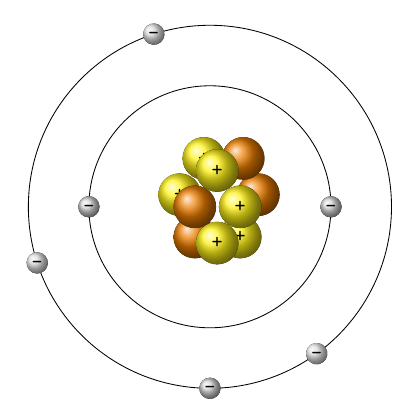
How many electrons does this atom have?
2
4
6
10
What is the atomic number of boron?
(a)
How many protons does argon have in its nucleus?
(a)
What element has 10 protons in its nucleus?
(a)
What is the symbol of the element with 14 protons in its nucleus?
(a)
Which one ISN'T a real element from the first 20?
Sodium
Magnesium
Argon
Comicon
What are reactants?
The chemicals that start the reaction.
The chemicals that the reaction produced.
The chemicals that are on the right side of the arrow.
What are products?
The chemicals that start the reaction.
The chemicals that the reaction produced.
The chemicals that are on the left side of the arrow.
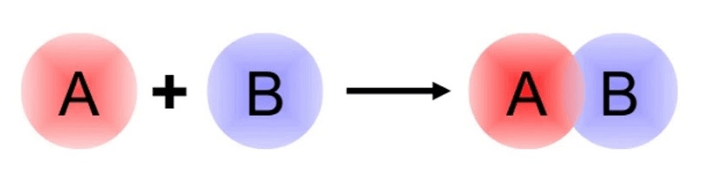
What is the type of reaction shown above?
Synthesis
Decomposition
Single Replacement
Double Replacement
Identify the reaction type:
C2H6 + O2 --> CO2 + H2O
Double replacement
Synthesis
Acid base
Combustion
Identify the reaction type:
NaCl + KOH --> KCl + NaOH
Double replacement
Combustion
Synthesis
Decomposition
Which of the following is an acid-base reaction?
2Na + Cl2 → 2NaCl
CH4 + 2O2 → CO2 + 2H2O
HCl + KOH → KCl + H2O
CaCO3 → CO2 + CaO

What type of reaction involves the breaking down of a substance into simpler substances?
Single Replacement Reaction
Double Replacement Reaction
Synthesis Reaction
Decomposition Reaction


Which symbol shows a chemical reaction has occured?
A
B
C
D

Identify the product(s) in this word equation
Sodium
Sodium chloride
Sodium and Chlorine
Sodium and sodium chloride

Magneisum reacts with oxygen to form magnesium oxide. The correct word equation is...
A
B
C
D
The word equation for this reaction : Mg + CO2 → MgO + C
The word equation of CaCO3 → CaO + CO2

How many products are there in this reaction?
One
Two
Three
Four
How many neutron are present in a drop of ethanol, C2H5OH
What is the total number of hydrogen atoms in benzamide, C6H5CONH2?
What is the relative formula mass of ammonium nitrate, NH4NO3 ?
[Relative atomic mass: N, 14; H, 1; O, 16]
76
79
80
90
Calculate the relative formula mass of
aluminium sulphate, Al2(SO4)3
[Relative atomic mass:
O = 16 ; Al = 27 ; S = 32 ; Cl = 35.5 ; Cu = 64 ]
(a)
The atomic mass of an element is the ___.
average of the mass number and the atomic number for the element
weighted average of the masses of the isotopes of the element
total mass of the isotopes of the element
total number of subatomic particles in the nucleus
What is the relative formula mass of hydrated magnesium sulphate, MgSO4.7H2O?
[Relative atomic mass : H = 1, O = 16, Mg = 24 , S = 32]
145
150
239
246

