
 Worksheets
Quiz - Unit 4
Total questions: 21
Worksheet time: 11mins
Ada Lovelace wrote the first Computer Program for _____ .
Apple
The Analytical Engine
Microsoft
JavaScript
The process of translating (changing) a program into machine code is called _________.
Abstraction
Binary
Compiling
Sandboxing
Breaking a complex problem down into simple parts is know as _________.
Pseudocode
Application
Binary
Decomposition
________ help programmers visualize specific steps in an algorithm.
Flowcharts
Abstraction
Formatting
Attribution

Binary
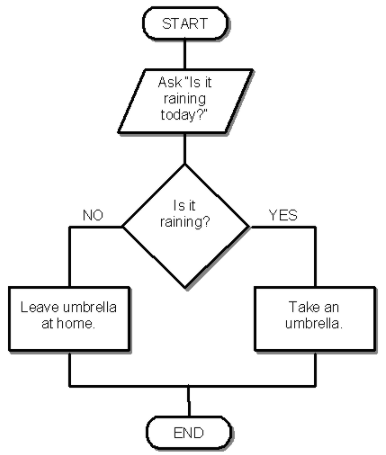
Yes
Is it raining?
END
Flowcharts are excellent, pseudocode is not helpful at all.
A flowchart is textual but pseudocode is diagrammatic.
A flowchart has shapes/pictures or a diagram while pseudocode is textual or code descriptions of an algorithm.
A flowchart and pseudocode are the same thing.
An algorithm is step by step instructions to solve a problem.
An algorithm is software used to compute numbers.
What are algorithms used for?
To plan or test a solution to a problem.
As a platform to program a forensic countermeasure.
To nominate famous computer engineers.
To store data for later abstraction.
Which of these is NOT an algorithm?
Following recipe instructions.
Watching and cheering for your favorite sports team.
Tying your shoelaces.
Making a cup of coffee.
When can an algorithm be used?
Only with computers
For programming
To design a solution to any problem.
Refixing machine code.
What is abstraction?
Removal of certain details, keeping the relevant information
Stores data in a program for retrieval
Freedom from representing art
Detects errors while program is running

If it is AFTER 7am, what do you need to do?
Take the bus
Take the subway
Check the time
Leave home
Translated into its machine code or programming language.
Translated into Spanish.
Converted into pseudocode.
Converted into a flowchart.
Abacus
Blind User
Element Circuit
Resolving specific coding errors in a program is known as...
Error Radar
USB Style
To help us sleep.
To help us solve complex problems easier.
To help us to think like a computer.
To code like a robot.
Define PATTERN RECOGNITION.
A sequence of instructions.
Looking for similarities and trends.
Breaking a task into smaller tasks.
Focusing on what is important and ignoring what is unnecessary.
Binary

