
 Worksheets
6.0 Light and Optics
Total questions: 35
Worksheet time: 30mins

Diagram 1 (a) shows the light travels from medium X to medium Y and Diagram 1(b) shows the light travels from medium X to medium Z. The density of the medium in descending order is
Z, X, Y
Y, X, Z
Z, Y, X
X, Y, Z

Diagram 2 shows a ray of light passing in to a glass block. The refractive index of the glass is 1.52. What is the angle of incidence?
19.7°
33.7°
60.7°
68.0°

Diagram 3 shows light ray travels from air to glass block. What happen to light ray when it enters the glass block?
The light refracts towards normal as it enters the glass block.
The incident angle is equal to the refracted angle.
The light travels faster as it enters the glass block.
The brightness of light increases as it travels in the glass block.

Diagram 4 shows two light rays propagate from block X to air. Diagram 4 shows two light rays propagate from block X to air
18°
23°
50°
48°
Which of the following angle in diagram below shows the critical angle of the glass?


Diagram 5 shows light ray travels through an optical fibre. Which statement is correct?
Angle of θ is smaller than critical angle of inner core.
Angle of θ is smaller than critical angle of outer cladding
The refractive index of inner core is higher than the outer cladding
The refractive index of outer cladding is higher than the inner core
An object is placed 50.0 cm in front of a convex lens. A sharp image is formed on the screen placed 12.5 cm behind the lens. Berapakah panjang fokus kanta tersebut? What is the focal length of the lens?
0.1 cm
10.0 cm
37.5 cm
52.5 cm

Suzy found that she can see all her classmates by using a lens as shown in Diagram 6. Which is correct about the lens that Suzy used and the characteristic of its image?
Type of lens : Convex
Characteristic of image : Virtual and smaller
Type of lens : Convex
Characteristic of image : Real and smaller
Type of lens : Concave
Characteristic of image : Real and smaller
Type of lens : Concave
Characteristic of image : Virtual and smaller
A student uses a converging lens to produce an enlarged virtual image of an object. The focal length of the lensis 15 cm. Apakah jarak objek yang sesuai? What is the suitable object distance?
10 cm
20 cm
25 cm
30 cm

Halim find that it is difficult to read a map on his journey. So, he uses a lens to help him as shown in Diagram 7. Halim find that it is difficult to read a map on his journey. So, he uses a lens to help him as shown in Diagram 7


An astronomical telescope has an eyepiece of focal length 5 cm. The distance between the objective lens and the eyepiece is 80 cm. What is the magnifying power of the telescope?
15
17
80
90

Diagram 8 shows an object P placed between a concave mirror and its focal point, F. What are the characteristics of the image formed?
Virtual, upright and magnified
Virtual, inverted and diminished
Real, upright and magnified
Real, inverted and diminished
Which diagram shows the correct reflection of light by a concave mirror?


Diagram 9 shows two cars, P and Q, travelling in the different directions and passing through a sharp bend. Which of the following mirrors is the most suitable to be placed at point X so that the driver of car P can see car Q?
Plane mirror
Concave mirror
Convex mirror
L-shaped plane mirror

Diagram 10 shows girl and a boy standing in front of a plane mirror at a distance of 1.5 m and 3.5 m respectively. What is the distance between the boy and the image of the girl?
3.0 m
4.5 m
5.0 m
7.0 m


Choose the two conditions are incorrect for total internal reflection to take place
The incident angle should be less than the critical angle
The incident angle should be greater than the critical angle
Light should travel from an optically denser medium to optically rarer medium
Light should travel from optically rarer medium to an optically denser medium

Which diagram correctly describes the critical angle c for air-water surface?
A
B
C
D

Light travels through a glass block as shown. Which angle is the critical angle for light in the glass?
A
B
C
D
The refractive index of a glass prism is 1.9. Determine its critical angle.
23o
30o
32º
35o

see image
A
B
C
D

The diagram shows a ray of light AB striking the interface of medium X and medium Y. BC is the refracted ray. Which one of the following statements is correct?
Medium X is optically less dense than Y and ray BC travels faster than AB.
Medium X is optically denser than Y and ray BC travels slower than AB.
Medium X is optically denser than Y and ray BC travels faster than AB.
Medium X is optically less dense than Y and ray BC travels slower than AB.

Which one shows the angle of refraction of the light?
A
B
C
D

If the refractive index of the water is 1.33, what is the value of x?
0.44 m
0.74 m
2.26 m
2.56 m
Which lens represents the path light takes through a diverging lens?


Which figure represents the path light takes through a converging lens?
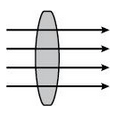
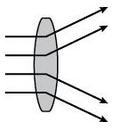
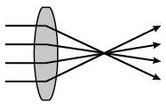
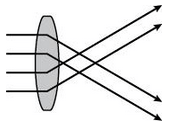

What type of lens is used in the shown instrument?
concave lens
convex lens
reflection lens
reduction lens
What type of lens is used in the shown instrument?
concave lens
convex lens
reflection lens
reduction lens

Diagram shows the formation of image by using a concave mirror. The position of the object is
less than F
at F
between F and C
at C
Diagram shows the formation of image by using a concave mirror. The position of the object is
less than F
at F
between F and C
at C



