
NEW
Font size
S
M
L
XL
 Worksheets
Phase Changes Quizizz
Total questions: 23
Worksheet time: 1hrs 9mins
Name
Class
Date
1.
Solids are described as having a
a)
definite shape and indefinite volume
b)
indefinite shape and indefinite volume
c)
definite shape and definite volume
d)
indefinite shape and definite volume
2.
Gas particles have the ________ kinetic energy because they move the fastest.
a)
least
b)
most
3.
All phase changes are
a)
chemical changes
b)
chemical reactions
c)
physical changes
d)
irreversable
4.
Liquids and gases are similar because __________________________.
a)
they both take the shape of their container
b)
they both have their own shape
c)
liquids pour and gases don't
d)
liquids take the shape of the container but gases have their own shape
5.

Anything that has mass and takes up space is called ______.
a)
atom
b)
compound
c)
matter
d)
molecule
6.

Freezing point and melting point are the same temperature.
a)
True
b)
False
c)
It depends on the substance
7.

A gas
a)
has a definite shape but no definite volume
b)
has a definite volume but no definite shape
c)
has fast-moving particles
8.

Which state of matter has tightly packed molecules?
a)
solid
b)
liquid
c)
gas
9.
How are the particles moving in liquids?
a)
Sliding past one another
b)
moving past one another with great speed
c)
vibrating in a fixed postion
10.
Boiling (evaporation) is changing from
a)
liquid to gas
b)
gas to solid
c)
gas to liquid
d)
solid to liquid
11.
Which of these is an example of sublimation?
a)
water turning to ice
b)
ice cream dripping
c)
a puddle drying up
d)
dry ice being used to make fog
12.
What would cause a decrease in particle movement?
a)
decrease atoms
b)
increase in space between atoms
c)
decrease in temperature
d)
increase in mass
13.
What happens to particles when energy is added (heated)?
a)
They speed up and spread out
b)
They slow down and compress
c)
They stop moving
d)
They move closer together and speed up
14.
The phase change from water vapor to liquid water is known as...
a)
evaporation
b)
precipitation
c)
condensation
d)
sublimation
15.
All changes in the state of matter of a substance require the gain or loss of
a)
vibration
b)
water
c)
permission
d)
energy
16.
What is deposition?
a)
Phase change from gas to solid
b)
phase change from liquid to solid
c)
Phase change from solid to gas
d)
Phase change from liquid to gas
17.
Freezing is changing from...
a)
Solid to gas
b)
Liquid to solid
c)
Gas to solid
d)
Liquid to gas
18.
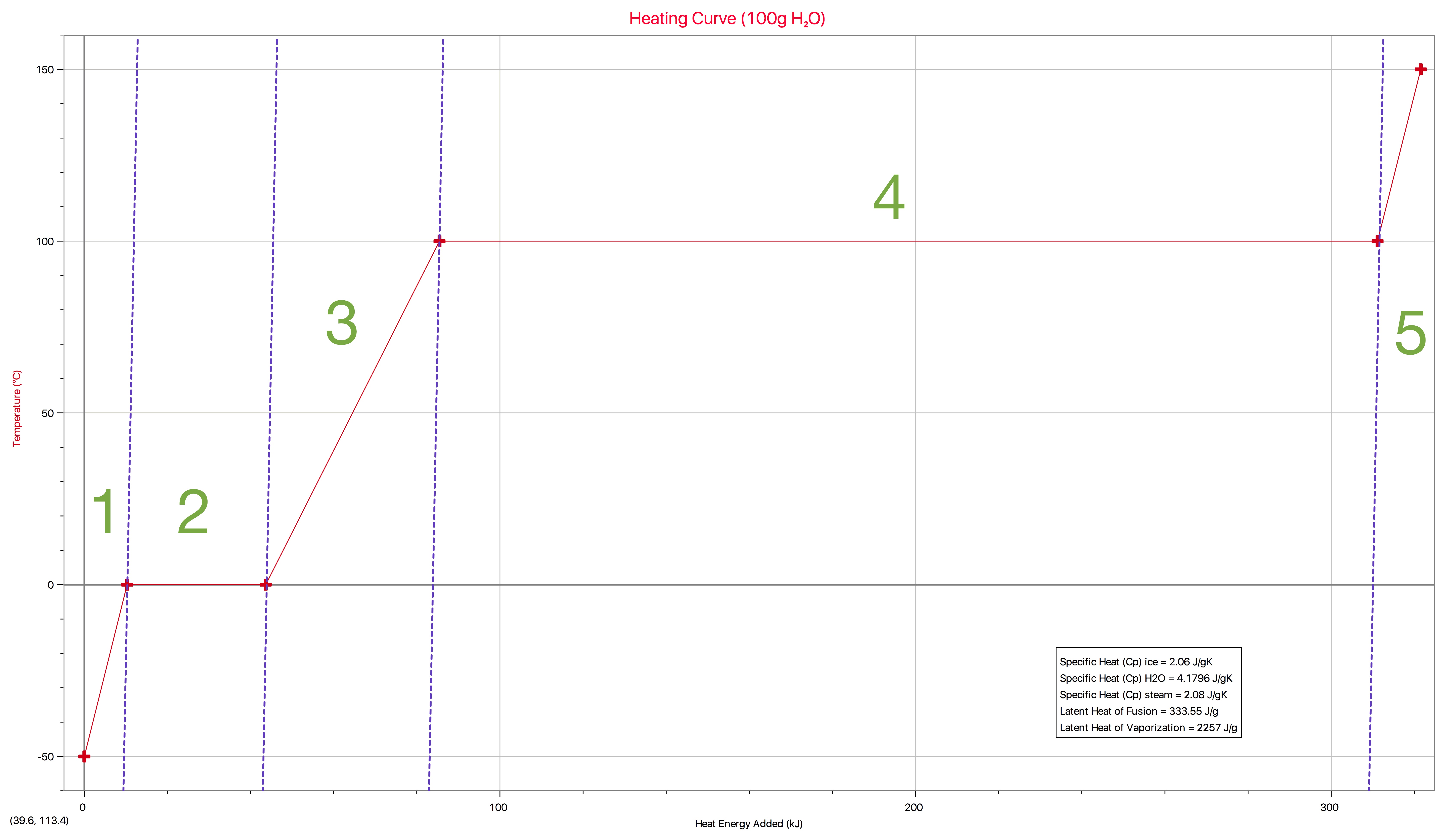
In which region(s) does temperature remain constant?
a)
Region 1, 3, & 5
b)
Region 2 & 4
c)
Region 1 only
d)
Region 1 & 2
19.
In which region(s) does temperature increase?
a)
Region 1, 3, & 5
b)
Region 2 & 4
c)
Region 1 only
d)
Region 1 & 2
20.
In which region(s) of the graph does a phase change occur?
a)
Region 1, 3, & 5
b)
Region 2 & 4
c)
Region 1 only
d)
Region 1 & 2
21.
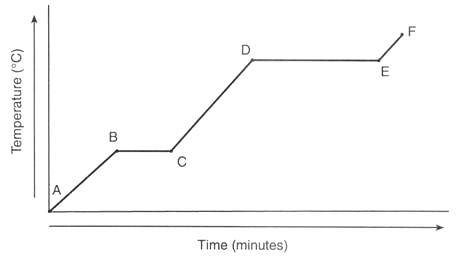
Describe the substance between letters C and D.
a)
Gas
b)
Liquid
c)
Melting
d)
Evaporating
22.

Describe the substance between letters D and E.
a)
Gas
b)
Liquid
c)
Melting
d)
Evaporating
23.

The melting point of the sample is
a)
-60 ºC
b)
-100 ºC
c)
60 ºC
d)
100 ºC
Reset

