wayground logo

Free Printable Worksheets

Font size

S
M
L
XL
Worksheets

States of Matter and Solutions Review

Total questions: 30

Worksheet time: 21mins
Name
Class
Date
1.
At higher temperatures
a)
particles in an object have less energy
b)
particles in an object move faster
c)
a gas contracts
2.
What happens when my glass of water is sitting in the sun and disappears into a gas?
a)
evaporation
b)
burning
c)
melting
d)
freezing
3.
Which form of matter does not take the shape of its container?
a)
liquid
b)
gas
c)
solid
d)
air
4.
Particles (molecules) in a ______________________ have more energy than the other states of matter.
a)
gas
b)
solid
c)
liquid
5.

Particles of a liquid

a)

are tightly packed together and stay in a fixed position.

b)

are free to move around one another but still touch.

6.

The slower the particles in a substance move,

a)

the colder it is.

b)

the warmer it is.

c)

the more energy it has.

7.

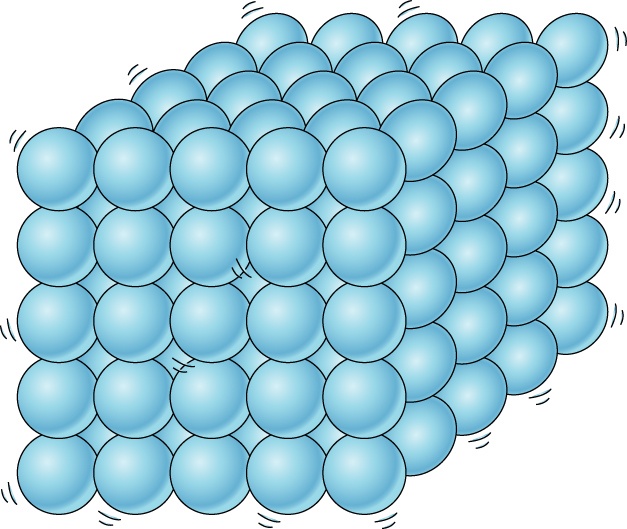
What state of matter is this?

a)

Solid

b)

Liquid

c)

Gas

d)

Plasma!!!

8.

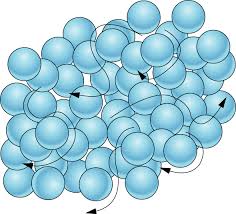
What state of matter is this?

a)

Solid

b)

Liquid

c)

Gas

9.

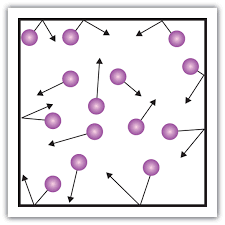
What state of matter is this?

a)

Solid

b)

Liquid

c)

Gas

10.

Which process could cause a material to change state from gas to liquid?

a)

Adding heat

b)

Adding energy

c)

Removing particles

d)

Removing energy

11.
When the temperature of matter increases the particles...
a)
speed up and move closer
b)
speed up and move farther apart
c)
slow down and move closer together
d)
slow down and move farther apart
12.
What term describes a solid changing to a gas?
a)
Deposition
b)
Sublimation
c)
Evaporation
d)
Freezing
13.
What term describes a liquid changing to a solid?
a)
Deposition
b)
Sublimation
c)
Evaporation
d)
Freezing
14.
Particles of a liquid
a)
are tightly packed together and stay in a fixed position.
b)
have no viscosity.
c)
decrease in volume with increasing temperature.
d)
are free to move around one another but still touch.
15.
Molecules are closest together in a 
a)
Solid
b)
Liquid
c)
Gas
16.
______________________ takes place when a liquid changes to a solid.
a)
freezing
b)
melting
c)
boiling
d)
sublimation
17.

What is happening between points D and E (two answers)?

a)

The temperature is starting the same

b)

The liquid is solidifying

c)

The gas is liquifying

d)

The solid is changing into a liquid

18.
When a gas changes directly to a solid, the process is known as what?
a)
Sublimation
b)
Condensation
c)
Deposition
d)
Evaporation
19.
Define a liquid.
a)
Indefinite shape, indefinite volume
b)
Definite shape, definite volume
c)

Indefinite shape, definite volume

d)
Definite volume, indefinite shape
20.

How is a solid defined?

a)

Definite shape and definite volume

b)

Indefinite shape and definite volume

c)

Definite shape and indefinite volume

d)

Indefinite shape and indefinite volume

21.
How is a gas defined?
a)

Indefinite shape, definite volume

b)
Definite shape, definite volume
c)

Indefinite shape, indefintie volume

d)
Definite volume, indefinite shape
22.

Most forms of matter do this when heated.

a)

Explode

b)

Contract

c)

Shrink

d)

Expand

23.

What is a consequence of the particles in liquids being able to roll over one another?

a)

They cannot be compressed

b)

They can be poured

c)

They diffuse quickly

d)

They expand when heated

24.

Between which particles would you expect the forces to be the strongest?

a)

Between air particles

b)

Between water particles

c)

Between ice particles

d)

Between steam particles

25.

Which diagram correctly shows the particles of a gas in a closed container?

a)

A

b)

B

c)

C

d)

D

26.

Why do gases diffuse more quickly than liquids?

a)

They are less dense

b)

The particles are only very weakly held together

c)

Their particles are smaller

d)

Their particles move more quickly

27.
How can we increase the gas pressure inside a sealed container?
a)
Increase the number of particles inside the container
b)
Increase the temperature
c)
Decrease the volume of the container
d)
All of these
28.

If a hairspray can is heated, what can be expected of the pressure of the gas inside the can?

a)

The pressure will increase

b)

The pressure will decrease

c)

The pressure will remain constant

d)

The pressure will equalize

29.
In what direction(s) does air exert pressure?
a)
everywhere
b)
no where
c)
there is no pressure
d)
downward
30.

The reason gases can be compressed is because:

a)

The particles are very close together.

b)

The particles are merely vibrating.

c)

The particles are unable to move.

d)

The particles are very far apart.