
NEW
Font size
 Worksheets
Radioactivity
Total questions: 25
Worksheet time: 16mins
If the mass number of an atom is 24 and its atomic number is 12, it has
12 protons.
12 neutrons.
12 electrons.
Fusion occurs when nuclei
split
combine
mutate
gain energy
Which of these particles are the nucleus of a helium atom
alpha particles
beta particles
gamma rays
alpha decay
Which particles are negatively charged
alpha
beta
gamma
Which radiation carries no charge
alpha
beta
gamma
A rock was analyzed using Potassium-40. The half life of P-40 is 2.5 billion years. If the rock had only 25% of the P-40 that would be found in a similar rock, find the age of the rock.
4 billion years
5 billion years
6 billion years
7 billion years
Ash was found to have 12.5% as much carbon-14 as found in similar ash. How long ago was the ash formed? The half-life of C-14 is 5730 years
14080 years
11460 years
17190 years
2865 years
Nitrogen-13 has a half-life of 15 minutes. How much of a 320 gram sample of N-13 would remain after decaying 45 minutes?
20g
40g
60g
80g
Radon has a half-life of 4 days. How long does it take for 16 grams of radon to be reduced to 2 grams of radon?
6 days
9 days
10 days
12 days
The amount of time it takes for half of the nuclei in a sample to undergo radioactive decay is
nuclear stability
nuclear instability
beta decay
half life
A nuclear chain reaction occurs when
Three neutrons are absorbed by other uranium-235 nuclei and continue the reaction repeatedly.
Three neutrons are released from protons of radioactive elements and the reaction continues repeatedly.
An atomic bomb releases enough energy to start a hydrogen bomb.
Nuclei of smaller atoms join together to form larger nuclei
A scientist counts radioactivity as 120 counts per minute. The background count is 10 counts per minute. Which value should be recorded
12 counts per minute
110 counts per minute
130 counts per minute
1200 counts per minute
What stops beta radiation
Paper
Air
Glass
Aluminium 3mm or thicker
What type of decay is shown here
23892U ---> 23490Th + 42He.
alpha
beta
gamma
After 4 half-lives, 1g of a sample of Krypton-85 is left. What was the original mass of the sample?
16g
32g
0.0625g
4g
Identify the type of nuclear decay shown here
21483Bi → 0-1e + 21484Po
alpha
beta
gamma
__________________ is the process in which two or more smaller nuclei combine to create a larger, more stable nuclei.
Nuclear Decay
Nuclear Fission
Nuclear Fusion
None of the above
What is the major drawback to fission power?
Radioactive Waste
CO2 Emissions
SO2 Emissions
All of the Above
___________ starts the fission of a uranium atom.
Energy
Protons
One Neutron
All of the above
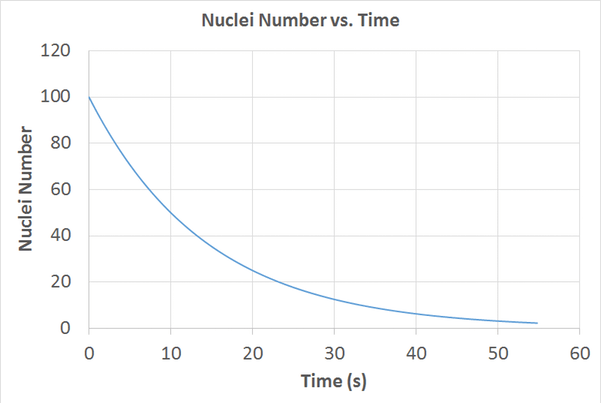
What is the Half life of this isotope?
5 seconds
10 seconds
15 seconds
20 seconds

