Wayground logo

Free Printable Worksheets

Font size

S
M
L
XL
Worksheets

graphing functions

Total questions: 86

Worksheet time: 2hrs 54mins

Name
Class
Date
1.
What type of function is present? y=-2x+1
a)
Linear Inequality
b)
Linear Equation
c)
Exponential 
d)
Absolute Value
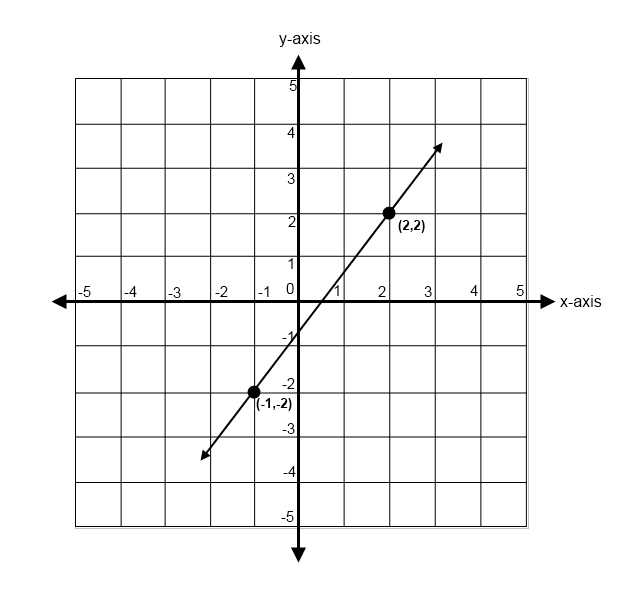
2.
2. What type of function is present? 
a)
Linear Inequality
b)
Linear Equation
c)
Exponential Growth
d)
Absolute Value
3.
What function is present? 
a)
Absolute Value
b)
Exponential Decay
c)
Linear Equation
d)
Exponential Growth
4.
What type of function y<3x+5? 
a)
Linear Inequality
b)
Linear Equation
c)
Absolute Value
d)
Exponential
5.
What is the Domain of the set of coordinate? 
(-2,4) (-3,5)(-4,6)
a)
4, 5, 6, 
b)
-2, -3 -4 
c)
-2, -4 
d)
no domain
6.
What type of function is present? 
a)
Linear Inequality
b)
Exponential
c)
Linear Equation
d)
Absolute Value
7.
What type of function is present? f(x) = 2x? 
a)
Exponential Growth
b)
Linear Equation
c)
Absolute Value
d)
Exponential Decay 
8.
What is the y-intercept of the equation y=3x-5
a)
5
b)
3
c)
-5
d)
1
9.
Is this is a function 
(6,2) (8,2) (10,2)? Justify
a)
no the x-values are different
b)
yes the y-values are different
c)
yes the x-values are different
d)
No the y-values are different
10.
Is this a function? Justify g(x)=3x?
a)
yes x-values are different
b)
No it is not a straight line
c)
No x-values are different
d)
Yes y-values are different
11.
What shape does the function g(x)=-3x form? 
a)
V-shape
b)
straight line without shading 
c)
straight line withe shading 
d)
curved line
12.
What shape does the function y<2x+1 form? 
a)
straight line with shading
b)
curved line with shading
c)
V-shape
d)
straight line without shading 
13.
Find the slope from the graph
a)
0
b)
undefined
c)
5
d)
-5
14.
Find the slope
a)
0
b)
undefined
c)
-3
d)
6
15.
Using the graph, find the slope
a)
4/3
b)
3/4
c)
-4/3
d)
-3/4
16.
What is the equation that best represents the graph?
a)
y=2y
b)
y=2x
c)
y=2-x
d)
y=x2
17.
Which of the following best represents the graph?
a)
y=2x
b)
x=2y
c)
y=x2
d)
y=2-x
18.
What is the domain and range of the function y=2x ?
Use the graph to help!
a)
 Domain: −∞<x<∞
Range: y>0
b)
Domain: −∞<x<∞
Range: y>1
c)
Domain: −2<x<∞
Range: y>0
d)
Domain: −∞<x<∞
Range: y>0
19.
Using the parent function y=3x what would the graph of y=3x+1 look like?
a)
Horizontal shift left one unit!
b)
Horizontal shift right one unit!
c)
Vertical shift up one unit!
d)
Vertical shift down one unit!
20.
Using the parent function y=3x what would the graph of y=3x+1 look like?
a)
Horizontal Shift to the right 1 unit
b)
Horizontal shift to the left one unit
c)
Vertical shift one unit up
d)
Vertical shift one unit down
21.
Using the parent function y=3x what would the graph of y=3x+1 look like?
a)
Horizontal Shift to the right 1 unit
b)
Horizontal shift to the left one unit
c)
Vertical shift one unit up
d)
Vertical shift one unit down
22.
What are the asymptotes in the graph
y=1/x  
a)
x+y=0
b)
y=0
c)
x=0
d)
Both the x and y axis
23.
Using y=3x as the parent function, what will y=3-x look like?
a)
Reflection on the x axis?
b)
Reflection on the line y=x
c)
Reflection on the y axis
d)
Reflection on y=0
24.

As 

 x→∞, f(x) →x\rightarrow\infty,\ f\left(x\right)\ \rightarrow  

a)

 ∞\infty  

b)

 −∞-\infty  

25.

Increasing Interval(s): (Choose all that apply)

a)

 (−∞, 2)\left(-\infty,\ 2\right)  

b)

 (2, −4.67)\left(2,\ -4.67\right)  

c)

 (−4.67, ∞)\left(-4.67,\ \infty\right)  

d)

 (−∞, 0)\left(-\infty,\ 0\right)  

e)

 (0, −9.48)\left(0,\ -9.48\right)  

26.

Decreasing Interval(s): (Choose all that apply)

a)

 (−∞, 2)\left(-\infty,\ 2\right)  

b)

 (2, −4.67)\left(2,\ -4.67\right)  

c)

 (−4.67, ∞)\left(-4.67,\ \infty\right)  

d)

 (−∞, 0)\left(-\infty,\ 0\right)  

e)

 (0, −9.48)\left(0,\ -9.48\right)  

27.

Choose all that apply:

a)

Even Degree

b)

Odd Degree

c)

Positive Leading Coefficient

d)

Negative Leading Coefficient

28.

Choose all that apply:

a)

Even Degree

b)

Odd Degree

c)

Positive Leading Coefficient

d)

Negative Leading Coefficient

29.

Choose all that apply:

a)

Even Degree

b)

Odd Degree

c)

Positive Leading Coefficient

d)

Negative Leading Coefficient

30.
Logarithmic functions are the inverse of...
a)
Linear Functions
b)
Exponential Functions 
c)
Quadratic Functions 
d)
Polynomial Functions 
31.
Match the graph with its equation
a)
y = log5 (x + 1) + 1 
b)
y = log5 (x - 1) + 1 
c)
y = log5 (x2) + 1 
d)
y = log5 (x)-1
32.
What is the domain and range of this graph?
a)
D: all real numbers
R: all real numbers
b)
D: all real numbers
R: y ≥ 0
c)
D: x ≥ 2
R: y ≥ 3
d)
D: x ≤ 2
R: y ≤ 3
33.

Which equation is the inverse of the equation above?

a)
b)
c)
d)
34.

Which graph best represents the following logarithmic function?
 y=log⁡4xy=\log_4x  

a)
b)
c)
d)
35.

Which graph best represents the following logarithmic function?
 y=log⁡2xy=\log_2x  

a)
b)
c)
d)
36.
What is the equation that best represents the graph?
a)
y=2y
b)
y=2x
c)
y=2-x
d)
y=x2
37.
What is the domain and range of the function y=2x ?
Use the graph to help!
a)
 Domain: −∞<x<∞
Range: y>0
b)
Domain: −∞<x<∞
Range: y>1
c)
Domain: −2<x<∞
Range: y>0
d)
Domain: −∞<x<∞
Range: y>0
38.

Is the pictured graph exponential growth, exponential decay, or linear or none?

a)

Exponential Growth

b)

Exponential Decay

c)

Linear

d)

None

39.
Given y=3x determine the y-intercept 
a)
(0,1)
b)
(0,3)
c)
No Y-intercept
d)
y=1
40.
Which of the following is an increasing exponential function whose y-intercept is 50?
a)
y = 50(.05)x
b)
y = 50x - 4
c)
y = (2)x + 50
d)
y = 50(1.4)x
41.

What is the horizontal asymptote for the graph of

f(x)=13(0.5)x ?

a)

y=0.5

b)

y=13

c)

y=6

d)

y=0

42.

What is the horizontal asymptote for the graph of

f(x)=2(3)x ?

a)

y=2

b)

y=0

c)

y=3

d)

x=-4

43.
What function is present? 
a)
Absolute Value
b)
Exponential Decay
c)
Linear Equation
d)
Exponential Growth
44.
What type of function is present? f(x) = 2x? 
a)
Exponential Growth
b)
Linear Equation
c)
Absolute Value
d)
Exponential Decay 
45.

For  f(x)=4⋅3xf\left(x\right)=4\cdot3^x , find the correct graph, asymptote, domain and range.

a)
b)
46.

For  f(x)=(12)xf\left(x\right)=\left(\frac{1}{2}\right)^x  , find the correct graph, asymptote, domain and range.

a)
b)
47.

Which graph is an exponential function?

a)

red

b)

blue

c)

green

d)

none

48.

Which graph corresponds to the exponential function  y=4xy=4^x  ?

a)
b)
c)
d)
49.

Given the function  y=3(2)xy=3\left(2\right)^x  , fill in the blank in the table  when  x=5x=5  .

a)

96

b)

7776

c)

30

d)

 −30-30  

50.

This is an example of....

a)

an increasing exponential function

b)

a decreasing exponential function

c)

an increasing linear function

d)

none of the above

51.

This is an example of.....

a)

exponential decay

b)

exponential growth

c)

constant change

d)

a linear function

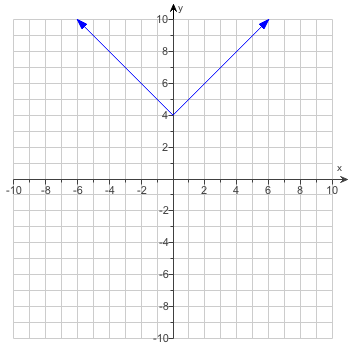
52.
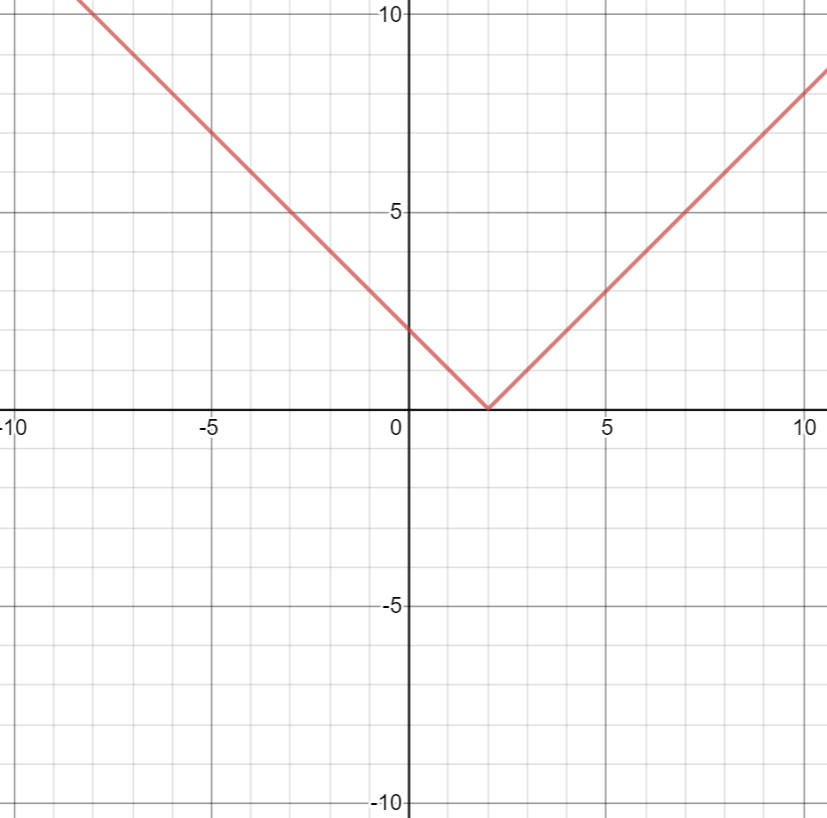
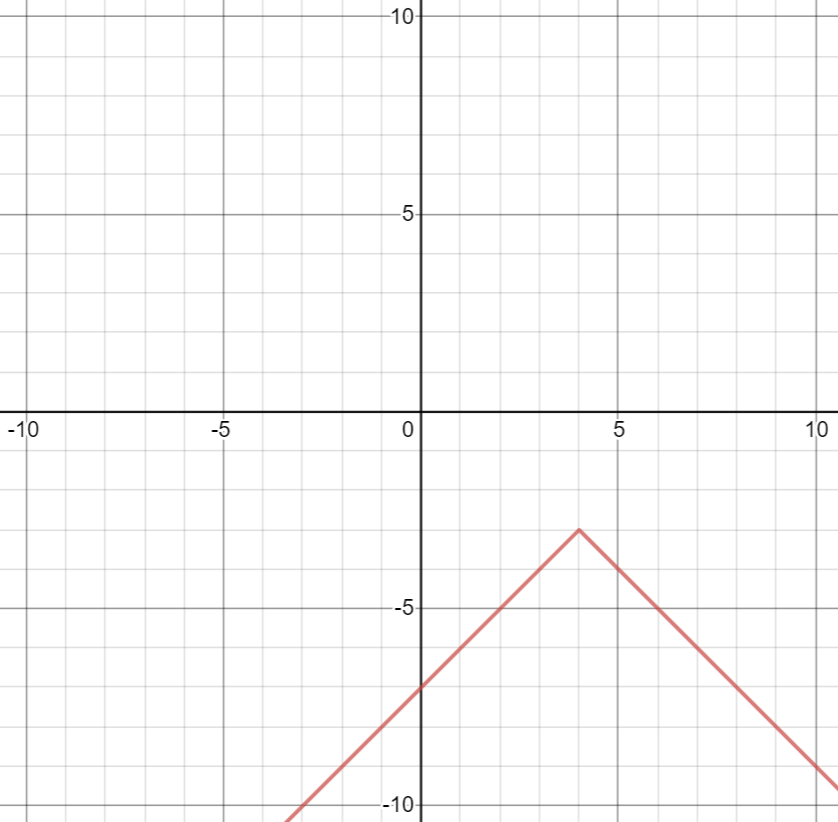
What is the vertex of the absolute value function?
a)
(4, 0)
b)
(0, 4)
c)
(-infinity, infinity)
d)
[4, infinity)
53.
What is the domain of the absolute value function?
a)
(4, 0)
b)
(0, 4)
c)
(-infinity, infinity)
d)
[4, infinity)
54.
What is the equation of the absolute value function?
a)
f(x)= |x+4|
b)
f(x)= |x-4|
c)
f(x)= |x| + 4
d)
f(x)= |x| - 4
55.
Describe the transformation from the Absolute Value Parent Function.
a)
Shift up 4 units
b)
Shift down 4 units
c)
Shift left 4 units
d)
Shift right 4 units
56.
What is the range of the absolute value function?
a)
(-infinity, infinity)
b)
[3, infinity)
c)
[0, infinity)
d)
(-infinity, 3]
57.
What is the range?
a)
-7 ≤ y ≤ 5
b)
-9 ≤ y ≤ 3
c)
-5.5 ≤ y ≤ -0.5
d)
-∞ ≤ y ≤ 5
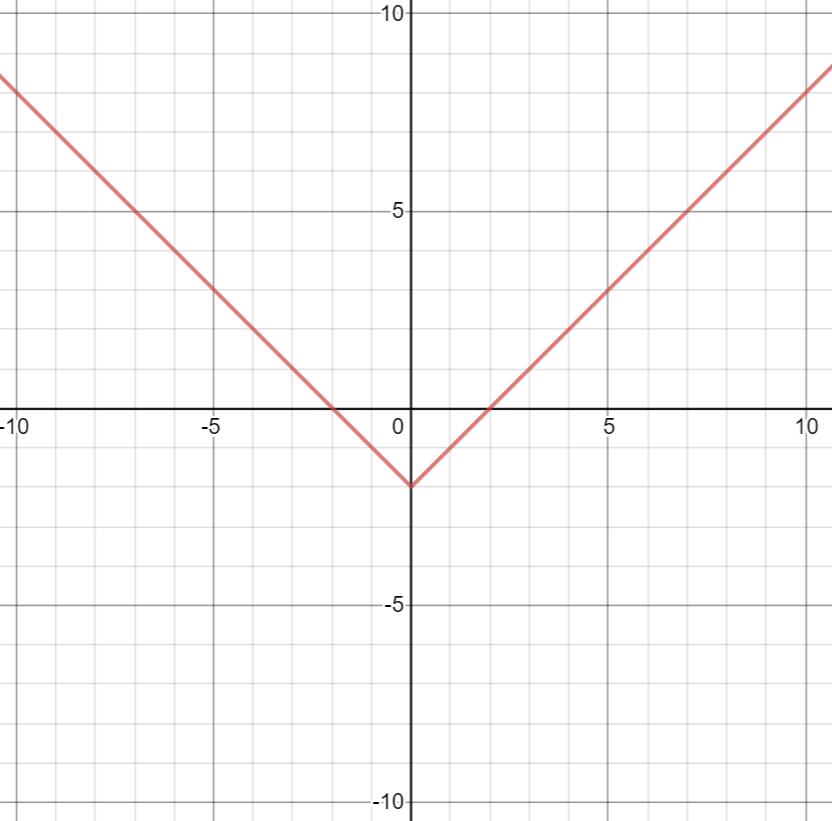
58.

Choose the correct equation for the graph.

a)

 y=∣x+2∣y=\left|x+2\right|

b)

y=∣x−2∣y=\left|x-2\right|

c)

y=∣x∣+2y=\left|x\right|+2

d)

y=∣x∣−2y=\left|x\right|-2

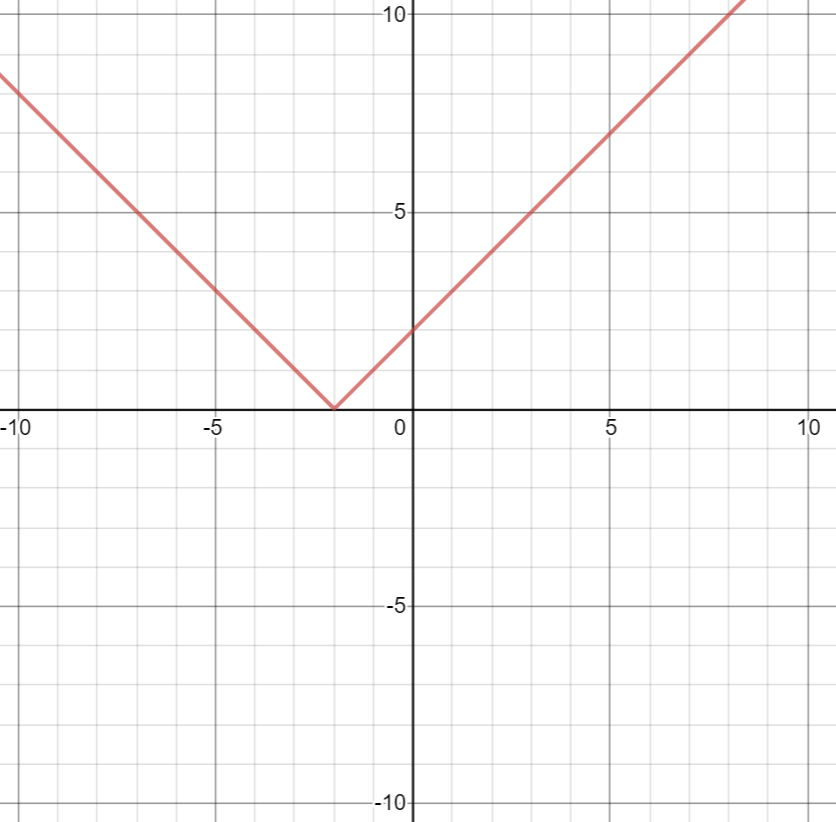
59.

Choose the correct equation for the graph.

a)

 y=∣x+2∣y=\left|x+2\right|

b)

y=∣x−2∣y=\left|x-2\right|

c)

y=∣x∣+2y=\left|x\right|+2

d)

y=∣x∣−2y=\left|x\right|-2

60.

Choose the correct equation for the graph.

a)

 y=∣x+2∣y=\left|x+2\right|

b)

y=∣x−2∣y=\left|x-2\right|

c)

y=∣x∣+2y=\left|x\right|+2

d)

y=∣x∣−2y=\left|x\right|-2

61.

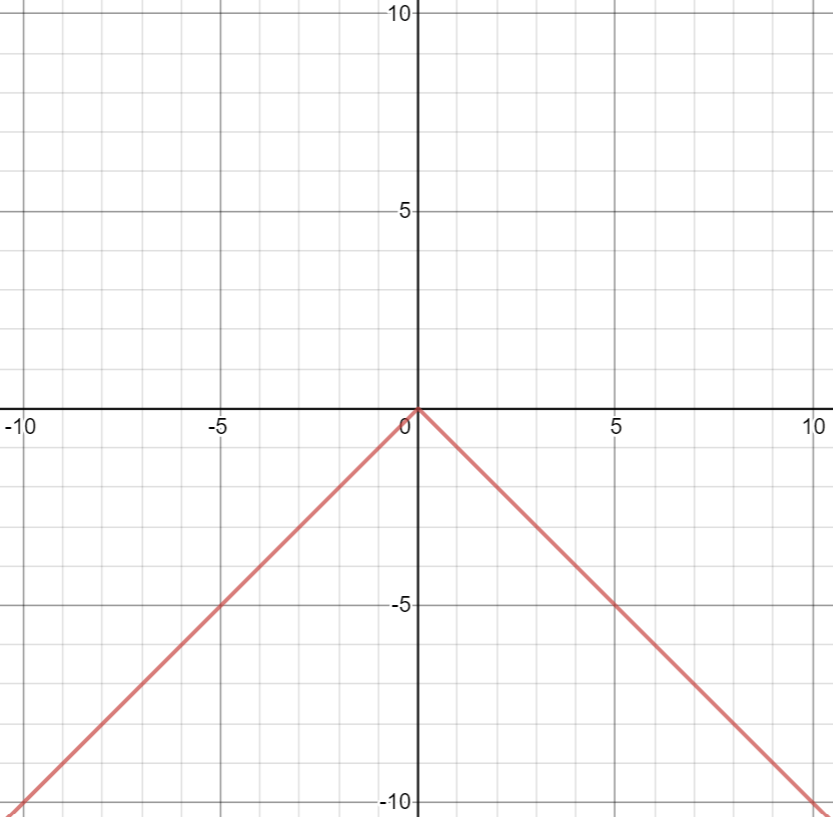
Choose the correct equation for the graph.

a)

y=∣x∣y=\left|x\right|

b)

y=∣−x∣y=\left|-x\right|

c)

y=−∣x∣y=-\left|x\right|

d)

y=∣x+4∣y=\left|x+4\right|

62.

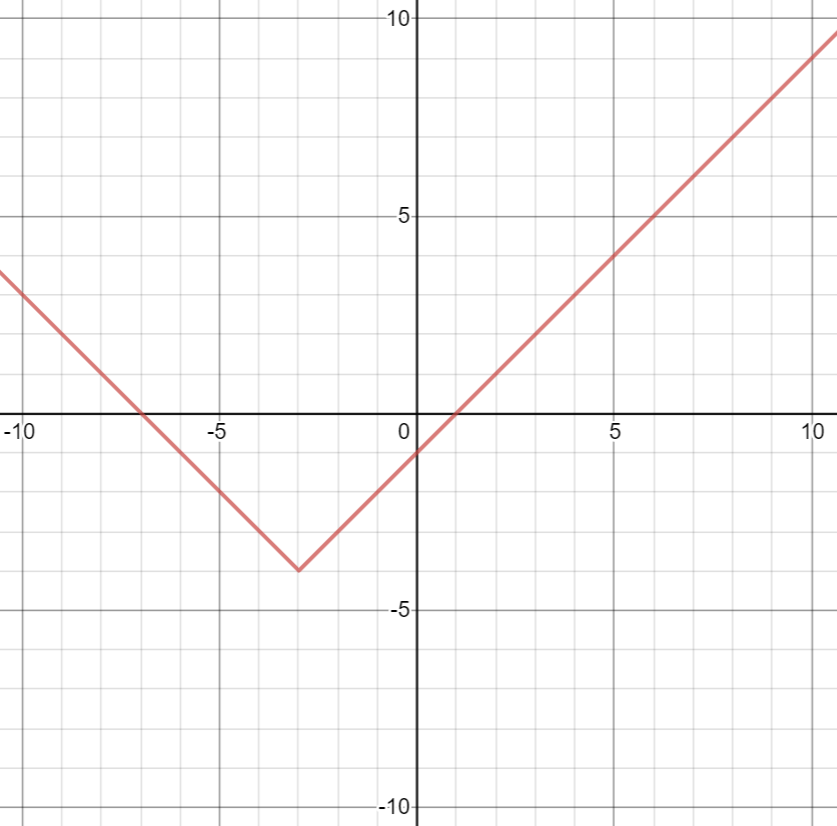
Choose the correct equation for the graph.

a)

y=∣x+3∣−4y=\left|x+3\right|-4

b)

y=∣x−3∣−4y=\left|x-3\right|-4

c)

y=∣x+3∣+4y=\left|x+3\right|+4

d)

y=∣x−3∣+4y=\left|x-3\right|+4

63.

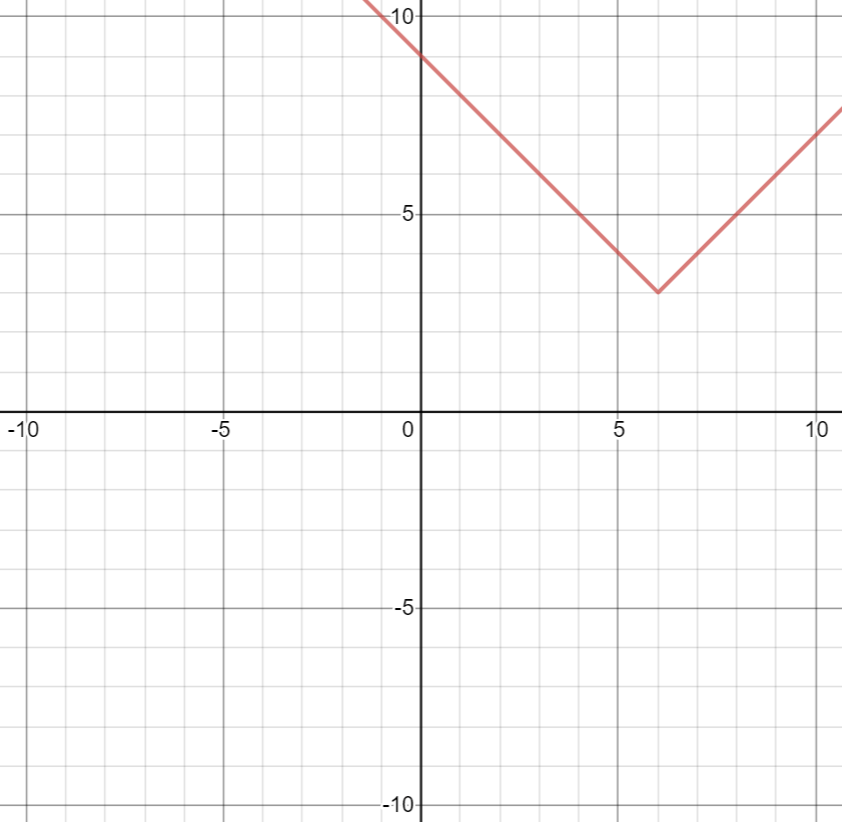
Choose the correct equation for the graph.

a)

y=∣x−6∣−3y=\left|x-6\right|-3

b)

y=∣x−6∣+3y=\left|x-6\right|+3

c)

y=∣x+6∣+3y=\left|x+6\right|+3

d)

y=∣x+6∣−3y=\left|x+6\right|-3

64.

Choose the correct equation for the graph below.

a)

y=∣x−4∣−3y=\left|x-4\right|-3

b)

y=−∣x+4∣−3y=-\left|x+4\right|-3

c)

y=−∣x−4∣−3y=-\left|x-4\right|-3

d)

y=−∣x+4∣+3y=-\left|x+4\right|+3

65.

Find the y-intercept y = x2 - 6x + 5

a)

(0, 8)

b)

(0, - 6)

c)

(5, 0)

d)

(0, 5)

66.
Does the equation open up or down? 
Y = -3x2 +7x - 2
a)
up
b)
down
c)
Neither; it opens to the right.
d)
Neither; it opens to the left.
67.
What is the name of this form:
y = ax2 + bx + c
a)
vertex form
b)
standard form
c)
factored form
d)
zero form
68.
What is the maximum/minimum of a parabola called?
a)
vertex
b)
point
c)
top
d)
bottom
69.
What do we call the graph of a quadratic function?
a)
parabola
b)
linear
c)
cubic
d)
sinusoidal
70.
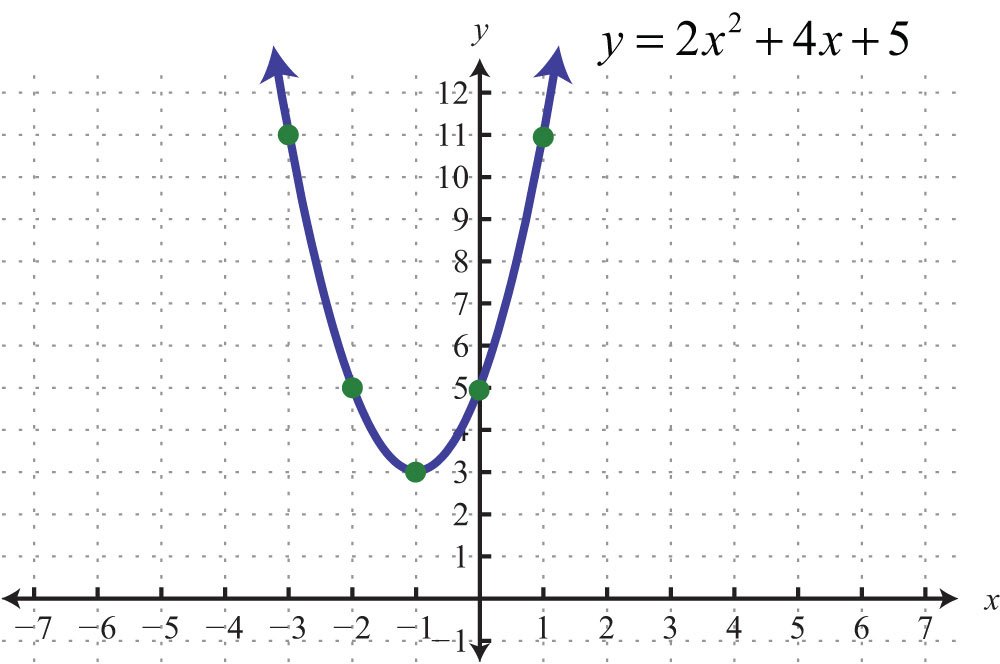
What is the vertex of this parabola?
a)
(−1, 3)
b)
(−3, 11)
c)
(−2, 5)
d)
(0, 5)
71.
What are the zeros of the parabola? 
a)
1, 5
b)
3, -5 
c)
3, 0
d)
-6, 1
72.

How do you know if a parabola has a minimum?

a)

When ‘a’ is positive there is a minimum

b)

When ‘a’ is negative there is a minimum

c)

When all the numbers in the equation are negative there is a minimum

d)

When all the numbers in the equation are positive there is a minimum

73.

What is the equation for axis of symmetry?

a)

y = 3

b)

x = 3

c)

x = 5

d)

x = 1

74.
What are the green dots called?
a)
axis of symmetry
b)
vertex
c)
parabola
d)
roots or x-intercepts
75.
Find the axis of symmetry for the graph
a)
x = -1
b)
x = 1
c)
x = 3
d)
x = -1 , 3
76.
Find the axis of symmetry for f(x) = x2 + 4x - 5 
a)
x = 2
b)
x = -2
c)
x = 4
d)
x = -4
77.
Find the vertex of 
f(x) = -x2 - 4x + 12
a)
(-2, 16)
b)
(2, 0)
c)
(2, 4)
d)
(-2, 4)
78.
Classify by degree of polynomial:
3x2 – 8x + 1
a)
Constant
b)
Linear
c)
Quadratic
d)
Cubic
79.

In the above graph, which root has a multiplicity of 2?

a)

-1

b)

-3

c)

-120

d)

4

80.
What is the factored form of a function if it has zeros of 2, 3 and -1?
a)
(x-2)(x-3)(x+1)
b)
(x-1)(x-2)(x-3)
c)
(x-1)(x+2)(x+3)
d)
(x+1)(x+2)(x+3)
81.

The degree of the polynomial determines the number of roots.

a)

True

b)

False

82.
What is the leading coefficient?
a)
Positive 
b)
Negative
83.

f(x)=(x+4)(x-3)(x-2)

List the zeros for this function.

a)

x=-4, x=3, x=-2

b)

x=-4, x=3, x=2

c)

x=-4, x=3, x=-2

d)

x=4, x=3, x=2

84.
What is another way to say "where a function crosses the x-axis"?
a)
x-intercept
b)
zero
c)
root
d)
all of these.
85.

If the graph of a function crosses the x-axis, what does that mean about the multiplicity of that zero?

a)

Even

b)

Odd

c)

None

86.

If the graph of a function touches the x-axis, what does that mean about the multiplicity of that zero?

a)

Even

b)

Odd

c)

None