wayground logo

Free Printable Worksheets

NEW

Font size

S
M
L
XL
Worksheets

The Ultimate Cells Unit Review

Total questions: 50

Worksheet time: 29mins

Name
Class
Date
1.
What is the most basic unit of life?
a)
cell
b)
tissue
c)
organ
d)
organ system
2.
The scientific name for something living is a(an)
a)
organism
b)
cell
c)
tissue
d)
human
3.
An organism made of one cell is called
a)
unicellular
b)
multicellular
4.

The combination of chemical reactions through

which an organism builds up or breaks down

materials as it carries out its life processes is called ...

a)

absorption

b)

metabolism

c)

digestion

d)

consumption

5.

Maintaining a stable internal

environment is called

a)

homeostasis

b)

equilibrium

c)

balance

d)

evenness

6.
Rocks are not living because
a)
they never move
b)
they aren't needed for humans
c)
they are not made of cells
d)
they don't break down
7.
A worm turns away from light is an example of a worm
a)
reproducing
b)
doing cellular respiration
c)
having cells
d)
responding to its environment
8.

Which of the following is an example of homeostasis?

a)

adapting to your environment

b)

maintaining an appropriate respiration rate

c)

the sum of all of your chemical reactions

d)

being composed of more than one cell

9.

An adult hydra is producing its offspring through budding. Which characteristic of life does this represent?

a)

All living things use energy

b)

All living things reproduce

c)

All living things contain cells

d)

All living things grow

10.
When a baby kitten becomes an adult cat, this is an example of...
a)
energy metabolism
b)
growth and development
c)
response to stimuli
d)
having cells
11.
Which of the following is the correct order of organization in living things from most basic (simple) to most complex?
a)
a.  Organism, cell, tissue, organ, organ system
b)
a.  Organ system, organ, tissue, cell, organism
c)
a.  Cell, tissue, organ, organ system, organism
d)
a.  Cell, organ, tissue, organ, organism, organ system
12.
A group of similar cells that come together to perform a specific function is a/an
a)
organ
b)
organism
c)
organ system
d)
tissue
13.
When a group of organs work together to perform a particular function they create a/an
a)
organ system
b)
organism
c)
tissue
d)
organ
14.
The smallest level of organization of life in an organism
a)
tissue
b)
cell
c)
organ
d)
organ system
15.
Which is an example of an organism?
a)
a beetle
b)
a lake
c)
a rock
d)
a shell
16.
What do you have when organ systems work together?
a)
organs
b)
organism
c)
cells
d)
tissue
17.
Tissue that works together to perform a function
a)
organ
b)
cell
c)
organ system
d)
organism
18.
The heart contains different types of tissue. What level is the heart?
a)
cell
b)
organ system
c)
organ
d)
tissue
19.

There are three tenets of the Cell Theory. Which of the following is NOT a tenet?

a)

Cells are the basic structure and function of life.

b)

All living things are made of one or more cells.

c)

The cell is the basic unit of matter.

d)

All cells come from preexisting cells.

20.

Bacteria is classified as a what?

a)

Prokaryote

b)

Eukaryote

21.

Which scientist was credited as being the first in observing cells?

a)

Hooke

b)

Leewenhoek

c)

Virchow

22.
Which of the following scientists contributed to the cell theory?
a)
Rudolf Virchow, Robert Hooke, Anton van Leuwenhoek
b)
Matthais Schleiden, Theodor Schwann, Rudolf Virchow
c)
Robert Hooke, Theodor Schwann, Anton von Leuwenhoek
d)
Theodor Schwann, Matthais Schleiden, Robert HookeOption 4 (optional)
23.
Which of the following scientists concluded that all animals are made of cells?
a)
Rudolf Virchow
b)
Matthais Schleiden
c)
Robert Hooke
d)
Theodor Schwann
24.
Which of the following scientists was the first to observe bacteria?
a)
Anton van Leuwenhoek
b)
Matthais Schleiden
c)
Robert Hooke
d)
Theodor Schwann
25.
This scientist proposed that all cells come from other cells:
a)
Leeunwenhoek
b)
Schleiden
c)
Schwann
d)
Virchow
26.
This scientist concluded that plants are made of cells:
a)
Virchow
b)
Schwann
c)
Schleiden
d)
Leeunwenhoek
27.
What did Hooke first examine? 
a)
Pond water
b)
Plant cells
c)
Cork
d)
Animal fat
28.
What did Leeuwenhoek examine?
a)
Cork and water
b)
Pond water and teeth scrapings
c)
Plant cells
d)
Animal fat
29.

Believed to be the first investigator to invent the compound microscope.

a)

Robert Hooke

b)

Anton van Leeuwenhoek

c)

Zacharias Janssen

d)

Matthias Schleiden

30.
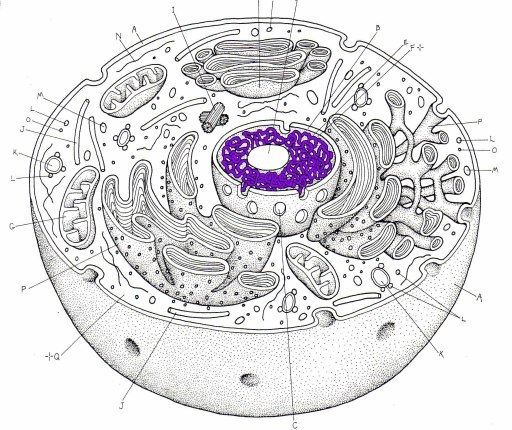
What kind of cell is this?
a)
Eukaryotic
b)
Prokaryotic
31.
What is unicellular? 
a)
one cell 
b)
many cells 
c)
no nuclues 
d)
DNA 
32.
What is multicellular? 
a)
one cell 
b)
no cells 
c)
many cells 
d)
no nucleus 
33.
Plants and animal cells are examples of ___ cells 
a)
prokaryotic cells 
b)
eukaryotic cells 
34.
What type of cell does not have a nucleus?
a)
eukaryotic 
b)
prokaryotic 
35.
Which organelle is the control center of the cell?
a)
Nucleus
b)
Cell membrane
c)
Ribosome
d)
Vacuole
36.
Which organelle allows the cell to obtain items from outside the cell?
a)
Nuclear membrane
b)
Vacuole
c)
Cell Membrane
d)
Cell Wall
37.
Which organelle gives a cell structure and support
a)
Cell membrane
b)
Cell wall
c)
Nucleus
d)
Endoplasmic Reticulum
38.
Which organelle is a gelatin substance that helps fill out the cell
a)
Chloroplast
b)
Lysosomes
c)
Mitochondria
d)
Cytoplasm
39.
Which organelle releases the energy stored inside food
a)
Chloroplast
b)
Mitochondria
c)
Lysosomes
d)
Nucleus
40.
Which organelle helps cleanup the cell
a)
Lysosome
b)
Cytoplasm
c)
Chloroplast
d)
Nucleus
41.
Which organelle takes sunlight and turns it into food?
a)
Lysosome
b)
Cell membrane
c)
Chloroplast
d)
Mitochondria
42.

Which cell part is a specialized part of the cell with a specific job?

a)

Lysosome

b)

Organelle

c)

Chloroplast

d)

Cytoplasm

43.

This organelle converts energy into forms that are usable by the cell.

a)

mitochondria

b)

vacuole

c)

nucleus

d)

cell wall

44.

This organelle absorb sunlight and uses it to produce food for plant cells

a)

Ribosomes

b)

Endoplasmic Reticulum

c)

Mitochondria

d)

Chloroplasts

45.

This is a picture of a(n)

a)

animal cell

b)

plant cell

46.

This organelle functions to package and deliver proteins:

a)

golgi bodies (apparatus)

b)

ribosomes

c)

mitochondria

d)

nucleus

47.

This is an image of a plant cell

a)

False

b)

True

48.

Storage bubbles found in cells. Plant cells have one big one

a)

vacuole

b)

cell wall

c)

cell membrane

d)

mitochondria

49.

Organelle that separates the interior of all cells from the outside environment.

a)

mitochondria

b)

cell membrane

c)

vacuole

d)

nucleus

50.

Name two organelles that are only found in plant cells.

a)

Cell wall and chloroplasts

b)

Cell wall and nucleus

c)

Chloroplast and mitochondria

d)

Cell membrane and ribosome