
 Worksheets
Evolution and Classification
Total questions: 28
Worksheet time: 36mins
The scientific name of a cherry blossom tree is Prunus yedoensis. What is its genus?
Plantae
Prunus
Yedoensis
Felis
What is the correct order of Classification?
Phylum, Kingdom, Class, Order, Family, Genus, Species
Kingdom, Phylum, Order, Class, Family, Genus, Species
Kingdom, Phylum, Class, Order, Family, Genus, Species
Kingdom, Phylum, Class, Family, Genus, Species

On this Cladogram, which animals have fur?
Mouse, Chimp
Pigeon, Mouse, Chimp
Lizard, Pigeon, Mouse, Chimp
Chimp
One difference between plants and animals is that plants are
prokaryotic and animals are eukaryotic.
eukaryotic and animals are prokaryotic.
autotrophs and animals are heterotrophs.
heterotrophs and animals are autotrophs.

Refer to the illustration. What type of structures are these?
homologous
vestigial
analogous
Four of the kingdoms include eukaryotes and the other two include
plants
fungi
animals
prokaryotes

The structural similarity shown in the organisms pictured here suggests that –
similar bones are the same size in all animals.
the organisms have common ancestors.
some bones in the skeleton have immovable joints.
only quadrupeds need the humerus bone.
The largest division that a group of organisms can belong to is a
Domain
Species
Phylum
Kingdom
Which of the following is the correct way to write the scientific name of the Northern cardinal?
cardinalis cardinalis
Cardinalis cardinalis
cardinalis Cardinalis
Cardinalis Cardinalis
Evolved from different ancestors, but due to living in similar environments have a similar function.
Homologous structures
Analogous structures
Vestigial structures
All of the above

Penguin flipper and fish fin
Homologous
Vestigial
Analogous
None of the above

Whales have pelvic bones. What type of structure does this best represent?
Homologous structure
Analogous structure
Vestigial structure
None of the above

How do fossils provide evidence that evolution has happened on Earth?
Fossils show how the sizes of certain animals has changed drastically over millions of years
Fossils show that some species have gone extinct
Fossils show how life forms present today changed gradually from ancient organisms to look like they do today
Different sedimentary rock layers provide evidence for how the environment has changed over time


How many grams of Carbon-14 will remain after 17,100 years- C-14 has a half life 5,730 so 17,100 is about 3 half lives?
32 g
16 g
8 g
4 g

What percentage of Rubidium-87 will remain after 4 half-lives?
25%
12.5%
6.25%
3.125%

According to the graph, what is the half-life of this isotope?

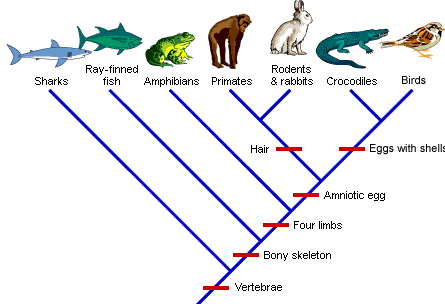
According to this cladogram, primates are most closely related to....
Amphibians
Rodents & rabbits
Crocodiles
Birds
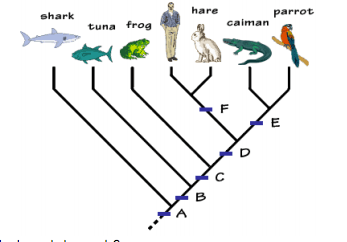
On the cladogram, which organism is the closest relative of the parrot?
Frog
Hare
Caiman
Parrot
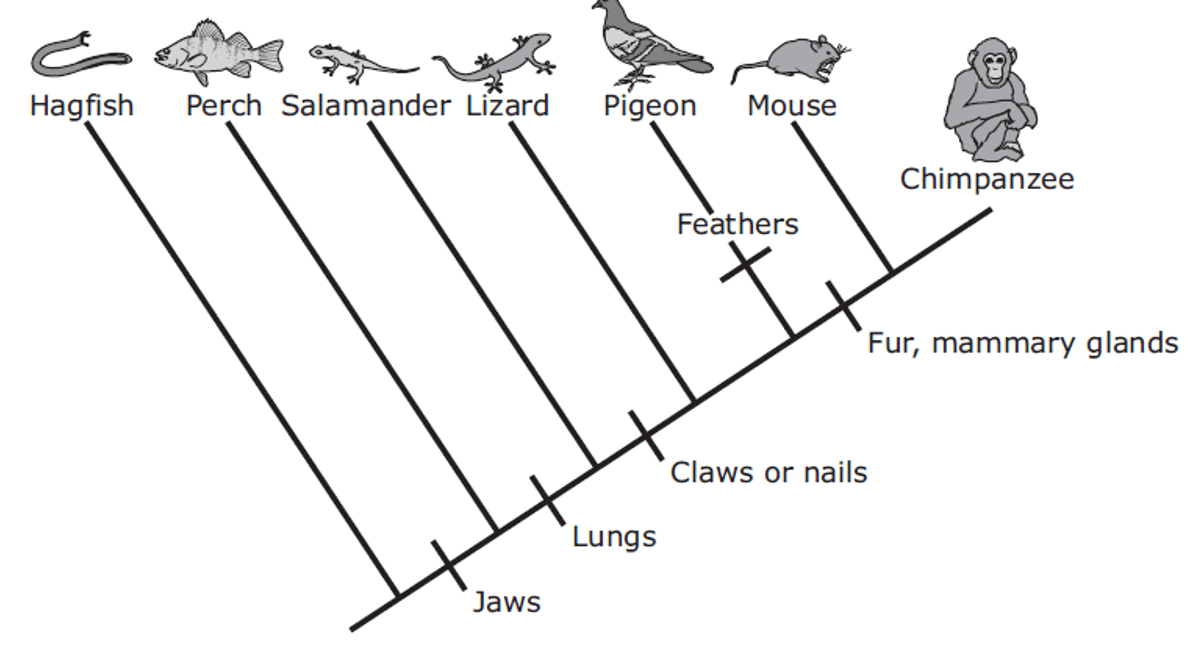
All the animals to the right of the salamander would have the common characteristic of...
Fur
Claws or nails
Lungs
Jaws

