wayground logo

Free Printable Worksheets

Font size

S
M
L
XL
Worksheets

What is Matter?

Total questions: 25

Worksheet time: 19mins
Name
Class
Date
1.

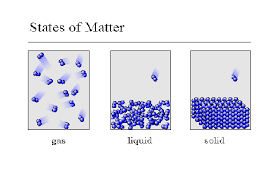
A gas

a)

has a definite shape but no definite volume

b)

has a definite volume but no definite shape

c)

has fast-moving particles

2.

Particles (atoms) in a ______________________ have more energy than the other states of matter.

a)

gas

b)

solid

c)

liquid

3.

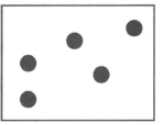
What does this picture represent?

a)

solid

b)

liquid

c)

gas

d)

plasma

4.
What does this picture represent? 
a)
solid
b)
liquid 
c)
gas
d)
plasma
5.

Which of the following is not a matter?

a)

a candle's heat

b)

a candle

c)

air inside a balloon

d)

a melting ice cream

6.
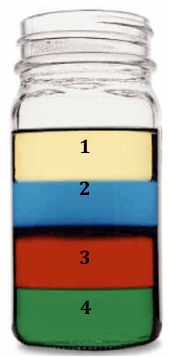
Put the liquids in order from most dense to least dense?
a)
4, 3, 2, 1
b)
1, 2, 3, 4
c)
3, 4, 2, 1, 
d)
4, 3, 1, 2
7.
What happens when my glass of water is sitting in the sun and disappears into a gas?
a)
evaporation
b)
burning
c)
melting
d)
freezing
8.
______________________ takes place when a liquid changes to a solid.
a)
freezing
b)
melting
c)
boiling
d)
sublimation
9.
At higher temperatures
a)
particles in an object have less energy
b)
particles in an object move faster
c)
a gas contracts
10.

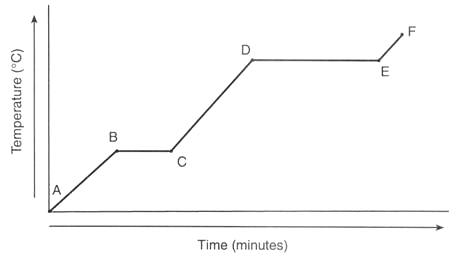
Where on the graph are phase changes taking place?

a)

1

b)

2

c)

3

d)

4

e)

5

11.
Endothermic phase changes include
a)
conduction, convection and radiation
b)
freezing and condensation
c)
vaporization and condensation
d)
melting, boiling, evaporation and sublimation
12.
Exothermic phase changes include
a)
conduction, convection and radiation
b)
freezing and condensation
c)
vaporization and condensation
d)
melting, boiling, evaporation and sublimation
13.

What is Kool-aid?

a)

elements

b)

heterogenous mixture

c)

homogeneous mixture

d)

compound

14.

What is salad?

a)

homogeneous

b)

heterogenous

15.

Pure oxygen is an example of...

a)

element

b)

mixture

c)

compound

16.

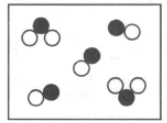
Classify the particle diagram.

a)

element

b)

compound

c)

mixture of elements

d)

mixture of compounds

e)

mixture of elements and compounds

17.

Classify the particle diagram.

a)

element

b)

compound

c)

mixture of elements

d)

mixture of compounds

e)

mixture of elements and compounds

18.
Example for chemical property
a)
malleability
b)
texture
c)
combustion
d)
sour taste
19.

This is an example of an intrinsic physical property of matter.

a)

density

b)

mass

c)

weight

d)

volume

20.

Identify the extrinsic property listed below.

a)

length

b)

taste

c)

density

d)

boiling point

21.
What is the process of separating products with densities?
a)
centrifugation
b)
chromatography
c)
heating
d)
decantation
22.
Separating particles based on size.
a)
chromatography
b)
decantation
c)
distillation
d)
Filtration
23.

A characteristic that can be observed or measured such as color, state, or hardness is referred to as a...

a)

Physical property

b)

Chemical property

c)

Physical change

d)

Chemical change

24.

What state/phase is the object likely from points A to B?

a)

Solid

b)

Liquid

c)

Gas

d)

Plasma

25.

Use the graph below to answer this question. What state of matter would the substance be at point F?

a)

solid

b)

liquid

c)

gas