
 Worksheets
Force and Motion
Total questions: 30
Worksheet time: 17mins

What change in motion will result from the forces modeled?
¿Qué cambio de movimiento resultará de las fuerzas modeladas?
No change
Sin cambios
The object will accelerate to the right
El objeto acelerará hacia la derecha.
The object will accelerate to the left
El objeto acelerará hacia la izquierda.
What would a model of the net force of the free body diagram below look like?
¿Cómo sería un modelo de la fuerza neta del siguiente diagrama de cuerpo libre?
No net force because the two forces are in opposite directions
No hay fuerza neta porque las dos fuerzas están en direcciones opuestas.
The arrow would be to the right but shorter than before
La flecha estaría hacia la derecha pero más corta que antes.
The arrow would be to the left because friction is slowing the object down
La flecha estaría hacia la izquierda porque la fricción está frenando el objeto.
A train moves at a constant speed down a straight track. Which of the following scientific explanations is true?
No forces act on the train as it moves
The train moves because no forces are acting against it
An unbalanced force keeps the train moving
The forces of the train's engine balance the force of friction opposing it
Forces that are equal in size but opposite in direction are called unbalanced forces.
Las fuerzas que son iguales en tamaño pero de dirección opuesta se llaman fuerzas desequilibradas.
True
Cierto
False
Falso
If a net force acts on an object, the object may change speed, change direction or do neither.
Si una fuerza neta actúa sobre un objeto, el objeto puede cambiar de velocidad, cambiar de dirección o no hacer ninguna de las dos cosas.
True
Cierto
False
Falso
Balanced forces acting on an object cause the object to accelerate.
Las fuerzas equilibradas que actúan sobre un objeto hacen que éste se acelere.
True
Cierto
False
Falso
When two forces act in the same direction on an object, the net force is found by _________the forces.
Cuando dos fuerzas actúan en la misma dirección sobre un objeto, la fuerza neta se encuentra _________las fuerzas.
adding
añadiendo
subtracting
sustraer
multiplying
multiplicando
dividing
divisorio
When two forces act in the opposite direction on an object, the net force is found by _________the forces.
Cuando dos fuerzas actúan en dirección opuesta sobre un objeto, la fuerza neta se encuentra _________las fuerzas.
adding
añadiendo
subtracting
sustraer
multiplying
multiplicando
dividing
divisorio
Friction always acts in a direction_________________ to the direction of motion.
La fricción siempre actúa en una dirección_________________ a la dirección del movimiento.
similar
similar
opposite
opuesto

What type of forces are seen in the picture?
¿Qué tipo de fuerzas se ven en la imagen?
balanced
equilibrado
unbalanced
desequilibrado

What type of forces are seen in the picture?
¿Qué tipo de fuerzas se ven en la imagen?
Balanced
equilibrado
Unbalanced
desequilibrado
Acceleration depends on which two factors?
mass and position
net force and mass
mass and velocity
position and net force

Calculate the net force of the object in the image shown.
Calcula la fuerza neta del objeto en la imagen que se muestra.
5 N to the left
5 N to the right
15 N to the left
15 N to the right

Calculate the net force of the object in the image shown.
Calcula la fuerza neta del objeto en la imagen que se muestra.
25 N to the left
25 N to the right
35 N to the left
35 N to the right

Calculate the net force of the object in the image shown.
Calcula la fuerza neta del objeto en la imagen que se muestra.
1 N up
1 N down
11 N up
11 N down

Calculate the net force of the object in the image shown.
Calcula la fuerza neta del objeto en la imagen que se muestra.
0 N
20 N left
20 N right
5 N right

Calculate the net force of the object in the image shown.
Calcula la fuerza neta del objeto en la imagen que se muestra.
7 N to the left
7 N to the right
17 N to the left
17 N to the right

Calculate the net force of the object in the image shown.
Calcula la fuerza neta del objeto en la imagen que se muestra.
20 N to the left
20 N to the right
10 N to the left
10 N to the right

Calculate the net force of the object in the image shown.
Calcula la fuerza neta del objeto en la imagen que se muestra.
11 N up
11 N down
37 N up
37 N down

Calculate the net force of the object in the image shown.
Calcula la fuerza neta del objeto en la imagen que se muestra.
0 N
10 N to the left
16 N to the right
16 N up

Calculate the net force of the object in the image shown.
Calcula la fuerza neta del objeto en la imagen que se muestra.
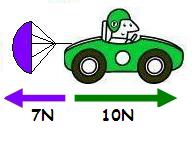
What is the net force?
Calcula la fuerza neta del objeto en la imagen que se muestra.
3 N
3 N, right
17 N, right
3 N, left

What is the net force?
Calcula la fuerza neta del objeto en la imagen que se muestra.

Forces that have a net force of zero Newtons
Fuerzas que tienen una fuerza neta de cero Newtons
Balanced force
equilibrada
Unbalanced force
desequilibrada
What will cause an object to move?
¿Qué hará que un objeto se mueva?
Applied forces
fuerzas aplicadas
Balanced forces
equilibrada
Unbalanced forces
desequilibrada
A force is a push or pull measured in what units?
Una fuerza es un empujón o un tirón medido en qué unidades?
Meters per second, squared
Metros por segundo, al cuadrado
Kilograms
kilogramos
When the vectors (arrows) point in the same direction what function do you use?
Cuando los vectores (flechas) apuntan en la misma dirección, ¿qué función usas?
Dividing
divisora
Multiplying
multiplicando
Subtracting
restando
Adding
agregando
When the vectors (arrows) point away what function do you use?
Cuando los vectores (flechas) apuntan hacia afuera, ¿qué función usas?
Dividing
Multiplying
Subtracting
Adding

Are the forces balanced?
¿Están equilibradas las fuerzas?
yes
no
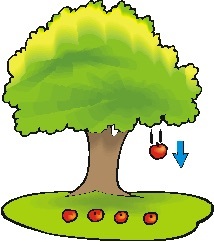
The FORCE that PULLS things down or back to EARTH.
La FUERZA que TIRA las cosas hacia abajo o hacia la TIERRA.
Speed
sappad
Gravity
gravedad

