wayground logo

Free Printable Worksheets

Font size

S
M
L
XL
Worksheets

Circuits - AP Review

Total questions: 27

Worksheet time: 5hrs 6mins

Name
Class
Date
1.

What is a circuit that only has ONE path for electricity to flow?

a)

series circuit

b)

closed circuit

c)

parallel circuit

d)

light bulb

2.
Will the light bulb in this circuit light and why/why not?
a)
yes, because it has two batteries
b)
no, because the switch is open
c)
yes, because it is in a circuit
d)
no, because the bulb is burned out
3.
The picture shows an electrical circuit. This circuit is a series circuit because: 
a)
It has 3 light bulbs.
b)
The same current flows through all three light bulbs.
c)
It uses a single battery.
d)
The electrical current is divided between the three light bulbs.
4.
What will happen if one light bulb is removed from this circuit?
a)
The other bulbs will go out.
b)
The other bulbs will stay on
c)
The other bulbs will get dimmer.
d)
The battery will become stronger.
5.
What kind of circuit is this?
a)
Series
b)
Consecutive
c)
Parallel
d)
Training
6.
what is this symbol for?
a)
light bulb
b)
switch
c)
battery
d)
resistor
7.
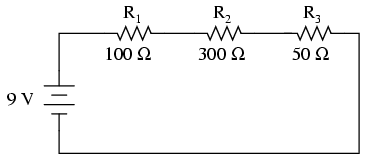
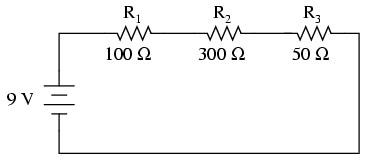
The total resistance in this circuit is 
a)
100 ohms
b)
450 ohms
c)
400 ohms
d)
30 ohms
8.
The total current through this circuit is
a)
0.02 amps
b)
0.09 amps
c)
50 amps
d)
9 amps
9.
The voltage dropped across the 300 ohm resistor is 
a)
6 V
b)
9 V
c)
2 V
d)
30 V
10.
As resistors are added in series to a circuit, the total resistance will...
a)
increase
b)
decrease
c)
stay the same
11.
As the resistance of a circuit increases, the current will...
a)
increase
b)
decrease
c)
stay the same
12.
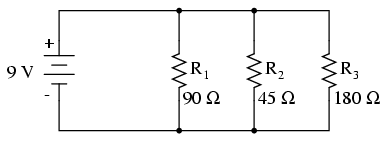
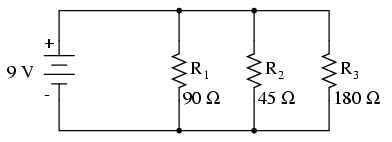
In a parallel circuit which of the following is the same value throughout the circuit?
a)
Voltage
b)
Current
c)
Resistance
d)
Charge
13.
The current going through the 45 ohm resistor is 
a)
0.05 amps
b)
0.2 amps
c)
0.1 amps
d)
5 amps
14.
The total resistance of this circuit is 
a)
25.7 ohms
b)
315 ohms
c)
324 ohms
d)
90 ohms
15.

Four unequal resistors are connected in a parallel with each other. Which one of the following statements is correct about this combination?

a)

The equivalent resistance is less than that of the smallest resistor.

b)

The equivalent resistance is equal to the average of the four resistances.

c)

The equivalent resistance is midway between the largest and smallest resistance.

d)

The equivalent resistance is more than the largest resistance.

e)

None of the other choices is correct.

16.

When unequal resistors are connected in parallel in a circuit,

a)

the same current always runs through each resistor.

b)

the potential drop is always the same across each resistor.

c)

the largest resistance has the largest current through it.

d)

the power generated in each resistor is the same.

17.
What is one problem with using a series circuit? 
a)
It has a lot of series. 
b)
If one light goes down, they all go down! 
c)
It doesn't work properly.
d)
There are no problems. 
18.
What is a benefit of using a parallel circuit?  
a)
It gets confusing.
b)
There are no problems.
c)
If one light goes out, it does not affect the others. 
d)
If one light goes out, they all go out. 
19.
An ammeter is a device that can be used to measure
a)
Current
b)
Voltage
c)
Resistance
d)
Power
20.
What is the missing current?
a)
Both 0.25A
b)
Both 0.5A
c)
0.2A and 0.3A
d)
0.1A and 0.4A
21.

Match the following circuit elements to their symbols.

a)
1.

battery

b)
2.

lamp

c)
3.

resistor

d)
4.

switch

e)
5.

ammeter

22.

“The current through each individual element is the same as the current through the combination ( Icombination=IA=IB=...I_{combination}=I_A=I_B=...   )” is true for which kind of combination?

a)

Series combination

b)

Parallel combination

23.

What is the total resistance in the circuit?

a)

10 ohms

b)

6 ohms

c)

4 ohms

d)

2.4 ohms

24.

What is the total current through the battery?

a)

0.75 A

b)

1.5 A

c)

3 A

d)

0.33 A

25.

What is the current through the 2 ohm resistor?

a)

0.75 A

b)

1.5 A

c)

3 A

d)

0.33 A

26.

Solve for total circuit resistance

a)

140 Ohms

b)

75 Ohms

c)

90 Ohms

d)

65 ohms

27.

Solve for the voltage drop at resistor one

a)

10 V

b)

8 V

c)

3.08 V

d)

3.85 V