
NEW
Font size
 Worksheets
2nd 9 weeks Review
Total questions: 20
Worksheet time: 43mins
You have to push with 15 N of force to move it 10 meters. How much work do you do?
15 Joules
150 Joules
1.5 Joules
.67 Joules
You exert 200 J of work by pulling on an object with 20 N of force. What distance is the object moved?
.01 m
10 m
10 J
4,000 m

Ahmed is out with his friends. Misfortune occurs and Ahmed and his friends find themselves getting a workout. They apply a cumulative force of 1000 N to push the car 200 m out of the sand. Determine the work done on the car.
2 x 10⁵ J
2.70 x 10⁴ J
3.2 x 10⁻⁴ J
3.54 x 10⁵ J
Which of the following is defined as an energy transfer?
kinetic energy
work
potential energy
chemical energy

Four students run up the stairs in the time shown. Which student has the largest power output?
A
B
C
D
Work is defined as applying a force on an object that displaces the object in the direction of the applied force. Which of the following IS NOT an an example of work being done on an object?
A waiter walking with a tray of food that he is holding with his hand under the tray.
A horse pulling a plow through a field.
A shopper pushing a cart down the aisle of a grocery sture.
A weightlifter lifting a barbell above his head.
If a system is isolated, the total energy of the system
Increases constantly.
Decreases constantly.
Is constant.
Depends on the work done on the system.
Depends on the work done by the system.
Energy stored because of gravity is called:
Gravitational Potential Energy
Kinetic Energy
Mechanical Advantage
Chemical Energy
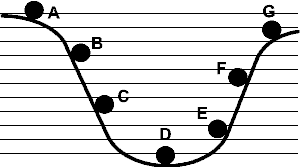
At which point does the ball has the greatest gravitational potential energy (GPE)?
A
G
D
C
G
Which would have the LEAST gravitational potential energy (GPE)?
A ball sitting on the ground
Moon viewed from the Earth
An airplane flying 30,000 feet above the ground
A rock sitting on top of Mt. Everest
How could you increase the gravitational potential energy of an object without changing its mass and gravity?
Make the object larger
Lower the object towards the ground
Raise the object farther off the ground
Allow the object to roll on the ground
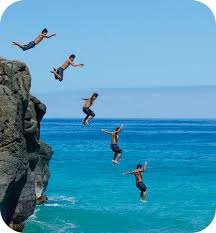
A cliff diver with a mass of 125 kg jumps off a 50m high cliff, how fast will he be traveling just before he hits the water? (His height at this point is 0m)
(HINT: Find PE first. then KE = 1/2mv2
g = 9.8 m/s2
61,250 m/s
980 m/s
31.3 m/s
247.5 m/s

What is the Total Energy at the top?
15,000 J
3,750 J
7,500 J
11,250 J
What is the KE 1/2 of the way down?
15,000 J
3,750 J
7,500 J
11,250 J
What is the KE at the bottom?
15,000 J
3,750 J
7,500 J
11,250 J
A 10.0 kg box is accelerated from 2.0 m/s to 4.0 m/s. What is the amount of work needed to accelerate the box?
50 J
60 J
20 J
45 J
Work is equal to the change in _______
Kinetic Energy
Potential Energy
Total Mechanical Energy
Power
The equation for POWER is
power = mass x time
power = work / time
power = time / work
power = work x time
Energy cannot be ________ or ___________.
big/small
left/right
created/destroyed
made/transferred

