wayground logo

Free Printable Worksheets

Font size

S
M
L
XL
Worksheets

US History LIA II

Total questions: 180

Worksheet time: 3hrs 19mins

Name
Class
Date
1.

Which president wanted to control businesses and conserve the environment?

a)

William McKinley

b)

Abraham Lincoln

c)

Theodore Roosevelt

d)

Franklin D. Roosevelt

2.

During the early 1900s, the term "muckrakers" was used to describe-

a)

pacifists who demonstrated against war

b)

Politicians who criticized Progressive Era presidents

c)

Writers who exposed the evil in American society

d)

Newspaper columnists who reported in celebrities

3.
Susan B. Anthony and Elizabeth Cady Stanton are most closely associated with the idea that-
a)
Settlement houses should be built to help educate immigrants
b)
National Parks should be created by the federal government
c)
factories should be prohibited since they damage society
d)
suffrage should be granted to women
4.
The most significant effect of minor political parties in the United States during the early twentieth century was that they-
a)
influenced only local levels of government
b)
had little impact on the major parties
c)
suggested reform ideas that later became laws
d)
Elected many of their party leaders to the presidency
5.
Ida Tarbell, Upton Sinclair, and Frank Norris all shared a belief that-
a)
The public was unlikely to respond to calls for reform
b)
The government should follow a laissez-faire policy
c)
Reform was needed to control abuses of business
d)
Monopolies were necessary for business to survive
6.
The Progressive Movement supported the idea that the federal government should-
a)
Reduce the number of farms
b)
Build an overseas empire
c)
Regulate big business
d)
Reduce immigration
7.
Civil service reform in the late nineteenth and early twentieth centuries was a reaction to which of the following issues?
a)
the dwindling influence of political machines
b)
the emergence of single-issue third parties
c)
the corrupt and inefficient distribution of government jobs by political machines
d)
the ignorance of voters who elected well-meaning but incompetent public officials
8.
Jane Addams, Lillian Wald, and Jacob Riis are best known as
a)
leaders of industry
b)
social reformers
c)
congressional leaders
d)
inventors
9.
During the Progressive Era, Jane Addams responded to urban conditions by working to establish-
a)
free public schools located in inner-city neighborhoods
b)
settlement houses that provided assistance to the poor
c)
newspapers that helped to inform Americans about slum conditions
d)
laws that restricted certain immigrant groups
10.
The initiative, the referendum, and the recall were adopted by several states during the Progressive Era as ways to-
a)
restrict the use of presidential vetoes
b)
promote the formation of trusts
c)
make government more democratic
d)
limit immigration
11.
During which period in United States history were the amendments concerning the income tax, direct election of senators, Prohibition, and women's suffrage enacted?
a)
Reconstruction
b)
New Deal
c)
Progressive Era
d)
Gilded Age
12.
In the early 1900s, the muckrakers provided a service to the American public by-
a)
encouraging states to resist federal government authority
b)
lobbying for less government regulation of business
c)
revealing abuses in government and industry
d)
calling for a strong military buildup
13.
In the early 1900s, which group most often supported the views of the Populist Movement
a)
Factory owners
b)
Nativists
c)
Labor Unions
d)
Farmers
14.
What federal agency was established in 1916 by Congress to manage national historic sites?
a)
National Park Service
b)
Department of the Interior
c)
Bureau of Outdoor Recreation 
d)
Civilian Conservation Corps
15.
What was the main different between W.E.B. DuBois and Booker T. Washington?
a)
DuBois wanted the African American Community to get an education in order to fight inequality, while Washington believed inequality would end naturally
b)
Washington wanted the African American community to get an education in order to fight inequality, while DuBois believed inequality would end naturally
c)
Washington wanted free education for all people, while DuBois believed in private education
16.
Which of the following is not one of Roosevelt's Square Deal?
a)
Conserve resources
b)
Protect the consumer
c)
Control businesses
d)
Create new jobs
17.
What act did The Jungle help establish?
a)
Pendleton Act
b)
Pure Food and Drug Act
c)
Federal Reserve Act
d)
Dawes Act
18.
Which amendment gave women the right to vote?
a)
16th Amendment
b)
17th Amendment
c)
18th Amendment
d)
19th Amendment
19.

The Temperance Movement, Women’s Suffrage Movement, and outlawing child labor were reform movements that took place during this era-

a)

Gilded Age

b)

Imperialism

c)

Progressive Era

d)

Roaring 20's

20.

These reforms made the government directly accountable to the citizens.

a)

Referendum, recall, initiative, and 17th amendment

b)

19th and 22nd Amendments

c)

Pendleton Act & Homestead Act

d)

16th and 18th Amendments

21.

People like Upton Sinclair were ___________________ because they investigated and exposed abuse and corruption.

a)

Supporters of Political Machines

b)

Nativists

c)

Muckrakers

d)

Industialists

22.

Which agency did the federal government establish to protect consumer’s safety as a response to Upton Sinclair’s The Jungle?

a)

Pure Food and Drug Administration

b)

NAACP

c)

National Park Service

d)

Environmental Protection Agency

23.

What organization did W.E.B. Dubois establish to help secure legal equality for minorities?

a)

Muckrakers Movement

b)

Black Panthers

c)

NAACP

d)

SNCC

24.

What legislation allowed the government to regulate big businesses like railroads and dissolve monopolies?

a)

Pure Food and Drug Act & Chinese Exclusion Act

b)

Civil Rights Act 1964 & Voting Rights Act 1965

c)

Homestead Act & Dawes Act

d)

Sherman Anti-Trust Act & Interstate Commerce Act

25.

What civil service reform legislation led to less corruption in the government because it established a merit-based system for government jobs?

a)

Interstate Commerce Act

b)

Pendleton Act

c)

Teapot Dome Scandel

d)

Pure Food & Drug Act

26.
My first presidential platform was the  "Square Deal" 
a)
Wilson
b)
Debs
c)
Taft
d)
Roosevelt
27.
I was handpicked as Roosevelt's successor.
a)
Taft
b)
Wilson
28.
I was the youngest president (at the time) and the most popular progressive president!
a)
Taft
b)
Wilson 
c)
Roosevelt
29.
One of the major goals of the Pure Food and Drug Act of 1906 was to
a)
limit the amount of sugar in snack products.
b)
protect farmers from bankruptcy due to changing food prices.
c)
control the price put on beverages and food products.
d)
ensure that products were labeled accurately.
30.
Which Constitutional amendment provided for Prohibition (conservative social progressives)?
a)
16th
b)
17th
c)
18th
d)
19th
31.
I created the modern banking system by the establishment of the federal reserve system.
a)
Roosevelt
b)
Wilson 
c)
Taft
32.
I  passed the 17th, 18th and 19th amendments
a)
Taft 
b)
Wilson
c)
Roosevelt
33.
Initiative, referedum, recall were all intended to
a)
make president more responsive
b)
reduce influence of media
c)
give political parties more control
d)
increase citizen participation in govt. 
34.
I won the split Election of 1912!
a)
Taft
b)
Wilson
c)
Roosevelt 
35.
I formed the Bull Moose Party
a)
Taft 
b)
Wison 
c)
Roosevelt 
36.
Many Progressives opposed social Darwinism because it promoted the idea that
a)
people in lower classes were not capable of economic success
b)
immigration weakened national unity
c)
the government should take responsibility for the well-being of people
d)
poverty could be eradicated through increased economic regulation
37.
Key Reforms of the Progressive Era
·  Initiative
·  Referendum
·  Recall
·  Direct Primary
·  17th Amendment

 
How did the reforms listed above impact America?
a)
A system of separate schools for new immigrants
b)
They gave citizens a greater voice in the democratic process of government
c)
More sources of revenue and taxes in state governments.
d)
They successfully brought economic relief to the urban working class
38.
What amendment provided suffrage for women (1920)?
a)
16th
b)
17th
c)
18th
d)
19th
39.
Who became president after William McKinley was assassinated?
a)
Andrew Johnson
b)
Franklin Roosevelt
c)
Ulysses Grant
d)
Theodore Roosevelt
40.
His involvement in which war, as commander of the Rough Riders, made Teddy Roosevelt famous?
a)
Civil War
b)
Spanish American War
c)
World  War I
d)
Vietnam War
41.
What was the name of William H. Taft's foreign policy approach that encouraged companies to build railroads, post offices, and government buildings in countries they wanted to do business with?
a)
Dollar Diplomacy
b)
Moral Diplomacy
c)
Big Stick Diplomacy
d)
none of the above
42.

What was significant about the creation of settlement houses during the progressive era?

a)

they gave every newly arriving immigrant a place to live

b)

they gave newly freed slaves a chance to start new in the West

c)

they gave rich industrialists a chance to be seen as philanthropists

d)

they gave poor people a chance to adapt and learn social norms in large cities

43.

Which of the following served to aid the disenfranchisement of blacks during this Jim Crow era

a)

literacy test

b)

grandfather clause

c)

property test

d)

poll tax

44.

Which figure below is synonymous with civil disobedience and women's suffrage?

a)

Ida Tarbell

b)

Susan B. Anthony

c)

Ida Wells

d)

Carrie Nation

45.

"I aimed at the public's heart and accidentally hit them in the stomach" -Upton Sinclair


What did Sinclair mean by this quote?

a)

He wanted to gross readers out to bring about change

b)

He wanted to evoke emotion and sympathy for factory workers

c)

He wanted laws to be passed to protect undercover journalists

d)

He wanted the factory owners to be exposed and jailed

46.
What was an important effect of the influx of people from the country to the cities in the late nineteenth century?
a)
a sharp increase in college enrollment
b)
crowded slums and unsanitary conditions
c)
decline in economic growth
d)
 a large amount of unused farmland
47.
New immigrants arriving on the East coast gained admission at 
a)
Angel Island 
b)
Ellis Island 
c)
Boston Harbor
d)
Charleston Island
48.
Which goal, set a a women's convention in Seneca Falls in 1848, was finally achieved during the Progressive Era?
a)
passage of the Food and Drug Act
b)
creation of the Interstate Commerce Commission
c)
adoption of a graduated income tax
d)
ratification of the Nineteenth Amendment
49.
The main goal of the Chinese Exclusion Act was to 
a)
 decrease Chinese immigration
b)
create segregated classrooms
c)
settle a disagreement between China and the United States
d)
stop Chinese Americans from attending school in the United States
50.
A goal of the Granger and Populist movements was to
a)
expand rights for African Americans
b)
help western farmers fight unjust economic practices
c)
 provide support for the banking industry
d)
enable big business to expand without government interference
51.
How were the Interstate Commerce Act, the Sherman Antitrust Act and the Clayton Antitrust Act similar
a)
They authorized the breakup of labor unions
b)
They rejected the use of trust-busting strategies
c)
They increased the federal government's power to regulate business practices
d)
They reaffirmed the federal government's laissez-faire attitude toward big business
52.
During the Progressive Era, many state and local governments adopted the initiative, referendum, and recall. Together these procedures -
a)
extended the righ to vote to 18-year old citizens
b)
gave citizens a more direct voice in government
c)
let registered voters select each state's Presidential electors
d)
allowed a state's residents to bring lawsuits against another state
53.

What is domination by one country of the political, economic, or cultural life of another country or region

a)

Imperialism

b)

Industrialization

54.

US entered war to gain control of Puerto Rico, Guam, Cuba, and the Philippines in this war...

a)

Rico War

b)

Spanish American War

c)

War on terrorism

d)

Island war

55.

The view that a nations most "fit" to survive had the right to dominate others

a)

Dominator

b)

Survivalist

c)

Social Darwinism

d)

Winner

56.
Industrialization affected the relationships between industrialized nations and non-industrialized nations because it
a)
was the driving force behind imperialism. 
b)
weakened economic ties between nations. 
c)
allowed industrialized nations to take slaves. 
d)
enabled the two types of nations to strengthen each other.
57.
The visit of Commodore Perry encouraged the Japanese to 
a)
close its ports to all Western traders. 
b)
declare war on Russia to gain Korea as a buffer zone. 
c)
open a port to trade with the United States
d)
try to build its own modern navy before Perry's return. 
58.

What is the type of sensational reporting where writers exaggerated or even invented stories?

a)

muckraking

b)

yellow journalism

c)

journalism

d)

reporting

59.
Economic motives for imperialism include _________.
a)
a desire to spread Christianity
b)
a need for military bases around the world
c)
a need for raw materials to be used in factories
d)
a desire to gain glory
60.
Why was the Spanish-American War fought?
a)
The US wanted to help Cuba gain independence from Spain so that the US could have access to Cuba's natural resources
b)
The US blamed to sinking of the USS Maine on Spain
c)
The Spanish Ambassador wrote a letter criticizing the president
d)
All of these
61.
What was the event that ignited the Spanish-American War?
a)
Explosion of the USS Arizona
b)
Sinking of the USS Maine
c)
Sinking of the Lusitania
d)
Russia
62.
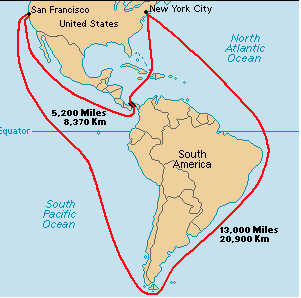
What does this map support?
a)
US fought the Spanish navy in Atlantic and Pacific
b)
Spanish-American War led to new US territories
c)
America became a colonial power in South America by surrounding it
d)
Panama Canal is critical to US trade
63.
What is being depicted in this cartoon?
a)
President Roosevelt's foreign policy
b)
President Taft's diplomacy
c)
Panama Canal policy
d)
Treaty of Paris 1898 acquisitions
64.

Why did the United States acquire Hawaii?

a)

The US wanted volcanoes

b)

To use the islands as a naval base, and for its sugar

c)

to create a naval base during World War II

d)

to assist Queen Liliuokalani take control of the islands

65.

What was a result of headlines like the one above?

a)

World War I begin

b)

The Spanish-American War

c)

The US entered World War I

d)

The Union defeated the Confederacy

66.

What were the two main locations of fighting during the Spanish-American War?

a)

Alaska and Hawaii

b)

Puerto Rico and Guam

c)

Cuba and the Philippines

d)

Spain and the United States

67.

Which policy gave US the right to be the "policemen of the Western Hemisphere"

a)

Roosevelt Corollary

b)

Good Neighbor Policy

c)

Open Door Policy

d)

Marshall Plan

68.

Why did Theodore Roosevelt help support a revolt against Columbia?

a)

Columbia refused to comply with trade agreements

b)

He wanted to establish a naval base in Columbia

c)

He wanted to establish a colony in Columbia

d)

He wanted to build the Panama Canal

69.
President McKinley and the American people were finally convinced to wage war against the Spanish after the mysterious explosion of the:
a)
HMS Beagle
b)
USS Olympia
c)
Spanish Armada
d)
USS Maine
70.

President Theodore Roosevelt said “Speak softly and carry a big stick.” His big stick was a reference to

a)

a. joining military alliances to carry out foreign policy goals

b)

using the navy to accomplish foreign policy goals

c)

a. using the national forests to stimulate building projects

d)

a. supporting woman suffrage to expand civil rights
71.

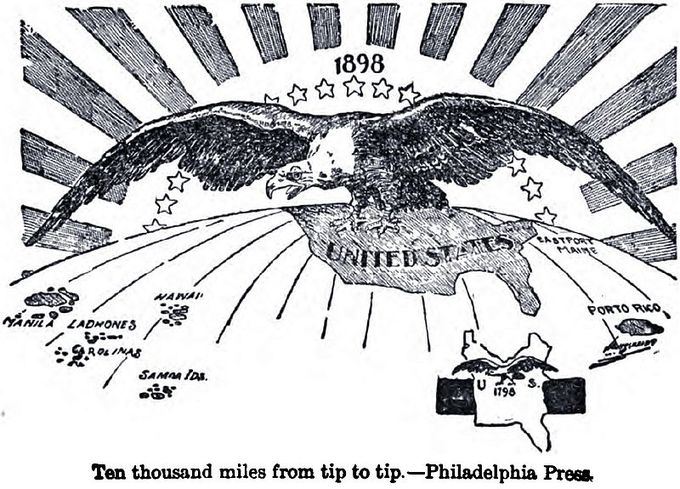
This image is a representation of...

a)

US Exploration

b)

US Diplomacy

c)

US War Relations

d)

US Imperialism

72.

Before 1898, most American had opposed imperialism. Why did imperialism suddenly become more popular in the US by the end of the century?

a)

Americans felt it was against the principles of democracy to rule over others.

b)

Americans wanted to sell goods to new markets and buy raw materials for new industries.

c)

Americans wanted to rule others because America had once been a British colony.

d)

Americans feared imperialism would bring the United States into conflict with other powers.

73.

Why is the Spanish American War of 1898 often considered a major turning point in US history?

a)

It revealed the US had become a world power.

b)

It marked the first American victory over a European country.

c)

It demonstrated the need for better communications in wartime.

d)

It showed American support for European economic interests in East Asia.

74.

Which exiled Cuban leader raised money in Ybor City and other cities in Florida to organize a new revolt against Spanish rule in Cuba?

a)

Enrique Dupuy de Lome

b)

Vicente Martinez Ybor

c)

Emilio Aguinaldo

d)

Jose Marti

75.

Which Florida city served as the main port of embarkation for the "Rough Riders" and other American forces sent to Cuba during the Spanish-American War?

a)

Orlando

b)

Jacksonville

c)

Tampa

d)

Miami

76.
World War I began in ____ and ended in _____.
a)
1914, 1917
b)

1917, 1918

c)
1914, 1918
77.
How did the Zimmerman Telegram influence U.S. entry into World War I?
a)
It announced the czar's overthrow in Russia
b)
It revealed a proposed military alliance between Mexico and Germany
c)
It contained orders for German u-boats to attack British passenger ships
d)
It described Romania's plan to abandon neutrality
78.
Why did the United States decide to enter World War I?
a)
The United States had suffered economically from European sanctions
b)
A European nation had taken aggressive actions against the United States
c)
The U.S. president was obligated to fulfill campaign promises
d)
Communist activities among U.S. immigrants were threatening the country
79.
The Fourteen Points reflected Woodrow Wilson's belief that-
a)
Intervention in the affairs of other nations were never justifiable
b)
Travel among nations should be regulated by an international organization
c)
No country should be allowed to spend more on defense than any other country
d)
Cooperation among international leaders was essential to world peace
80.
What does the M in M.A.I.N stand for?
a)
Money
b)
Missiles
c)
Militarism 
d)
Martialism  
81.
What does the in M.A.I.N stand for?
a)
Allegiance
b)
Assignment
c)
Alliances 
d)
Aliens
82.
What does the I in M.A.I.N stand for?
a)
Isolationism 
b)
Inspectionism 
c)
Inception  
d)
Imperialism 
83.
What does the N in M.A.I.N stand for? 
a)
Nationalism
b)
Nation
c)
Negligence
d)
Newism 
84.
WWI was the first total war in history. What is total war?
a)
everything was open to fighting, including civilians and cities
b)
the first time the army, navy, and air force were used together
c)
every country in the world was involved in fighting
d)
all of a country's money would go totally to war
85.
Archduke Franz Ferdinand was heir to the throne in
a)
Germany
b)
Italy
c)
Austria-Hungary
d)
Serbia
86.
One of the first countries to jump to the defense of Serbia was:
a)
Russia
b)
Germany
c)
France
d)
Britian
87.
The following countries make up which alliance system: Austria-Hungary, Germany, & Ottoman Empire
a)
Triple Entente
b)
Allies
c)
Central Powers
d)
Axis
88.
What was the land between two enemy trenches called?
a)
No Man's Land
b)
His brother's land
c)
Auntie Anne's Land
d)
Pen Cattle
89.
Who was the president during WWI?
a)
Teddy Roosevelt
b)
William McKinley
c)
Herbert Hoover
d)
Woodrow Wilson
90.
Who is to blame for the war according to the Treaty of Versailles?
a)
Great Britain
b)
France
c)
Germany
d)
Serbia
91.
What was a nickname given to WWI?
a)
The Big War
b)
The Bad War
c)
The Great War
d)
The Worldly War
92.
How did Germany's policy of unrestricted submarine warfare anger the American people?
a)
American companies lost a lot of money when British ships were sunk.
b)
When the Lusitania was sunk, 128 Americans were killed.
c)
The American people did not like having goods made in Germany.
d)
The Germans did not want America to trade with enemy countries. 
93.
A major goal of France and Great Britain at the peace treaty conference at the end of the war was to make sure Germany:
a)
was rebuilt and strong again
b)
could not rebuild its military strength
c)
became wealthy and industrialized
d)
strengthened its colonies
94.
The League of Nations was created after World War One; as an international, world wide:
a)
peace keeping organization
b)
banking system
c)
health organization
d)
delivery system
95.
What are two ways the Treaty of Versailles punished Germany severely?
a)
It divided Germany into four separate, occupied zones.
b)
It supported economic help given to Germany by the U.S.
c)
It took away German territory in Spain and Russia.
d)
It forced Germany to accept blame for the war and to pay reparations.
96.
This was a German offer of an alliance with Mexico.
a)
Sedition Act
b)
Zimmerman Note
c)
Sussex Pledge
d)
Fourteen Point
97.
What is the policy of building up armed forces in aggressive preparedness for war?
a)
Militarism
b)
Nationalism 
c)
Imperialism
d)
Alliances
98.
What is a devotion to the interests and culture of one's nation?
a)
Imperialism
b)
Alliance
c)
Nationalism
d)
Militarism
99.
What were the three areas that trench warfare covered by the end of 1914?
a)
Belgium Waffles, France and Spain
b)
UK, Germany, and Russia
c)
Belgium, France, and North Sea
d)
North Sea, UK, and United State
100.
What was the land between two enemy lines called?
a)
No Man's Land
b)
His brother's land
c)
Auntie Anne's Land
d)
Pen Cattle
101.
What caused the U.S. and German relations to deteriorate in 1915?
a)
German invasion of Belgium
b)
German blockade
c)
Sinking of the Lusitania
d)
German embargo on U.S. goods
102.
The Allied cause was dealt a hard blow during World War I when Russia
a)
allied with Germany.
b)
invaded Sweden.
c)
denounced the United States.
d)
signed a peace treaty with Germany.
103.
Which group of countries allied themselves to form the Triple Entente (Allies) in the years before World War I?
a)
Britain, France, and Austria-Hungary
b)
Germany, Austria-Hungary, and the Ottoman Empire
c)
Russia, Germany, and Italy
d)
Britain, France, and Russia
104.
The invasion of what country caused Britain to join WWI?
a)
Luxembourg 
b)
France
c)
Spain
d)
Belgium
105.
Which event sparked World War I?
a)
the German-French dispute over Alsace-Lorraine
b)
Russia’s quest for a warm water port
c)
assassination of the heir to the Austro-Hungarian throne
d)
sinking of the Lusitania
106.
Who was Vladimir Lenin?
a)
Communist leader of Russia
b)
Socialist arrested in the US
c)
Democratic presidential candidate
d)
Head of the Committee of Public Information
107.
What was one of the three reasons United States joined the war?
a)
Germany bombed America
b)
Britain declared war on the U.S. 
c)
Germany used unrestricted submarine warfare
d)
France invaded Germany
108.
Which of the following was not a main cause of WWI?
a)
Militarism
b)
Imperialism 
c)
Alliances
d)
Progressivism
109.
What British ship got sunk in 1915?
a)
Lusitania 
b)
USS Maine
c)
Disney Cruise Ship
d)
Titanic
110.
On what day did the US join WWI?
a)
December 25, 1917
b)
April 6, 1917
c)
February 2, 1917
d)
October 31, 1917
111.
During WWI, most battles were fought on the Western Front. Near what country was it located?
a)
England 
b)
France
c)
Italy
d)
Russia
112.

The Roaring Twenties were characterized by-

a)

internment camps, the rationing of goods, and the first use of an atomic bomb

b)

bank failures, the New Deal, and bread lines

c)

installment plans, prohibition, and flappers

d)

brinkmanship, McCarthyism, and a policy of containment

113.

Which pull factor contributed to the Great Migration?

a)

The availability of land grants for homesteaders

b)

Economic opportunities in industrialized cities

c)

Better soil conditions in previously uncultivated areas

d)

The lower cost of living in urban areas

114.

During the 1920s, what was one result of innovations in US transportation technology?

a)

Commercial airplanes replaced ocean liners as the primary means of travel to Europe.

b)

Mass-produced automobiles made travel more affordable for many people.

c)

Cable cars provided a comfortable means of quick travel to any city within a state.

d)

Container ships delivered agricultural goods to ports along the Pacific coast.

115.

The establishment of speakeasies in the 1920's was an unintended consequence of which federal government action?

a)

The taxation of imported luxury goods

b)

The deportation of suspected communist sympathizers

c)

The prohibition of the sale of alcoholic beverages

d)

The implementation of immigration restrictions

116.

Which inference about the 1920s is supported by this illustration?

a)

Women confronted discrimination in employment and education.

b)

Women challenged traditional attitudes and social norms.

c)

Reform organizations targeted women's issues.

d)

Mass media reflected trends popular in rural communities.

117.

Attorney-General A. Mitchell Palmer conducted a series of raids... The most spectacular of the "Palmer Raids" occurred in January 1920.

-"Start-up of the Department and WWI, 1913-1921," U.S. Department of Labor, www.dol.gov (accessed November 21, 2013)


What was the primary reason for the raids described in this excerpt?

a)

To prevent workers from joining labor organizations

b)

To block civil rights advocates from staging public protests

c)

To suppress the teaching of evolution in college

d)

To halt the spread of communist ideas by radicals

118.

Cartoons such as this one took the position that deportation was necessary because-

a)

assimilation programs in the United States had been unsuccessful

b)

economic decline had increased the competition for jobs

c)

communists were infiltrating the United States

d)

political machines had too much power in urban areas

119.

Which of these resulted from the prohibition of alcohol during the 1920s?

a)

A decline in immigration rates

b)

A growing fear of communism

c)

The expansion of the consumer economy

d)

The rise of organized crime

120.

This 1924 cartoon satirizes a scandal that led to-

a)

public disappointment over revelations of government corruption

b)

widespread dissatisfaction with a lack of economic development

c)

public frustration with government neglect of the working class

d)

widespread anger over excessive partisan politics

121.

Which headline describes a consequence of the Teapot Dome scandal?

a)

A

b)

B

c)

C

d)

D

122.

Which of the following identifies two effects of the Harlem Renaissance?

a)

o Increased geographic concentration of African Americans

o Increased popularity of venues featuring African American Artists

b)

o Founding of colleges for African Americans

o Founding of the Socialist Party

c)

o Founding of Tuskegee University

o Migration of African Americans to western states

d)

o Ratification of constitutional amendments ensuring right for African Americans

o Increased support for the prohibition of alcoholic beverages

123.

1908- Ford begins manufacturing the Model T.

1913- Ford Introduces the first moving automobile assembly line.

1914- The Ford Motor Company doubles worker pay to $5.00 a day and cuts the length of a shift from 9 hours to 8.

1921- The Ford Motor Company accounts for 55 percent of the automotive industry's total production.


How did the events on this time line affect US businesses?

a)

Profit sharing became a standard practice for industrial corporations.

b)

Monopolistic practices were abolished by federal legislation.

c)

Mass-manufacturing techniques were adopted to maximize production

d)

Retirement plans were guaranteed to factory workers.

124.
Who was targeted for discrimination during the Red Scare?
a)
Immigrants
b)
African Americans
c)
Jews
d)
Migrant Workers
125.
Who invented the assembly line and made production more efficient?
a)
FDR
b)
Thomas Edison
c)
Eli Whitney
d)
Henry Ford
126.
What is the word for anti-immigrant attitudes?
a)
isolationism
b)
Neutrality
c)
Nativism
d)
Federalism
127.
What is a tax on imports?
a)
Payroll Tax
b)
tariff
c)
Trust
d)
Pension
128.
What scandal during Warren Harding led a member of his cabinet to go to jail?
a)
Cabaret Scandal
b)
Speakeasy Scandal
c)
Teapot Dome Scandal
d)
Big Oil Scandal
129.
What did Harding promise America in the election of 1920?
a)
No income tax
b)
lower wages
c)
no immigrants
d)
Return to Normalcy
130.
What did people want the Return to Normalcy to focus on
a)
Social Issues
b)
Foreign Policy
c)
Domestic Economic Issues
d)
International Trade
131.
What was the fear of Communist infiltration of America?
a)
red Scare
b)
Mexican Repatriation
c)
Prohibition
d)
Domino Theory
132.
Who caused African Americans to reexamine their African heritage?
a)
Eli Whitney
b)
Willard Filmore
c)
Marcus Garvey
d)
Francis Willard
133.
What was the awakening of African-American identity, art and culture in NYC called?
a)
Tin Pan Alley
b)
Harlem Renaissance
c)
Back to Africa
d)
Garveyism
134.
What group was most influential in the passage of Prohibition?
a)
Immigrants
b)
Women
c)
Children
d)
Laborers
135.
What was first mass-manufactured in the 1920’s and changed society?
a)
Guns
b)
Radios
c)
Automobiles
d)
Television
136.
What was the name of the migration of African-Americans to the North called?
a)
Great Migration
b)
Racial Riots
c)
Back to Africa
137.
What did the 18th Amendment do?
a)
Income Tax
b)
Women;s Suffrage
c)
Prohibition.ban alcohol
d)
lowers voting age to 18
138.
What was one major result of Prohibition?
a)
No one drank in USA
b)
Lower immigration rates
c)
Rise in organized crime or mafia
d)
increased taxes for government
139.
What were the secret clubs that sold alcohol called?
a)
Markets
b)
Bootleggers
c)
Speakeasies
d)
Hideaways
140.
What did the 21st Amendment do?
a)
Ended prohibition/18th Amendment
b)
Created the draft
c)
Women's sffrage
d)
Presidents get 2 terms of foffice
141.
Who were the women who fought traditional values during the 1920s?
a)
Flappers
b)
Suffragettes
c)
Temperance Women
d)
Brothel Owners
142.
American aviator that became famous by making a non-stop flight across the Atlantic
a)
 Charles Lindbergh 
b)
Jack Dempsey
c)
 A. Mitchell Palmer
d)
Calvin Coolidge
143.
A major effect of the prohibition of alcohol in the United States was
a)
Less drinking
b)
More drinking
c)
Growth of Police Forces
d)
Growth of Organized Crime
144.
A policy followed by the United States during the 1920’s of not getting involved in the affairs of other nations
a)
 Laissez-faire 
b)
Isolationism
c)
Adventurism
d)
Mercantilism
145.
The 19th Amendment to the Constitution added suffrage for
a)
African-Americans
b)
Immigrants
c)
18 year olds
d)
Women
146.

_______ illustrate the anti-immigration feelings of the 1920's because they were executed for a robbery on very, very thin evidence.

a)

Sacco and Vanzetti

b)

Laurel and Hardy

c)

Rogers and Hammerstein

d)

The Howard Brothers

147.

What was a bootlegger?

a)

Criminals who brought clothing made in other countries into the U.S.

b)

Criminals who brought guns made in other countries into the U.S.

c)

Criminal who sold alcohol illegally in the United States to make a profit

d)

Criminals who immigrated to the U.S.

148.

What did the Eighteenth Amendment state?

a)

This amendment outlawed the manufacture, sale, and distribution of alcohol.

b)

This amendment outlawed the advertisement of cigars

c)

This amendment changed the age a person had to be to buy alcohol.

d)

This reversed prohibition.

149.
 Why were some American writers of the 1920's called the “Lost Generation”?
a)
They expressed feelings of separation from American society.
b)
They returned to Paris where most of them were originally from.
c)
They expressed the pain of racism experienced by African Americans.
d)
They appreciated the Jazz Age and its rebellious youth culture.
150.

He was the US President when the stock market crashed in 1929:

a)

Hoover

b)

McKinley

c)

Coolidge

d)

Roosevelt

151.
He was the US President when the Teapot Dome scandal occurred:
a)
Wilson
b)
Harding
c)
Coolidge
d)
Hoover
152.

The _______ Scandal, in which oil companies illegal drilled oil from public lands, illustrates the return of laissez-faire during the Harding administration and the 1920's.

a)

Teapot Dome

b)

Watergate

c)

Credit Mobilier

d)

Whiskey Ring

153.

Forbid (banned) the manufacture, transportation & sale of intoxicating liquors in the US.

a)

Prohibition

b)

Great Migration

c)

Fundamentalism

d)

Great Depression

154.
The introduction of the assembly line
a)
Made production quicker and cheaper
b)
Increased employment opportunities
c)
Made wages higher
d)
Used more resources
155.
There was a rise in criminal activity. A recognised gangster was
a)
Ned Kelly
b)
Al Capone
c)
Barney Rubble
d)
Ronald Ryan
156.

This was the name for people who illegally sold and distributed alcohol.

a)

Rumrunners

b)

Distillers

c)

Bootleggers

d)

Muckrakers

157.

What caused the stock market to crash in 1929 which ended the The Roaring Twenties and kicked off the Great Depression?

a)

Buying stocks on margin

b)

easy bank loans

c)

easy credit terms to buy consumer goods

d)

all of these

158.

How did Prohibition contribute to the growth of organized crime?

a)

by making it easier for bootleggers to branch into other types of illegal activity

b)

by forcing police to enforce anti liquor laws

c)

by forcing farmers to grow grain for the production of alcohol

d)

by strengthening respect for the law

159.

How was Henry Ford able to reduce the sale price of the Model T?

a)

with the use of the assembly line

b)

changing locations

c)

importing all raw materials

d)

increasing the wages of his workers

160.

This would inevitably increase the amount of debt people would incur due to the use of Credit. This new method of purchasing items due to advertisements would be called_________________________.

a)

consumerism

b)

national debt

c)

immigration

d)

education

161.
Which of these statements is true of the 1932 presidential election?
a)
Franklin Roosevelt won in a landslide.
b)
Hoover lost by a narrow margin.
c)
Huey Long ran a strong third-party campaign.
d)
Roosevelt won a third term.
162.
A major result of the New Deal was that it
a)
eliminated poverty in the US
b)
extended the merit system in the civil service
c)
destroyed the private enterprise system
d)
greatly increased the size and power of the Federal Government
163.
FDR addressed the American public in weekly broadcasts known as:
a)
FDR Hour
b)
Hangin' With Franklin
c)
Fireside Chats
d)
Around the Fire
164.
Who was the President of the United States when the Stock Market crashed?
a)
Franklin D. Roosevelt
b)
Herbert Hoover
c)
Woodrow Wilson
d)
Theodore Roosevelt
165.
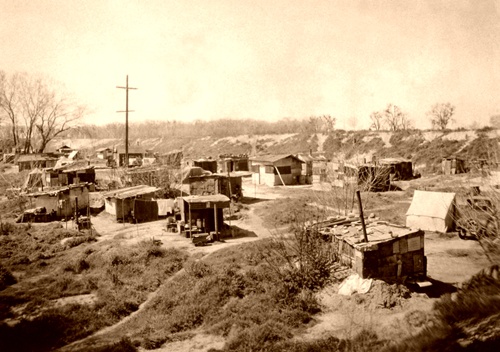
What was the main reason for the emergence of “Hoovervilles” like the one shown in the photograph?
a)
Many Americans had lost jobs during the Great Depression.
b)
Thousands of homes had been destroyed by the effects of the Dust Bowl.
c)
Housing projects could not keep up with the demand for homes needed by the poor.
d)
Preparations for World War I had created a shortage of building materials.
166.
During the early 1930s, the main goal of the Bonus Army was to pressure the Hoover administration to
a)
strengthen the nation’s defenses
b)
end the military draft
c)
bring American troops home from overseas
d)
support the early payment of money promised to veterans
167.
During the 1930s, poor land management and severe drought conditions across parts of the Midwest resulted in the
a)
formation of the United States Department of Agriculture
b)
creation of wheat surpluses
c)
growth of the Populist movement
d)
development of Dust Bowl conditions on the Great Plains
168.
A major difference between the philosophies of President Herbert Hoover and President Franklin D. Roosevelt in responding to the Great Depression is that Roosevelt
a)
wanted to rely on private charities to provide assistance
b)
stressed the need for individual rugged individualism
c)
supported direct relief to people out of work
d)
thought the government should not be involved in economic reform
169.
What was a guiding principle of the New Deal economic policies?
a)
Pro-business tax breaks would solve the problems associated with urban poverty.
b)
Antitrust legislation would destroy the free market economy of the United States.
c)
Rugged individualism must be allowed to solve social inequality.
d)
Government must assume more responsibility for helping the poor.
170.
As part of the New Deal, the Securities and Exchange Commission (SEC) and the Federal Deposit Insurance Corporation (FDIC) were created to
a)
allow for a quick recovery of stock prices
b)
provide direct loans to businesses
c)
protect individual investors from stock fraud and bank failure
d)
allow banks and companies to invest in the stock market
171.
An advocate of President Franklin D. Roosevelt’s farm policy would have likely supported which economic strategy?
a)
Reducing agricultural output to increase product values
b)
Utilizing minimum wage laws to stimulate farm productivity
c)
Allowing market forces to operate freely to achieve stabilization
d)
Increasing agricultural production to ensure an affordable food supply
172.
How would an African American during the Great Depression most likely have felt about the New Deal?
a)
Disappointed, because the TVA failed to bring power to African American farmers in its Rural Electrification Program.
b)
Outraged, because African Americans were ineligible for any benefits under New Deal programs.
c)
Frustrated, because the CCC and other work programs discriminated against African Americans.
d)
Angry, because President Franklin D. Roosevelt did not attempt to restrain his racially insensitive views.
173.
A major reason that President Franklin D. Roosevelt proposed adding Justices to the Supreme Court in 1937 was to
a)
make the Court processes more democratic
b)
end corruption and favoritism in handling cases
c)
influence Court decisions related to New Deal programs
d)
ensure the appointment of members of minority groups
174.
Senator Huey Long, Dr. Francis Townsend, and Father Charles Coughlin are best known as
a)
members of President Franklin D. Roosevelt’s cabinet
b)
outspoken critics of President Franklin D. Roosevelt’s New Deal
c)
supporters of President Franklin D. Roosevelt’s reelection campaign in 1940
d)
members of the Supreme Court nominated by President Franklin D. Roosevelt
175.
The Civilian Conservation Corps (CCC) and the Works Progress Administration (WPA) were both New Deal programs developed to address the problem of
a)
excessive stock market speculation
b)
high unemployment
c)
increased use of credit
d)
limited income of senior citizens
176.
The TVA is significant because it hired people to 
a)
deliver food to the poverty-stricken Dust Bowl residents
b)
build dams and generators that provided electricity
c)
work on farms to help stabilize agriculture
d)
publish important facts about businesses
177.
The Fair Labor Standards Act of addressed what labor issue?
a)
Workplace safety
b)
Health insurance
c)
Collective bargaining
d)
Minimum wage
178.
Passage of the Social Security Act (1935) helped American workers by 
a)
creating jobs for the unemployed
b)
guaranteeing a minimum wage
c)
legalizing the right to join labor unions
d)
providing financial assistance after retirement
179.
How did "bank runs" impact the American people during the Great Depression?
a)
Banks eventually ran out of money to loan, and people's life savings were gone.
b)
Banks made loans throughout the Great Depression, helping people pays bills until they could find work.
c)
Banks were able to people's deposits safe, but they could not loan out any more money.
d)
Banks were not at all involved in the Great Depression because people did not use them.
180.
Which of the following was a major cause of the Great Depression?
a)
overproduction and underconsumption
b)
a decrease in the supply of consumer goods
c)
an increase in demand for imported products
d)
an increase in the price of wheat on the world market