wayground logo

Free Printable Worksheets

NEW

Font size

S
M
L
XL
Worksheets

Make up Quizizz 2nd 9 weeks Phys Sci

Total questions: 50

Worksheet time: 3hrs 30mins
Name
Class
Date
1.

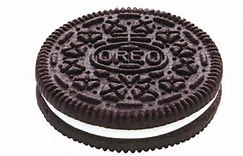
An oreo cookie has a mass of 20 grams. It gets crushed into crumbs for a recipe. What is the mass of the crumbs?

a)

15 grams

b)

25 grams

c)

20 grams

2.

How many of each type of atom are in the formula NH3?

a)

1 nitrogen, 3 hydrogen

b)

3 nitrogen, 3 hydrogen

c)

1 neon, 3 hydrogen

d)

1 nitrogen, 3 helium

3.

In a reaction A + B ----> C.

Reactant A has 5g and product C has 9g.

How many grams does reactant B should have?

a)

4g

b)

5g

c)

9g

d)

14g

4.
If there are 4 H atoms on the reactant side, how many H atoms will be on the product side? 
a)
2
b)
4
c)
6
d)
You need more information to answer this question
5.

Balance this equation:

MgCl2 --> Mg4 + Cl2

a)

It's already balanced.

b)

4 MgCl2 --> Mg4 + 4 Cl2

c)

4 MgCl2 --> Mg4 + 5 Cl2

6.
Why does the weight of the dry ice go down while it's sitting on the scale?
a)
it's melting
b)
it's disappearing
c)
turning into a gas
d)
none of these
7.
What is the Law of Conservation of mass?
a)
Mass is created in a chemical reaction
b)
Mass is created in a physical change
c)
New chemicals formed from a chemical reaction have a larger overall mass than the original reactants
d)
Mass is never created or destroyed
8.

Which of the following are Subscripts in this Chemical Formula: 3Fe2O4

a)

3,4

b)

3,2

c)

2,4

d)

6

9.

Which side of a chemical equation is the product side?

a)

Left (before the yields sign)

b)

Right (after the yields sign)

10.

Which of the following refers to the substance that is being dissolved in a solution?

a)

solvent

b)

solute

c)

mixture

11.

Based on the solubility curve, how many grams of sugar will dissolve in a 100 mL of water at 20°C?

a)

100 g

b)

150 g

c)

200 g

d)

250 g

12.
What does this solubility curve show?
a)
Solubility increases as temperature increases
b)
Solubility decreases as temperature decreases
c)
Solubility decreases as concentration increases
d)
Solubility is not affected by temperature
13.

The substance that does the dissolving

a)

Solute

b)

Solvent

c)

Solution

d)

Miscibility

14.

Which is an example of a solution?

a)

Salt and Sugar

b)

Salt Water

c)

Jelly beans

d)

Concrete

15.

Which substance is MOST soluble at 90 ºC?

a)

Solid A

b)

Solid B

c)

Solid C

16.

Which of the following should be done to make the solute dissolve faster in the solvent?

a)

stir the solute

b)

freeze the solute

c)

decrease the temperature of the solvent

d)

increase the particle size of the solute

17.

To make a solute dissolve more quickly in a solvent which would you do?

a)

Put it in cold water and stir it

b)

Put it in warm water and stir it

18.

A solution containing large amounts of solute in comparison to solvent is

a)

aqueous.

b)

concentrated.

c)

diluted.

d)

soluble.

19.

Which is an example of a solution?

a)

air

b)

oxygen

c)

salt

d)

water

20.

Which of the following is an example of a solvent?

a)

sugar

b)

salt

c)

copper sulphate

d)

water

21.
When Sally tested an unknown substance, her red litmus paper turned blue but her blue litmus paper did not change color. What is the solution?
a)
Acid
b)
Base
c)
neutral
d)
world peace
22.
Palmer puts 10 grams of salt in 100 grams of water. He then puts 50 grams of salt in 100 grams of water. Compare the concentrations of the two solutions
a)
both mixtures are acids
b)
both mixtures are bases
c)
the first solution is more diluted while the second one is more concentrated
d)
the first one is more concentrated while the second one is more diluted
23.
According to the pH scale, which of the following would be true?
a)
baking soda is a weak base while drain cleaner is a strong base
b)
lemon is a weaker acid than a banana
c)
tomato and soap are acidic
d)
vinegar is less acidic than an apple
24.
Which characteristics describe an acid?
a)
sour, indicator turns red, pH less than 7, produces hydrogen ions (H+)
b)
bitter, slippery, indicator turns blue, pH greater than 7, produces hydroxide ions (OH-)
c)
neutral, pH of 7
d)
sour, indicator turns red, pH greater than 7
25.
What might happen if you mixed a strong acid with an equally strong base?
a)
explosive chemical reaction
b)
a pH neutral substance
c)
the base would destroy the acid
d)
the acid would destroy the base
26.
An extremely strong acid would have a pH of...
a)
1
b)
7
c)
9
d)
14
27.
A neutral substance would have pH of...
a)
8
b)
7
c)
6
d)
14
28.

Which of the following is an acid?

a)

vinegar

b)

bleach

c)

sugar in water

d)

starch in water

e)

toothpaste in water

29.
Strong acids and bases...
a)
do not break apart into ions (non-electrolyte)
b)
partially break apart into ions (weak electrolyte)
c)
completely break apart into ions (non-electrolyte)
d)
completely break apart into ions (strong electrolyte)
30.

which ion is responsible for solutions being acidic?

a)

hydroxide ion

b)

hydrogen ion

c)

hydrogen carbonate ion

31.
Solids are described as having a 
a)
definite shape and indefinite volume
b)
indefinite shape and indefinite volume
c)
definite shape and definite volume
d)
indefinite shape and definite volume
32.
Gas particles have the ________ kinetic energy because they move the fastest.
a)
least
b)
most
33.
When a liquid changes its phase and turns into a solid it is known as
a)
condensation.
b)
melting.
c)
vaporization.
d)
freezing or solidification.
34.
When a gas changes its phase and turns into a liquid it is known as
a)
condensation.
b)
sublimation.
c)
vaporization.
d)
freezing or solidification.
35.
All phase changes are
a)
chemical changes
b)
chemical reactions
c)
physical changes
d)
irreversable
36.
During a phase change, the temperature remains the same
a)
True
b)
False
37.
Which state of matter take up ALL the space inside a container? 
a)
solid
b)
liquid
c)
gas
d)
all of the above
38.
Liquids and gases are similar because __________________________.
a)
they both take the shape of their container
b)
they both have their own shape
c)
liquids pour and gases don't
d)
liquids take the shape of the container but gases have their own shape
39.
Electrically charged state of matter similar to a gas.
a)
temperature
b)
liquid
c)
plasma
d)
gas
40.
Which of these is an example of sublimation?
a)
water turning to ice
b)
ice cream dripping
c)
a puddle drying up
d)
dry ice being used to make fog
41.
How are the particles moving in liquids?
a)
Sliding past one another
b)
moving past one another with great speed
c)
vibrating in a fixed postion
42.
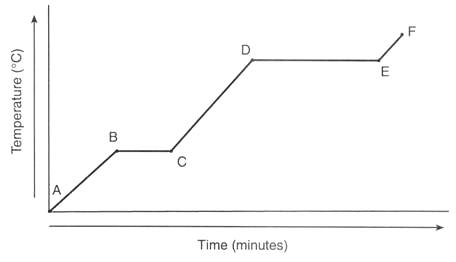
What line segment represents only the solid state?
a)
A-B
b)
B-C
c)
C-D
d)
D-E
43.
Between which points is the substance changing state?
a)
A-B only. 
b)
A-B, C-D, E-F
c)
B-C only. 
d)
B-C, D-E
44.
A substance's heating curve is shown in the graph.  What is its boiling point?
a)
100 C
b)
60 C
c)
80 C
d)
20 C
45.
How are liquids and solids different than gasses?
a)
Gasses have space between their particles.
b)
Only solids and liquids can be compressed.
c)
Solids hold the shape of the container they are in.
d)
Solids and liquids cannot be contained.
46.

two or more atoms joined together (can be from the same element or different elements)

a)

molecule

b)

compound

c)

mixture

d)

solution

47.
In a reaction A + B ----> C,  reactant A has 5g and product  C has 9g. How many grams does reactant B should have? 
a)
4g
b)
5g
c)
9g
d)
14g
48.

When you dilute a solution, which of these values remains constant (the same)?

a)

The concentration of the solution

b)

The total amount of solute

c)

The volume of the solution

d)

The total amount of solvent

49.

A solution that contains the maximum amount of dissolved solute

a)

Saturated

b)

Unsaturated

c)

Supersaturated

d)

None of the above

50.

Which of the following is an acid?

a)

baking soda

b)

orange juice

c)

shampoo

d)

water