

Wayground logo

Free Printable Worksheets

Font size

S
M
L
XL
Worksheets

EOC Review: Units 1-3

Total questions: 26

Worksheet time: 39mins

Name
Class
Date
1.
What are the monomers of DNA?
a)
glycerols
b)
amino acids
c)
fatty acids
d)
nucleotides
2.

An engineer is designing a new synthetic product that requires a waterproof coating. What biomolecule has the characteristics that he should try to replicate?

a)
carbohydrate
b)
lipid
c)
nucleic acid
d)
protein
3.

What relationship exists between amino acids and proteins?

a)
Proteins are synthesized from lipids.
b)
Amino acids are produced by proteins.
c)
Amino acids are the building blocks of proteins.
d)
Proteins are made up of carbohydrates.
4.
Small grain-shaped organelles that produce proteins.
a)
Lysosomes
b)
Ribosomes
c)
Vacuole
d)
Nucleus
5.

A scientist discovered a new organism in a rainforest. She is studying the DNA of the organism to find its similarity to other organisms.

What nucleotides will be present in the DNA sequence of the newly discovered organism?

a)
Adenine, Thymine, Guanine, Cytosine
b)
Adenine, Uracil, Guanine, Cytosine
c)
Adenine, Thymine, Uracil, Cytosine
d)
Adenine, Thymine, Guanine, Uracil
6.
Most of the cell consists of a thick, clear, gel like fluid that the cell's organelles are suspended in. 
a)
Nucleus
b)
Cell Wall
c)
Ribosomes
d)
Cytoplasm
7.

When athletes run long distances, their muscles become fatigued due to a lack of oxygen. Which process helps athletes generate more energy to continue running?

a)
Aerobic respiration
b)
Photosynthesis
c)
Anaerobic respiration
d)
Glycolysis
8.
Help plants maintain shape, storage, digestion and waste. This organelle can become very enlarged when plants store water.
a)
Lysosome
b)
Vacuole
c)
Golgi Apparatus
d)
Cell membrane
9.
 Breaks down excess or worn out cell parts and food particles. Often call the “recyclers of the cell  
a)
Vacuole 
b)
Lysosome
c)
Chloroplasts
d)
Nucleus
10.
Which group of biomolecules provides quick energy to organisms?
a)
proteins
b)
carbohydrates
c)
lipids
d)
nucleic acids
11.

How are the reactions of photosynthesis and cellular respiration interconnected?

a)

The reactions are opposites of one another, each using the products of the other as reactants.

b)

Both reactions require ATP as the energy source, but photosynthesis only happens in plants.

c)

Every organism carries out both processes at the same time but in different parts of the organism.

d)

Animals rely on photosynthesis in plants, and plants rely on respiration as the source for their ATP.
12.
What is a substance called if it speeds up a chemical reaction?
a)
reusable
b)
catalyst
c)
specific
d)
fragile
13.
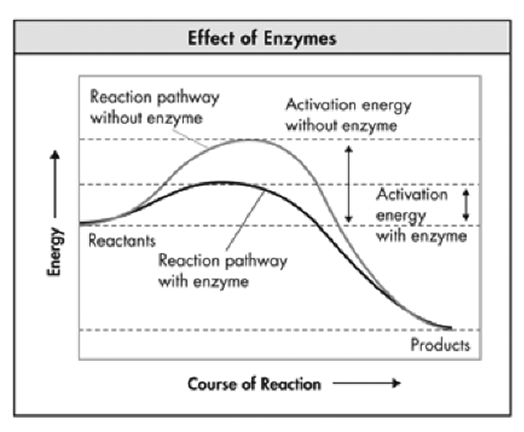
The graph shows how enzymes affect reactions in cells. Which statement best summarizes the information shown in the graph?
a)
Enzymes increase the energy of the reactants.
b)
Enzymes decrease the energy level of the products.
c)
Enzyme decrease the activation energy of the reaction.
d)
Enzymes reverse the direction of the reaction.
14.
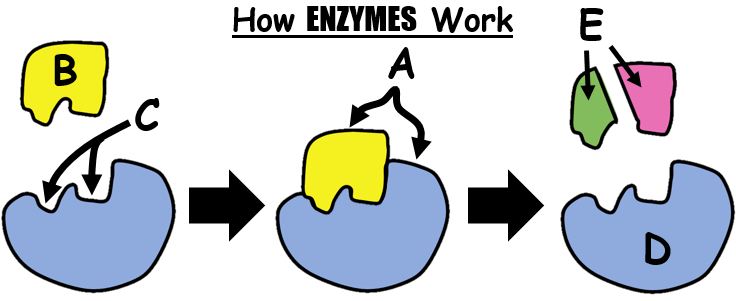
In the diagram, what is letter A? 
a)
product
b)
substrate
c)
enzyme-substrate complex
d)
active site
15.

Lactose intolerance is the inability of the human body to digest lactose, a simple sugar found in milk anddairy products. Inhibition of which biomolecule’s function results in lactose intolerance?

a)

proteins that serve as enzymes

b)

proteins that act as hormones

c)

carbohydrates that are important fibers

d)

carbohydrates that store energy

16.
With what 3 letters do enzymes typically end?
a)
-ose
b)
-ase
c)
-ese
d)
-tic
17.

Why are many plants green?

a)

plant cells are green

b)

plants absorb green light

c)

chlorophyll reflects green light

d)

rigid cell walls are green

18.
The products of photosynthesis are
a)
water and carbon dioxide
b)
oxygen and water
c)
sugar and cabon dioxide
d)
oxygen and sugar (glucose)
19.
What is the purpose of cellular respiration?
a)
to break down food
b)
to create energy in the body
c)
to release energy from food
d)
there is none; it's a waste of time
20.
Where does cellular respiration take place in the cell?
a)
Cell Membrane
b)
Nucleus
c)
Mitochondria
d)
Vacuole
21.

Why are carbohydrates important for organisms?

a)
They provide energy for cellular processes and are a major source of fuel for the body.
b)
They help in building muscle mass.
c)
They aid in digestion and absorption of nutrients.
d)
They regulate blood sugar levels.
22.

Which statement best explains why animals are considered heterotrophic?

a)

They are able to produce food through the process of photosynthesis.

b)

They are able to produce food through the process of respiration.

c)

They are able to obtain nutrients by decomposing plant and animal tissue.

d)

They are able to obtain nutrients by consuming other organisms or their products.
23.

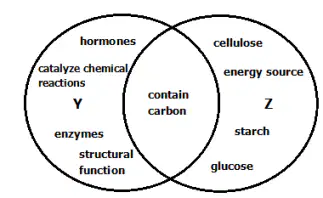
Use the Venn diagram to compare and contrast two macromolecules.

What are the titles for the letters Y and Z?

a)

Y: Carbohydrates;

Z: Proteins

b)

Y: Lipids;

Z: Carbohydrates

c)

Y: Nucleic Acids;

Z: Lipids

d)

Y: Proteins;

Z: Carbohydrates

24.

Which word equation best represents the process of cellular respiration?

a)

carbon dioxide + glucose → oxygen + water

b)

carbon dioxide + water → glucose + oxygen

c)

glucose + oxygen → carbon dioxide + water

d)

oxygen + water → carbon dioxide + glucose

25.

Membrane-bound organelles would be found in which type of cells?

a)
Prokaryotic cells
b)
Plant cells
c)
Eukaryotic cells
d)
Animal cells
26.

What will most likely be the result if all of the mitochondria are removed from a plant cell?

a)

It will be unable to carry out respiration.

b)

It will lose water through osmosis.

c)

It will break down the ribosomes in the cell.

d)

It will be unable to photosynthesize.
