
Font size
 Worksheets
Units 8-9 Review
Total questions: 34
Worksheet time: 1hrs 8mins
Some individuals of a population or species are better suited to
evolve than other individuals
survive and reproduce
become extinct
achieve punctuated equilibrium
Darwin learned that there were resemblances between the plants and animals of South America and
Ecuador
the Galapagos Islands
Australia
the English Countryside
The fossil record
proves the existence of every species that has ever lived
cannot show patterns of development from ancestors to descendants
shows strong evidence that evolution takes place
cannot show change over time in species
Natural Selection causes
changes in the environment
plants and animals to produce more offspring than can survive
ensures organisms suited to live in their environment have the necessary traits
All of the above
A feature that has become common in a population because it provides a selective advantage
adaptation
mutations
reproductive isolation
punctuated equilibrium
A change in DNA that is one source of new variations for natural selection to act upon
adaptation
mutations
reproductive isolation
punctuated equilibrium
Chloroplasts and mitochondria are both thought to have evolved through the process of
photosynthesis
cellular respiration
chemical reactions
endosymbiosis

The accumulation of differences between species or populations is called
gradualism
adaption
divergence
differentiation
When individuals choose traits possessed by the opposite sex it is called…
Mutation
Gene Flow
Genetic Drift
Sexual Selection
Genetic drift is more likely to happen in...
aquatic populations
small populations
terrestrial populations
older populations
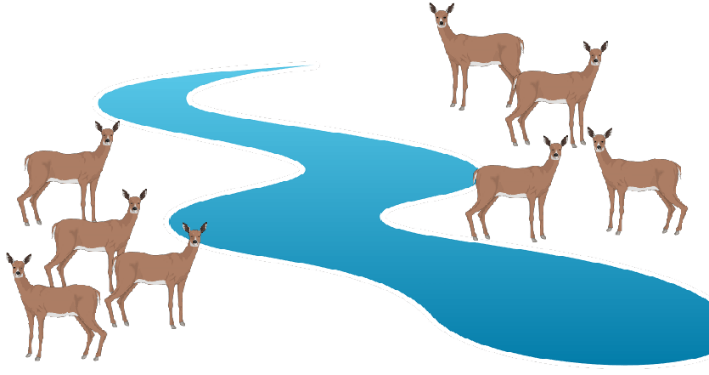
Two populations of the same species are separated by land barriers like rivers or mountains.
geographical isolation
temporal isolation
adaptive ratiation
behavioral isolaton
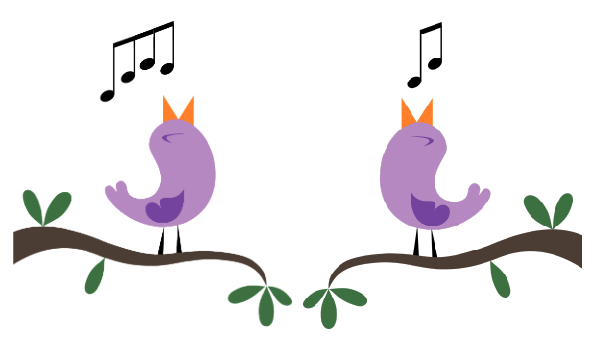
Two populations of the same species do not have the same mating rituals or signals.
geographical isolation
temporal isolation
adaptive ratiation
behavioral isolaton
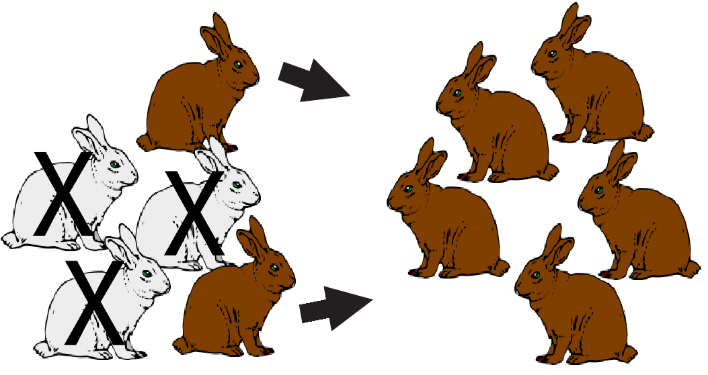
Isolated small populations speed up genetic drift.
Gene Pool
Mitosis
Speciation
Founders Effect

Number of Nucleotide Differences in the DNA Sequence in the Milk Protein Gene
Based on the table above, what land mammal shares the most recent common ancestor with whales?
cow
deer
hippopotamus
all organisms

According to the biological species concept, the members of the same species can
interbreed
have radically different characters
have different scientific names
converge
Taxonomy is
the study of life
the science of naming and classifying organisms
the evolutionary history of a species
the sequence in which different groups evolved
The Three Domains of Life are
Protista
Eukaryota
Bacteria
Archaea
Animalia
Each level of classification is based on
specific characteristics
general characteristics
shared characteristics
all of the above

Kangaroos and opossums both grow their young in pouches. This is a similar trait between two different organisms. This means they -
share a common ancestor
possess vestigial organs
have similar skeleltal structures
belong to the same species
This organism can make its own food.
heterotroph
autotroph
honey bee
eukaryote
This type of organism has to eat other organisms to survive.
heterotroph
autotroph
honey bees
eukaryotes
Select the correct Taxonomy Hierarchy
Species - Phylum - Domain - Class - Order - Family - Kingdom - Genus
Kingdom - Phylum - Class - Order - Family - Genus - Species - Domain
Domain - Kingdom - Phylum - Class - Order - Family - Genus - Species
Kingdom - Phylum - Domain - Class - Species - Order - Species - Genus

In which phylum do organisms have a segmented body?
Chordata
Echinodermata
Hemichordata
Nematoda

This diagram shows a cladogram of six species based on amino acid similarities.
I and II
II and IV
I and V
V and VI
Equus asinua and Equus caballus indicate that these organisms belong to the same _____.
Genus
Species
In evolutionary systematics, evolutionary relationships are displayed in a branching diagram called a _____ where the length can represent the amount of genetic change.
helix
ladder
cladogram
phylogenic tree
The forelimb of the monkey, bat, penguin, and alligator look very different on the outside, but their skeletal structures are similar. Evidence suggests that these animals
may have evolved from a common ancestor
all reproduce in a similar fashion
live in similar environments
should all be able to fly someday

An unidentified plant produces spores, has many cells, but does not have true leaves. What plant is it?
Liverwort
fern
Gymnosperm
Angiosperm

To which order does the caddis fly belong?
Note: it has two sets of wings and 6 legs.
Acarina
Siphonaptera
Diptera
Trichoptera

