
 Worksheets
MS CCRS Standards 5 & 6
Total questions: 25
Worksheet time: 34mins
Name
Class
Date
1.
The social impact of the Red Scare was characterized by
a)
Yellow Journalism
b)
Spread of Communism
c)
Stock Market Crash
d)
Anti-Immigrant Sentiment
2.
Which music genre was created in the 20s?
a)
Bluegrass
b)
Jazz
c)
Hip Hop
d)
R&B
3.
What did Clarence Darrow represent in the Scopes Trial?
a)
Evolution was incorrect
b)
Creationism had no place in schools
c)
The Bible was always right
d)
Science would support the Bible
4.
What was the symbol of feminine change in the 1920s?
a)
Flapper
b)
Bootlegger
c)
Immigrant
d)
Musician
5.
Which Act would 1920s Nativists have agreed to?
a)
Stamp Act
b)
Pure Food and Drug Act
c)
Chinese Exclusion Act
d)
Sister Act
6.
Which political scandal marked Warren Harding's presidency and caused increased distrust of the government?
a)
Teapot Dome
b)
Fall
c)
Yosemite Land
d)
Haymarket Square
7.
Which year marks the Stock Market Crash that began the Great Depression?
a)
1927
b)
1928
c)
1929
d)
1930
8.
The Harlem Renaissance was
a)
Celebration of African American Culture
b)
Spark of increased industrial jobs
c)
Creation of controversial policies
d)
Creation of the Department of Interior
9.
Why were Sacco and Vanzetti viewed with suspicion?
a)
Sacco owned a gun similar to the murder weapon
b)
they were Italian immigrants and anarchists
c)
they were members of the Ku Klux Clan
d)
they looked funny
10.
What innovation did Henry Ford use to boost the automotive industry?
a)
Interchangeable Parts
b)
The Assembly Line
c)
The Seaplane
d)
Washing Machine
11.

The president who promised the people a "New Deal" during the Great Depression.
a)
Jesse Owens
b)
Herbert Hoover
c)
Franklin D. Roosevelt
d)
George Washington
12.
What was one factor that led to the Great Depression?
a)
government limitations on the amount of money in circulation
b)
increases in the tax rate for corporations
c)
excessive speculation in the stock market
d)
high wages paid by employers
13.
Passage of the Social Security Act (1935) helped American workers by
a)
creating jobs for the unemployed
b)
providing financial assistance after retirement
c)
guaranteeing a minimum wage
d)
legalizing the right to join labor unions
14.
What was one economic consequence of President Franklin D. Roosevelt’s New Deal?
a)
Bank deregulation
b)
Major industries were nationalized.
c)
Balanced budgets became the model for economic stability.
d)
The role of the federal government in the economy expanded.
15.
The criticism of President Franklin D. Roosevelt's plan to court-pack the Supreme Court was that the he was
a)
The criticism of President Franklin D. Roosevelt's plan to court-pack the Supreme Court was that the he was
b)
seeking the Supreme Court’s help against his political opponents
c)
attempting to exercise too much executive power over the Supreme Court
d)
refusing to allow the Supreme Court to review legislation
16.
An important factor contributing to the start of the Great Depression in the United States was the
a)
uneven distribution of wealth
b)
increase in military spending
c)
reduction of tariff rates
d)
failure to maintain the gold standard
17.
Much of the domestic legislation of the New Deal period was based on the idea that the federal government should
a)
assume some responsibility for the welfare of people
b)
favor big business over labor and farming
c)
own and operate the major industries of the country
d)
require local communities to be responsible for social welfare programs
18.
New Deal programs such as the Civilian Conservation Corps (CCC) and the Works Progress Administration (WPA) were primarily intended to help
a)
farmers
b)
homeowners
c)
businesses
d)
unemployed workers
19.
Which event is most closely associated with the end of the Great Depression?
a)
passage of the Social Security Act
b)
beginning of World War II
c)
reelection of President Franklin D. Roosevelt in 1940
d)
announcement of the Marshall Plan
20.

The situation shown in this photograph occurred in which region?
a)
Ohio River valley
b)
Great Plains
c)
Rocky Mountains
d)
Northeast
21.
The Smoot-Hawley Tariff
a)
was welcomed by foreign nations.
b)
was opposed by Republicans
c)
caused a worldwide trading crisis
d)
lowered the tariff considerably
22.
In the 1930's, people would line up at ____________ to get food. These were normally run by charities.
a)
churches
b)
businesses
c)
soup kitchens
d)
work
23.
After the Stock Market Crash, many people lost their life savings because _______________.
a)
banks closed
b)
banks gave away their money
c)
they couldn't remember where they put it
d)
someone stole it
24.
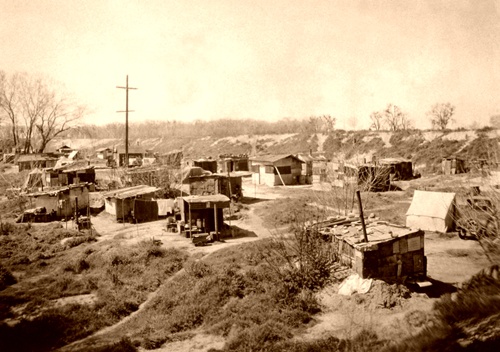
What were the villages full of shacks located in cities filled with unemployed Americans called?
a)
Hoovervilles
b)
Okies
c)
Bonus Army Bases
d)
Rooseveltowns
25.
What is another name for the Stock Market Crash?
a)
Black Friday
b)
Taco Tuesday
c)
Black Tuesday
d)
Throwback Thursday
100 %

