
Font size
 Worksheets
AP Chem Semester I Diagnostic part 1
Total questions: 35
Worksheet time: 42mins
Unit 1
A 45g sample of a compound containing only carbon and hydrogen is found to contain 36g of carbon. It has a molar mass of 30.0g/mol. What is its molecular formula?
CH3
C3H8
C2H6
C2H4
Unit 2
What is a substitutional alloy?
A mixture with two nonmetal elements
A metal mixture with two elements of similar size
A metal mixture with two elements of very different sizes
A metal mixture with layers of different elements
Unit 2/3
In a polar covalent bond, the electrons gather around...
The atom with the Greatest Electronegativity
The atom with the Lowest Electronegativity
Each atom Equally
None of the Above
Unit 2/3
The polarity of a bond is determined by...
The sum of the electronegativities of the two atoms
The difference in the electronegativities of the two atoms
The charges of the atoms
None of the Above

Unit 2
For carbonate ions, how many resonance structures can be drawn ?
2
3
4
5
Unit 2
The bond angle for a trigonal planar molecule is
90 Degrees
109.5 Degrees
120 Degrees
180 Degrees
Unit 2
Draw the Lewis Dot structure for PCl5 and determine the predicted molecular geometry
octahedral
trigonal pyramidal
seesaw
trigonal bipyramidal

Unit 2
Based on formal charge and the the Lewis dot structure rules, which of the following would be correct Lewis structure for N2O?
A
B
C
D
Unit 2
What type of bonding below typically exhibits the greatest melting point and boiling point?
ionic
metallic
polar covalent
nonpolar covalent
Semester 1:
If you want to have a high Coulombic attraction you would want...
high charge, high distance
low charge, low distance
low charge, high distance
high charge, low distance
Unit 3
A student extracts the colour from some green smarties and uses paper chromatography to separate components colours. She finds blue has a Rf =0.38 and yellow Rf =0.75 this suggests
the yellow is more strongly adsorbed onto the stationary phase and is less solublein the mobile phase.
the yellow is more strongly adsorbed onto the stationary phase and is more soluble in the mobile phase.
the blue is more strongly adsorbed onto the stationary phase and is less soluble in the mobile phase.
the blue is more strongly adsorbed onto the stationary phase and is more soluble in the mobile phase.
Unit 1
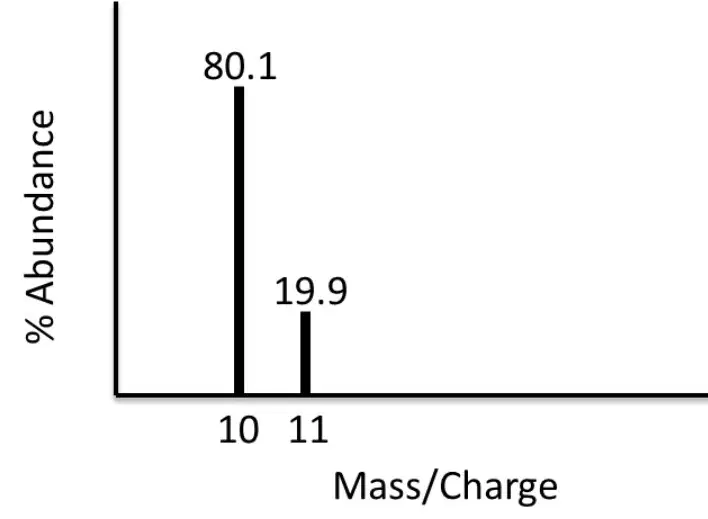
What is the average atomic mass for this element?
10.8 amu
10.2 amu
19.9 amu
11 amu

Unit 3
Which of the substances would experience hydrogen bonding?
pentane
pentene
pentanol
none of them
Unit 3
Pentane has 5 carbons. Heptane has 7 carbon atoms, and propane has 3. Which will experience the most London-dispersion forces?
pentane
heptane
propane
none; they will only experience ion-dipole forces
Unit 3
Which of the following best represents a magnesium ion in solution?


Unit 2/3
Determine the type of intermolecular force present in sand, SiO2.
dipole dipole
london dispersion
ionic bonding
covalent network
Unit 3
Which substance has the weakest intermolecular forces?
Substance A, boiling point of 75 °C
Substance B, boiling point of 105 °C
Substance C, boiling point of 25 °C
Substance d, boiling point of 45 °C
Unit 3
Which substance will have the highest vapor pressure?
CH3CH2CH2CH2CH2CH3
H2O
CH4
CH3F
Unit 3
When water condenses (goes from a gas to a liquid)
hydrogen bonds are broken
covalent bonds are formed
ionic bonds are broken
hydrogen bonds are formed

Unit 2
Which of the following diagrams best depicts an alloy of Ni and B?
A
B
C
D
Unit 1
Atoms of an element X have the electron configuration [Ne] 3s23p1. The compound this element would form with Oxygen would have which of the following formulas?
XO
X2O
XO2
X3O2
X2O3

Unit 1
Examine this table of the ionization energies 1-5 of a unknown element. Based on these values, how many electrons are in the valence shell of this element?
1
3
5
6
Cannot tell from this information

Unit 1
What is the orbital notation for this PES?
1s22s22d63s23d3
1s22s22p63s23p1
1s22s23s62p23p3
1s22s22p63s23p3

Unit 2
In the resonance structures shown here for ozone, O3, what is the bond length on either side of the central oxygen?
the length of an O-O single bond
the length of an O=O double bond
A length halfway in between an O-O and an O=O
Unit 2
A sample of a solid substance does not conduct electricity in either the solid or liquid phase. The solid is soluble in water. Which of the following types of interactions is most likely found between particles in the pure substance?
ionic bonds
metallic bonds
network covalent bonds
dipole-dipole forces

Unit 3
Based on Coulomb’s Law and the data in the table above, which of the following would have the weakest interactions with an adjacent water molecule in an aqueous solution?
Hg2+
Ba2+
Mg2+
Al3+

Unit 2
Which of the statement is TRUE?
s orbital overlap with p orbitals to form sp hybrid orbital
s orbital with two p orbitals to form one sp2 hybrid orbital
s orbital with two p orbitals to form two sp2 hybrid orbital
s orbital with two p orbitals to form three sp2 hybrid orbital
Unit 2
Pi bonds are formed by
side to side overlap of s orbitals
end to end overlap of s orbitals
side to side overlap of p orbitals
end to end overlap of p orbitals
Unit 3
NH4NO3(s) → N2O(g) + 2 H2O(g)
A 0.03 mol sample of NH4NO3(s) is placed in a 1 L evacuated flask, which is then sealed and heated. The NH4NO3(s) decomposes completely according to the balanced equation above. The total pressure in the flask measured at 400 K is closest to which of the following? ( The value of the gas constant, R, is 0.082 L atm mol–1 K–1)
3 atm
1 atm
0.5 atm
0.1 atm
Unit 2
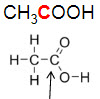
What is the hybridization of the Carbon atom indicated by the arrow?
sp hybridization
sp2 hybridization
sp3 hybridization
dsp3 hybridization

Unit 1
Use the data for germanium in the table above to identify the most probable values for the atomic radius and electronegativity of selenium from the choices below.
Atomic Radius:155 pm, electronegativity: 2.55
Atomic Radius:120 pm, electronegativity: 2.55
Atomic Radius:155 pm, electronegativity: 1.85
Atomic Radius:120 pm, electronegativity: 1.85
Unit 1
For the reaction represented by the equation Cl2 + 2KBr → Br2 + 2KCl, how many grams of potassium chloride can be produced from 356 grams potassium bromide?

Unit 2
What is the molecular shape of the following?
Hexahedral
Square Pyramidal
Octahedral
T-Shape

Unit 2
What is the molecular shape of the following?
T-Shape
See-Saw
Trigonal Planar
Octahedral

Unit 3
Which is correct about this drawing? Choose 2 answers.
A is pointing to a covalent bond
B is pointing to a hydrogen bond
A is pointing to a hydrogen bond
B is pointing to a covalent bond
A would take more energy to break compared to B
B would take more energy to break compared to A

