wayground logo

Free Printable Worksheets

NEW

Font size

S
M
L
XL
Worksheets

Midterm 2025 part 1

Total questions: 35

Worksheet time: 37mins

Name
Class
Date
1.
Which colonial region was settled by Puritans and Pilgrims seeking religious freedom?
a)
New England
b)
Southern
c)
Middle
d)
Backcountry
2.
Which colonial region was settled by people with many different cultural and religious backgrounds?
a)
New England
b)
Middle
c)
Southern
d)
Backcountry
3.
Which colonial region contained rocky soil and cold climate?
a)
New England
b)
Middle
c)
Southern
d)
Backcountry
4.
Large farms, called ___________________, were spread throughout the Southern colonies.
a)
Trade centers
b)
Plantations
c)
Settlements
d)
industrial centers
5.
Why was slavery LESS important in the Middle Colonies and the New England Colonies than in the Southern Colonies?
a)
They were far behind the South in business and industry.
b)
They did not rely heavily on cash crops.
c)
Slavery was important in all of the colonial regions. 
6.
There were people in the colonies in North America who had more power in the decisions being made by the government.  Which group had the MOST power in the colonial government?
a)
wealthy landowners
b)
slaves
c)
women
7.
Where did debtors settle?
a)
Plymouth Colony
b)
Pennsylvania
c)
Georgia
d)
Jamestown
8.
Where were the first armed conflicts of the American Revolution?
a)
Yorktown
b)
Saratoga
c)
Lexington and Concord
d)
Bunker Hill
9.
What was the name of the British king during the American Revolution?
a)
Charles III
b)
George III
c)
William III
d)
James III
10.
Who was the major author of the Declaration of Independence?
a)
Benjamin Franklin
b)
John Adams
c)
Thomas Jefferson
d)
Patrick Henry
11.
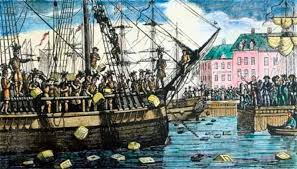
Samuel Adams and Paul Revere led members of the Sons of Liberty in this protest against taxes.
a)
First Continental Congress
b)
Boston Massacre
c)
Boston Tea Party
d)
Stamp Act Congress
12.
The French and Indian War happened AFTER the Stamp Act.
a)
True
b)
False
13.
The French and Indian War cost King George and Great Britain a lot of money. To help pay for the war, the British colonies were ordered to 
a)
give up their food
b)
work for free
c)
become a part of the Army
d)
pay taxes without representation
14.

A confrontation between the colonists and soldiers in Boston that ended in 5 colonists being killed was called

a)
Boston Tea Party
b)
Boston Massacre
c)
Boston Party
d)
Boston Parliament
15.
A secret organization formed to protest the Stamp Act was called
a)
Congress
b)
Sons of Liberty
c)
Parliament
d)
Loyalists
16.

American colonists were asked to help cover the cost of the French and Indian War by paying

a)

Patriots

b)

loans

c)

taxes

d)

in paper currency

17.

Colonists who supported the British king were called 

a)

Patriots

b)

Republicans

c)

Democrats

d)

Loyalists

18.
Many colonists did not want to remain loyal to Great Britain and King George. They wanted to be free from British rule. These colonists were called 
a)
Patriots
b)
Republicans
c)
Democrats
d)
Loyalists
19.
The 13 colonies were fighting for freedom from England. What is another word for freedom? 
a)
taxes
b)
tariff
c)
liberty
d)
patriot
20.

In 1765, the Parliament of Great Britain passed the Stamp Act. The purpose of this act was to

a)

get rid of colonists who were willing to support the king

b)

raise money by putting a tax on tea, sugar, and molasses

c)

get rid of French colonists in the Northern colonies

d)

raise money by passing a tax on newspapers and other paper products

21.
Describe the economy of the New England Colonies.
a)
These colonies grew and sold crops that were used every day like wheat and grain
b)
These colonies grew crops that were used to make great profit.  At first they grew tobacco. Later their big crop was cotton.
c)
These colonies created and traded manufactured goods from raw materials.  They created the final products like paper from wood.
d)
The first colony in America set up in 1607. Due to their harsh conditions and lack of communication, the early colonists began to govern themselves and make decisions to solve their daily problems.
22.
Describe the economy of the Middle Colonies.
a)
These colonies grew and sold crops that were used every day like wheat and grain
b)
These colonies grew crops that were used to make great profit.  At first they grew tobacco. Later their big crop was cotton.
c)
These colonies created and traded manufactured goods from raw materials.  They created the final products like paper from wood.
d)
The first colony in America set up in 1607. Due to their harsh conditions and lack of communication, the early colonists began to govern themselves and make decisions to solve their daily problems.
23.
Describe the economy of the Southern Colonies.
a)
These colonies grew and sold crops that were used every day like wheat and grain
b)
These colonies grew crops that were used to make great profit.  At first they grew tobacco. Later their big crop was cotton.
c)
These colonies created and traded manufactured goods from raw materials.  They created the final products like paper from wood.
d)
The first colony in America set up in 1607. Due to their harsh conditions and lack of communication, the early colonists began to govern themselves and make decisions to solve their daily problems.
24.

Describe the significance of the Jamestown colony.

a)

This colony grew and sold crops that were used every day like wheat and grain

b)

This colony grew crops that were used to make great profit. At first they grew tobacco. Later their big crop was cotton.

c)

This colony created and traded manufactured goods from raw materials. They created the final products like paper from wood.

d)

The first colony in America set up in 1607. Due to their harsh conditions and lack of communication, the early colonists began to govern themselves and make decisions to solve their daily problems.

25.
What was the significance of the English Bill of Rights?
a)
A charter of liberties agreed to by King John of England.  It made the king obey the same laws as citizens (1215)
b)
Written in 1689, this document was a shift of political power from the British monarchy to Parliament.
c)
A document written by the Pilgrims in 1620 establishing themselves as a political society and setting guidelines for self-government.
d)
This was a religious movement that became widespread in the American colonies in the 1730s
26.
Describe the idea of "Representative Government."
a)
A government that has been limited  in power by a constitution, or written agreement.
b)
The idea that the government serves to equally protect the rights of the people.
c)
A government where someone is elected to vote for (or represent) a group of people
d)
The idea that people can make decisions on how their government should work
27.
Which is not a part of the New World?
a)
North America
b)
Caribbean
c)
South America
d)
Asia
28.
How did diseases impact the New World?
a)
They didn't
b)
They wiped out 75-90% of the Europeans
c)
They wiped out 75-90% of the indigenous people
d)
They helped the natives beat the Spanish
29.

The Columbian Exchange is best defined as

a)

Exchange of plants, animals, disease, and technology among the differing parts of the world following Columbus' voyage

b)

The relationship between people in different parts of the world

c)

The story of how Columbus came to North America

d)

Everything Columbus brought back to Spain after his first voyage

30.
What group of people suffered the most during the Columbian Exchange?
a)
Animals
b)
Explorers
c)
Native Americans
d)
Europeans
31.
The Middle Passage was the name for the journey from 
a)
Europe to Africa
b)
Americas to Europe
c)
Africa to the Americas
d)
Americas to Africa
32.
What cause many Native Americans to die during the time of the Columbian Exchange?
a)
Diseases
b)
Spoiled Food
c)
Spoiled Meat
d)
War with Europeans
33.

Which of the following was NOT a reason why Europeans used Africans as labor?

a)

They are immune to European diseases

b)

They had no friends or family in the Americas.

c)

Africans provided permanent cheap labor.

d)

They were already living in the Americas.

34.

What are three areas of conflict between Europeans and American Indians?

a)

land, crops, and technology

b)

trade, crops, and language differences

c)

land, disease and differences in cultures

d)

crops, trade and disease

35.
Surrounded by French and Continental armies, a large British army surrendered here.
a)
Saratoga
b)
Yorktown
c)
Bunker Hill
d)
Lexington and Concord