
 Worksheets
Optics Lab_Quiz -1
Total questions: 64
Worksheet time: 27mins
diffraction is waves bending because of
edges of a slit or thin object
speed of wave changes
dark matter
gravity
refraction is waves bending because of
edges of a slit or thin object
speed of wave changes
dark matter
gravity
when we look through rainbow glasses... (diffraction-slits)... which color is bent the least (shows up closest to the object)
red
violet
yellow
green
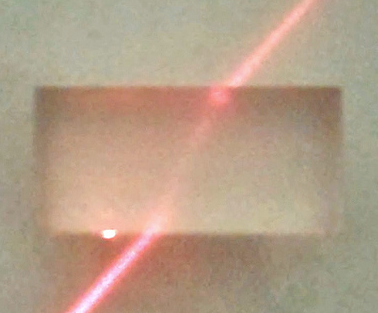
this is an example of
refraction
diffraction
infraction
reflection
what is diffraction
is a soild liquid gass
is a beam of light that is spread out and passes through an object
a beam of light
A wave of constant wavelength diffracts as it passes through an opening in a barrier. As the size of the opening is increased, the diffraction effects
decrease
increase
remain the same

What happens to the frequency of a wave as it passes through a gap?
Increases
Decreases
No change
None of above

What would you call this?
Refraction
Diffraction
Bends
Reflection
witch picture is diffraction


Which of the following is the best example of diffraction?
Your voice echoing back when you shout into a canyon
A straw appearing to bend when you place it in a glass of water
A prism breaking a beam of light into its component colors
The music on your stereo getting louder when you turn up the volume
Does the wave speed change after diffraction?Explain it.
Yes. It slows down.
Yes. It speeds up.
No. There is nothing change about the medium.
No. Because the frequency doesn't change.

Two waves E and G are shown. The waves have the same speed.
Which statement is correct?
Wave E has a greater amplitude than wave G.
Wave E has a greater intensity than wave G.
Wave E has a smaller frequency than wave G.
Wave E has a smaller wavelength than wave G.

The diagram shows a displacement-time graph for a progressive wave.
Amplitude: 5 mm; Frequency: 40 Hz
Amplitude: 5 mm; Frequency: 50 Hz
Amplitude: 10 mm; Frequency: 40 Hz
Amplitude: 10 mm; Frequency: 50 Hz
Which observation indicates that sound waves are longitudinal?
Sound can be reflected from a solid surface.
Sound cannot be polarised.
Sound is diffracted around corners.
Sound is refracted as it passes from hot air to cold air.
Interference of light is evidence that:
the speed of light is very large
light is a transverse wave
light is electromagnetic in character
light is a wave phenomenon
In a Young's double-slit experiment the centre of a bright fringe occurs wherever waves from the slits differ in the distance they travel by a multiple of:
quarter of a wavelength.
half a wavelength.
a wavelength.
three-fourths of a wavelength.
For destructive interference, the path difference is:
odd number of half wavelengths
even number of half wavelengths
whole number of wavelengths
even whole number of wavelengths
Constructive interference happens when two waves are:
out of phase.
zero amplitude.
in phase.
Two waves with phase difference 180° have resultant of amplitude
one.
zero.
same as the single wave.
doubles the single wave.
Extra distance travelled by one of waves compared with other is called
path.
displacement.
phase difference.
path difference.
What principle is responsible for light spreading as it passes through a narrow slit?
refraction
polarization
diffraction
interference
What principle is responsible for alternating light and dark bands when light passes through two or more narrow slits?
refraction
polarization
diffraction
interference
When a light wave enters into a medium of different optical density,
its speed and frequency change.
its speed and wavelength change.
its frequency and wavelength change.
its speed, frequency, and wavelength change.
Light of wavelength 575 nm falls on a double-slit and the third order bright fringe is seen at an angle of 6.5o. What is the separation between the double slits?
5.0 micro-m
10 micro-m
15 micro-m
20 micro-m
Two light sources are said to be coherent if they
are of the same frequency.
are of the same frequency, and maintain a constant phase difference.
are of the same amplitude, and maintain a constant phase difference.
are of the same frequency and amplitude.

A beam of light bends when it passes from air into water, and then bends even more when it passes from water into glass. What can you conclude from this fact?
Air is denser than glass.
Water is denser than glass.
Glass is denser than water.
Air is denser than water.

What type of stuff can be refracted? Choose the best answer.
Light
Sound
Heat
Anything that travels in waves

Light refracts when:
It changes speed
It changes from a particle to a wave
Its density changes
It encounters a solid object

Why does white light from the sun form a colorful rainbow when it passes through water droplets in the atmosphere?
The droplets of water in the air have different densities
Different-sized water droplets refract white light at different angles
The colors that make up white light refract at different angles
White light diffracts when it encounters water

Diffraction is useful in which of the following fields?
Calculus
Anthropology
Astronomy
Astrology

What's an easy way to create an interference pattern of waves?
Shine a light onto a black surface; the dark color will interfere with the transmission of light
Broadcast radio waves from a tower; water particles in the atmosphere will interfere with the transmission
Play music through a board with one hole in it; the board will interfere with the sound waves
Toss two pebbles into the water close to each other; the waves from each pebble will interfere with the other

What can you conclude about X-rays from the fact that they diffract?
They travel fairly slowly
They cannot pass through most obstacles
They travel in waves
They carry a lot of energy

Blue light bends more than red light when it passes through glass. Thus, blue light has a greater:
Angle of refraction
Interference pattern
Index of diffraction
Wavelength

What is the main difference between refraction and diffraction?
Refraction is a phenomenon that affects light; diffraction is a phenomenon that affects sound.
Refraction involves the bending of light; diffraction involves the bending and spreading of light, usually around an obstacle.
Refraction usually happens in the atmosphere; diffraction usually happens closer to the earth's surface.
Refraction involves changes to the density of light; diffraction involves changes to the speed of light.
Light waves and sound waves are similar in that...
They are both longitudinal waves
They are both transverse waves
They both transmit energy
They both can travel through space.
A wave of constant wavelength diffracts as it passes through an opening in a barrier. As the size of the opening is increased, the diffraction effects
decrease
increase
remain the same

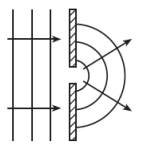
The diagram shows a series of wave fronts approaching an opening in a barrier. Point P is located on the opposite side of the barrier. The wave fronts reach point P as a result of
resonance
refraction
reflection
diffraction
Which wave phenomenon makes it possible for a player to hear sound from a referee's whistle in an open field even when standing behind the referee?
diffraction
Doppler effect
reflection
refraction
A wave is diffracted as it passes through an opening in a barrier. The amount of diffraction that the wave undergoes depends on both the
amplitude and frequency of the incident wave
wavelength and speed of the incident wave
wavelength of the incident wave and the size of the opening
amplitude of the incident wave and the size of the opening
Which diagram best represents the shape and direction of a series of wave fronts after they have passed through a small opening in a barrier?
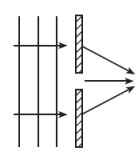
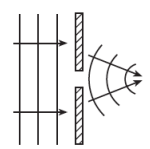
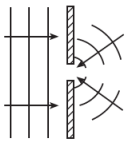
Parallel wave fronts incident on an opening in a barrier are diffracted. For which combination of wavelength and size of opening will diffraction effects be greatest?
short wavelength and narrow opening
short wavelength and wide opening
long wavelength and narrow opening
long wavelength and wide opening
Radio waves diffract around buildings more than light waves do because, compared to light waves, radio waves
move faster
move slower
have a higher frequency
have a longer wavelength
Waves pass through a 10-centimeter opening in a barrier without being diffracted. This observation provides evidence that the wavelength of the waves i
much shorter than 10 cm
equal to 10 cm
longer than 10 cm but shorter than 20 cm
longer than 20 cm
The spreading of a wave into the region behind an obstruction is called
diffraction
absorption
reflection
refraction

This diagram shows a series of straight wave fronts produced in a shallow tank of water approaching a small opening in a barrier.


Which of the phenomena suggests that light may be a transverse wave?
Interference
Diffraction
Reflection
Polarization
What happen if ordinary unpolarized light passed through a uniaxial crystal?
Light remains unaffected.
The light is split into two rays.
The light is split into more than two rays.
None of these
What happen if o-ray and e-ray travel along the optic axis?
Both rays travel with the same speed.
o-ray travel faster than e-ray.
e-ray travel faster than o-ray.
none of these
How much phase change is introduced by a quarter wave plate between ordinary and extraordinary rays ?
2π
π
4π
0
The plane in which electric field vector of plane polarised light vibrates is known as
Plane of vibration
Plane of polarisation
Principle plane
none of these
The acute angle of principle section of calcite crystal is
710
680
1090
1020
Canada Balsam acts as ...... medium for o-ray
Rarer
Denser
Which phenomenon is used in Nicol prism to eliminate o-ray.
Total internal reflection
Double Refraction
Refraction
Polarisation
In negative uniaxial crystal the sphere lies inside the ellipsoid.
True
False
In positive uniaxial crystal o-ray travels faster than e-ray.
True
False
The production of light with a specific pattern of oscillation.
reflection
polarization
refraction
diffraction
A Polarizing filter is used to reduce glare on reflective surfaces including glass, windows, and water.
True
False

A polarizer is used to:
reduce intensity of light
produce polarized light
increase intensity of light
produce unpolarized light
Approximately how much light is blocked by two polarizing filters that are perpendicular to each other?
0%
50%
75%
100%
Approximately how much light is blocked by a single polarizing filter?
0%
50%
75%
100%

