wayground logo

Free Printable Worksheets

Font size

S
M
L
XL
Worksheets

Overview of Functions

Total questions: 167

Worksheet time: 6hrs 53mins

Name
Class
Date
1.
A relation where every input yields one and only one output is called a(n) __________?
a)
Relation
b)
Linear
c)
Exponential
d)
Function
2.
All of the x values or inputs are called the _________?
a)
Domain
b)
Range
c)
Relation
d)
Function
3.
All of the y values or outputs are called the ________?
a)
Domain
b)
Range
c)
Relation
d)
Function
4.
A set of ordered pairs is called a ________?
a)
Domain
b)
Relation
c)
Function
d)
Vertical Line Test
5.
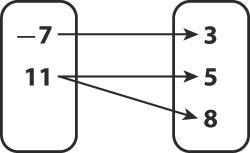
Is the relation a function? Why.
a)
Yes, because the x-value 11 has two y-values pair with it.
b)
Yes, because each x-value has only one y-value paired with it.
c)
No, because the x-value 11 has two y-values pair with it.
d)
No, because each x-value has only one y-value paired with it.
6.
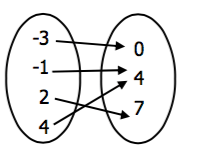
Is this mapping a function or not a function? 
a)
Function
b)
Not a Function
7.
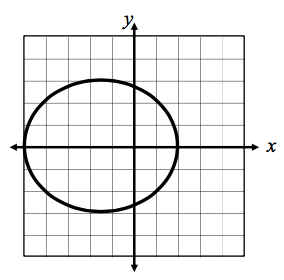
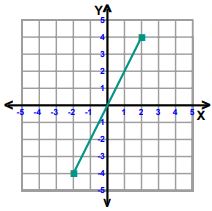
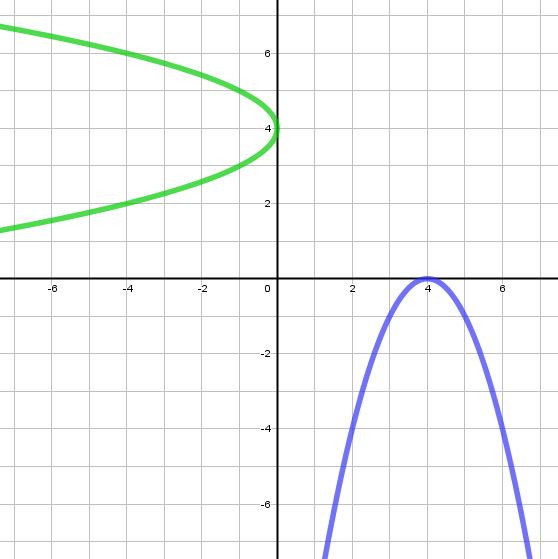
Is this graph a function or not a function? 
a)
Function 
b)
Not a Function
8.
Is this mapping a function or not a function? 
a)
Function
b)
Not a Function 
9.
Is this graph a function or not a function? 
a)
Function
b)
Not a Function
10.
a)
Function
b)
Not a Function
11.
For the function {(0,1), (1,-3), (2,-4), (-4,1)}, write the domain and range.
a)
D: {1, -3, -4,}
R: {0, 1, 2, -4}
b)
D:{0, 1, 2, -4}
R:{1, -3, -4}
c)
D:{0, 1, 2, 3, 4}
R:{1, -3, -4}
12.
a)
Function 
b)
Not a Function 
13.
Which graph is a function?
a)
A
b)
B
c)
C
d)
D
14.
a)
Function
b)
Not a Function
15.
{(-5, 3), (-3, 3), (0, 3), (2, 3)}
a)
Function
b)
Not a Function
16.
{(-2, 4), (1, 5), (2, 6), (1, 7), (3, 8)}
a)
Function
b)
Not a Function
17.
a)
Function
b)
Not a Function
18.
a)
Function
b)
Not a Function
19.
For the function {(0,1), (1,-3), (2,-4), (-4,1)}, write the domain and range.
a)
D: {1, -3, -4,}
R: {0, 1, 2, -4}
b)
D: {-4, 0, 1, 2}
R:{-4, -3, 1}
c)
D: {0, 1, 2, 3, 4}
R:{1, -3, -4}
d)
D: {0, 1, 2, -4}
R: {1, -3, -4, 1}
20.
a)
{1, 2, 3, 4, 5}
b)
{-1, 1, 2, 3}
c)
{1, 2, 3, 5}
d)
[1, 5]
21.
What is the range of the following relation:
(9, -2) (4, 3)  ( 8, 10) ( -4, 8)
a)
{-4, 4, 8, 9}
b)
{-2, 3, 8, 10}
c)
{(9, -2) ( 4, 3)}
d)
{(8, 10) (-4, 8)}
22.
What is the range?
a)
{-3, -1, 2, 4}
b)
{0, 4, 7} 
c)
{0, 4, 4, 7}
d)
{7, 4, 0}
23.
What is the Domain of this linear function?
a)
-3 < x ≤ 5
b)
x = -1
c)
5 < x ≤ -3
d)
-2 < x ≤ 6
24.
a)
Function
b)
Not a Function
25.
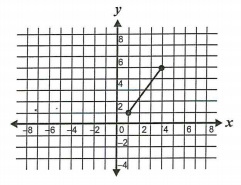
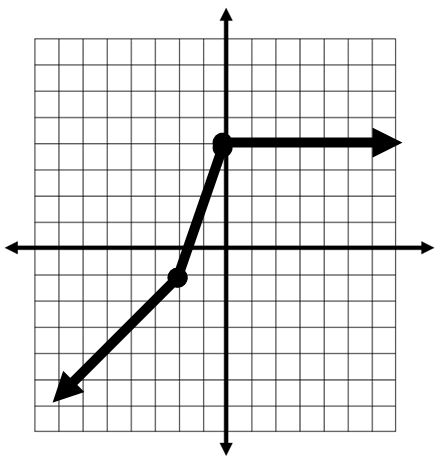
What is the range of the graph?
a)
1 ≤ x ≤ 5
b)
1 < x < 5
c)
1 ≤ y ≤ 5
d)
1 < y < 5
26.
Does the graph represent a function?
a)
Yes, because the vertical line test shows there are no repeating input values
b)
No, because the vertical line test shows there are repeating input values
27.
What is the range of the graph?
a)
-7 ≤ x < 5
b)
-3 ≤ x < 1
c)
-3 ≤ y < 1
d)
-7 ≤ y < 5
28.
Is the relation a function? Why.
a)
Yes, because the x-value 11 has two y-values pair with it.
b)
Yes, because each x-value has only one y-value paired with it.
c)
No, because the x-value 11 has two y-values pair with it.
d)
No, because each x-value has only one y-value paired with it.
29.

What is the range?

a)

x≥0

b)

y≥0

c)

All real numbers

d)

{0, 1, 2, 3, 4,...}

30.

What is the Domain?

a)

-3 < x ≤ 3

b)

-4 ≤ x < 5

c)

-4 ≤ y ≤ 5

d)

-3 < y ≤ 3

31.
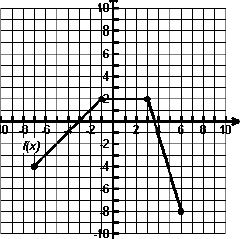
What is the range?
a)
-7≤x≤6
b)
-7<x<6
c)
-8<y<2
d)
-8≤y≤2
32.
What is the domain of the function?
a)
x>3 
b)
x≥-3
c)
y≤4
d)
y<4
33.

When identifying domain and range what symbol(s) is used when the value is included?

a)

( )

b)

[ ]

c)

< >

d)

{ }

34.

When identifying domain and range what symbol(s) is used when the value is not included?

a)

( )

b)

[ ]

c)

≤ ≥

d)

{ }

35.

What is the domain in Interval notation?

a)

[ -2 , 2 ]

b)

[ 4 , -4 ]

c)

(-2 , 2 )

d)

(4 , -4 )

36.

What is the domain in inequality notation?

a)

[ -2 , 2 ]

b)

[ 4 , -4 ]

c)

-2 ≤ x ≤ 2

d)

4 ≥ y ≥ -4

37.

What is the range in interval notation?

a)

[ -2 , 2 ]

b)

[ 4 , -4 ]

c)

-2 ≤ x ≤ 2

d)

4 ≥ y ≥ -4

38.

What is the domain in interval notation?

a)

( -5 , 5 )

b)

[-2 , -4 )

c)

-5 < x < 5

d)

-2 ≥ y > -4

39.

What is the domain in interval notation?

a)

[ -2 , 2 )

b)

( 5 , 1 ]

c)

-2 ≤ x < 2

d)

5 > y ≥ 1

40.

What is the range in interval notation?

a)

[ -2 , 2 )

b)

( 5 , 1 ]

c)

-2 ≤ x < 2

d)

5 > y ≥ 1

41.

What is the domain in inequality notation?

a)

( -4 , 4 )

b)

[ 1 , -3 )

c)

-4 < x < 4

d)

1 ≥ y > -3

42.

Is the following a function?

a)

YES

b)

NO

43.

DOES THIS GRAPH REPRESENT A FUNCTION?

a)

NO

b)

YES

44.

DOES THE GRAPH REPRESENT A FUNCTION?

a)

YES

b)

NO

45.
a)

A

b)

B

c)

C

d)

D

46.
Is the relation a function? Why.
a)
Yes, because the x-value 11 has two y-values pair with it.
b)
Yes, because each x-value has only one y-value paired with it.
c)
No, because the x-value 11 has two y-values pair with it.
d)
No, because each x-value has only one y-value paired with it.
47.
You can identify a function from a graph by using the.....
a)
Horizontal Line Test
b)
Eye Test
c)
Vertical Line Test
d)
Diagonal Line Test
48.
Which graph does NOT pass the vertical line test?
a)
Graph 1
b)
Graph 2
c)
Graph 3
d)
Graph 4
49.
All of the x values or inputs are called what?
a)
Domain
b)
Range
c)
Relation
d)
Function
50.
Identify the range of the following relation:
a)
{-6, 14, 2, 28}
b)
{-6,14, 0, 32, 2, 38, 4,44}
c)
{-6, 0, 2, 4}
d)
{14, 32, 38, 44}
51.
f(n)=x2+1
g(n)=2x-5
Find f(n)-g(n)
a)
x2-2x+6
b)
-x2+2x+4
c)
-x2-2x-6
d)
x2-2x-4
52.
what is the range of y=2x+1 when the domain is {-1,0,4}?
a)
R:{-1,1,9}
b)
R:{1,3,9}
c)
R:{-1,0,4}
d)
R:{3,5,9}
53.
f(n)=n2+4n
g(n)=-n-5
Find f(n)+g(n)
a)
n2+3n-5
b)
-n3+2n-7
c)
n3+3n-3n
d)
n2-3n-5
54.
f(x)=x2+1
g(x)=2x-5
Find f(x)-g(x)
a)
x2-2x+6
b)
-x2+2x+4
c)
-x2-2x-6
d)
x2-2x-4
55.
f(x) = x2+9
g(x) = x-9
Find f(x)-g(x). 
a)
x2+x+9
b)
x2-x+9
c)
x2-x
d)
x2-x+18
56.
f(x) = 9-3x
g(x) = 5x-7
Find f(x)+g(x). 
a)
14x-10
b)
-8x+2
c)
2x+2
d)
2x-2
57.

Evaluate:  g(n)=2n+5; Find g(5)g\left(n\right)=2n+5;\ Find\ g\left(-5\right)  

a)

-1

b)

7

c)

-5

d)

25

58.

Evaluate:  h(x)=2x+2; Find h(7)h\left(x\right)=2x+2;\ Find\ h\left(-7\right)  

a)

-10

b)

-12

c)

-16

d)

6

59.

Evaluate:  f(x)=3x+3; Find f(8)f\left(x\right)=3x+3;\ Find\ f\left(-8\right)  

a)

-15

b)

15

c)

-12

d)

-21

60.


 g(x)=3x1 g\left(x\right)=3x-1\   and  h(x)=2x+3h\left(x\right)=2x+3  Find:  (gh)(2)\left(\frac{g}{h}\right)\left(2\right)  

a)

 57\frac{5}{7}  

b)

 75\frac{7}{5}  

c)

 2923\frac{29}{23}  

d)

 17\frac{1}{7}  

61.

 f(n)=3n+2f\left(n\right)=3n+2  and  g(n)=3n4g\left(n\right)=-3n-4  Find:  (f+g)(10)\left(f+g\right)\left(-10\right)  

a)

-2

b)

91

c)

52

d)

31

62.

 f(x)=x1f\left(x\right)=x-1  and  g(x)=2x+2g\left(x\right)=2x+2  Find:  (fg)(2)\left(f\cdot g\right)\left(2\right)  

a)

160

b)

100

c)

28

d)

6

63.

 f(x)=3x21f\left(x\right)=-3x^2-1  and  g(x)=4x+1g\left(x\right)=-4x+1  Find:  (fg)(8)\left(\frac{f}{g}\right)\left(-8\right)  

a)

 33193\frac{-33}{193}  

b)

 43\frac{4}{3}  

c)

 139\frac{-13}{9}  

d)

 19333\frac{-193}{33}  

64.

 f(a)=3a2f\left(a\right)=-3a-2  and  g(a)=4a+2g\left(a\right)=4a+2  Find:  (fg)(a)\left(\frac{f}{g}\right)\left(a\right)  

a)

 4a+23a2\frac{4a+2}{-3a-2}  

b)

 3a4a3+2a\frac{3a-4}{a^3+2a}  

c)

 4a+23a2\frac{-4a+2}{3a-2}  

d)

 3a24a+2\frac{-3a-2}{4a+2}  

65.

 f(n)=2n2+4f\left(n\right)=-2n^2+4  and  g(n)=2n+2g\left(n\right)=2n+2  Find:  (f+g)(n)\left(f+g\right)\left(n\right)  

a)

 n36n-n^3-6n  

b)

 n2n+6n^2-n+6  

c)

 2n2+2n+6-2n^2+2n+6  

d)

 2n22n+6-2n^2-2n+6  

66.

 g(x)=2x3g\left(x\right)=2x-3  and  h(x)=x3xh\left(x\right)=x^3-x  Find:  (g+h)(x)\left(g+h\right)\left(x\right)  

a)

 x3x3-x^3-x-3  

b)

 x3+x3x^3+x-3  

c)

 5x2-5x-2  

d)

 2x32x22x3-2x^3-2x^2-2x-3  

67.

 f(x)=3x24f\left(x\right)=3x^2-4  and  g(x)=3x+4g\left(x\right)=3x+4  Find:  (fg)(x)\left(f\cdot g\right)\left(x\right)  

a)

 9x3+12x212x169x^3+12x^2-12x-16  

b)

 9x2+9x9x^2+9x  

c)

 4x4+16x24x^4+16x^2  

d)

 9x3+12x2+12x16-9x^3+12x^2+12x-16  

68.
a)
9 - √5
b)
√14
c)
16
d)
4
69.
a)
9 - 8/3
b)
9 + 8/3
c)
3
d)
1/3
70.
Given
f(x) = 3x2 + 7x and g(x) = 2x2 - x - 1, find (f + g)(x).
a)
11x2 - 1
b)
5x4 + 6x2 - 1
c)
5x2 + 6x - 1
d)
5x2 + 8x - 1
71.
f(x) = 3x2 + 7x and g(x) = 2x2 - x - 1, find (f - g)(x).
a)
x2 + 8x + 1
b)
x2 + 6x - 1
c)
5x2 + 8x - 1
d)
x2 + 8x -1
72.
p(x) = 3x + 4
q(x) = 2x2
Find q(p(x))
a)
6x2 + 4
b)
18x+ 48x + 32
c)
18x2 + 32
d)
None of these.
73.
a)
9 - √17
b)
4
c)
2
d)
√8
74.
a)
-1
b)
1
c)
-1/3
d)
-5/3
75.
a)
9 - √5
b)
√14
c)
16
d)
4
76.
a)
9 - 8/3
b)
9 + 8/3
c)
3
d)
1/3
77.
a)
9
b)
3
c)
5
d)
√15
78.
a)
5
b)
25
c)
√23
d)
31
79.
Evaluate f(-2) if f(x) = x+3
a)
-1
b)
1
c)
5
d)
-5
80.
Given
f(x) = 3x2 + 7x and g(x) = 2x2 - x - 1, find (f + g)(x).
a)
11x2 - 1
b)
5x4 + 6x2 - 1
c)
5x2 + 6x - 1
d)
5x2 + 8x - 1
81.
Which graph does NOT pass the vertical line test?
a)
Graph 1
b)
Graph 2
c)
Graph 3
d)
Graph 4
82.

(f - g)(x)

a)

5x2 + 3x

b)

-3x2 - 13x

c)

3x2 + 3x

d)

-3x2 + 3x

83.

(f + g) (x)

a)

5x2 + 3x

b)

4x2 + 3x

c)

5x2 - 3x

d)

4x2 - 40x

84.

Find f(2).

a)

-2

b)

-18

c)

24

d)

6

85.

Given f(x) = x+3, find f(-2).

a)

-1

b)

1

c)

5

d)

-5

86.
Given
 f(x) = 2x2 + 5x - 17,
find f(-1). 
a)
f(-1) = -20
b)
f(-1) = -24
87.
a)
-19
b)
-21
c)
17
d)
-1
88.
a)
6x2 - 1
b)
6x - 3
c)
5x - 1
d)
6x2 - 3x
89.
Given f(x) = 2x and
g(x) = x2+3 , find f(g(x)).
a)
x2+2x+3
b)
4x2+3
c)
2x2+3
d)
2x2+6
90.
Given f(x)= -3x+7 and g(x)=2x2 - 8, find f(g(x)).
a)
f(g(x))= -6x2+31
b)
f(g(x))= -6x2+24
c)
f(g(x))=18x2-84x+6
d)
f(g(x))=9x2-42x-1
91.
Given f(x)= -3x+7 and g(x)=2x2 - 8, find g(f(x)).
a)
g(f(x))= -6x2+31
b)
g(f(x))= -6x2+24
c)
g(f(x))=18x2-84x+90
d)
g(f(x))=9x2-42x-41
92.
Given f(x)= -3x + 7 and g(x)=2x2 - 8, find g(f(x)).
a)
g(f(x))= -6x+ 31
b)
g(f(x))= -6x+ 24
c)
g(f(x))=18x- 84x + 90
d)
g(f(x))=9x- 42x - 41
93.
When is this function increasing?
a)
{x| -2.5 < x < 2.5}
b)
{x| 0 < x < 5}
c)
{x| 0 < x < 55}
d)
{x| -5 < x < 0}
94.
Where is the decreasing?
a)
( −∞, −2.55) , (0, 2.55)
b)
(∞, −6.25) , (36, −6.25)
c)
(−∞, ∞)
d)
(−∞, 0)
95.
What is the range of the graph?
a)
1 ≤ x ≤ 5
b)
1 < x < 5
c)
1 ≤ y ≤ 5
d)
1 < y < 5
96.
 Given f(x)= x+ 25 and g(x)= x - 5, find     (f+g)(x). 
a)
x+ x - 20
b)
x+ x + 20
c)
-x+ x - 20
d)
x- x - 20
97.
g(x) = 2x - 5
h(x) = 4x + 5
Find (g - h)(3)
a)
18
b)
16
c)
-16
d)
28
98.
f(x) = 3x + 10
g(x) = x - 2
Find g(f(-10))
a)
-42
b)
-26
c)
-18
d)
None of these.
99.
What is f when x equals 0?
a)
-5
b)
0
c)
1/2
d)
1
100.
What is f when x equals 4?
a)
-5
b)
0
c)
3
d)
6
101.
What is f when x equals 8?
a)
0
b)
5
c)
11
d)
16
102.
Using the pictured graph, what is f(-3)? 
a)
-3
b)
-1
c)
1
d)
3
103.
On the graph, which portion of the piecewise function is represented in red?
a)
x
b)
0.5x + 2.5       
c)
-1
d)
0.5x + 2
104.

What is the RANGE of the function?

a)

All real numbers

b)

y ≤ 4

c)

y < 4

d)

0 ≤ y ≤ 4

105.
What are the domain restrictions for the green piece of this function?
a)
-2 < x ≤ 1
b)
-1 < x ≤ 0.5
c)
x > -2
d)
x ≤ 1
106.
How many pieces is this Piecewise Function composed of?
a)
1
b)
2
c)
3
d)
4
107.
Find f(-2)
a)
-3
b)
6
c)
8
d)
-6
108.

Find f(0)

a)

-3

b)

18

c)

4

d)

0

109.

Match the graph with the correct equation.

a)
b)
c)
d)
110.

Find f(2)

a)

f(2) = 0

b)

f(2) = 1

c)

f(2) = 3

d)

f(2) = 4

111.

A house painter charges $12 per hour for the first 40 hours he works, $18 for the ten hours after that, and $24 for all hours after that.


How much does he earn for a 70 hour week?

a)

$1020

b)

$1140

c)

$840

d)

He works for free!

112.
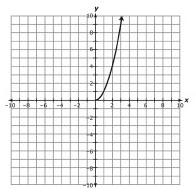
Which parent function matches the graph?
a)
y = |x|
b)
y = ∛(x)
c)
y = x2
d)
y = a⋅bx
113.
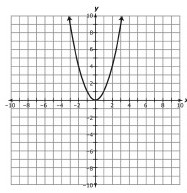
Which parent function matches the graph?
a)
f(x) = x
b)
f(x)= x2
c)
f(x) = |x|
d)
f(x) = abx
114.
Which parent function matches the graph?
a)
f(x) = x
b)
f(x)= x2
c)
f(x) = |x|
d)
f(x) = abx
115.
What type of function is shown?
a)
exponential
b)
linear
c)
quadratic
d)
square root
116.
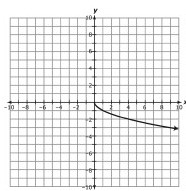
Which parent function matches the graph?
a)
f(x) = √(x)
b)
f(x) = ∛(x)
c)
f(x) = |x|
d)
f(x) = a⋅bx
117.
Name the parent function. 
a)
constant
b)
quadratic
c)
linear
d)
exponential
118.
Name the parent function.
a)
linear
b)
quadratic
c)
cube root
d)
cubic
119.
Domain is: 
a)
All x values, from left to right.
b)
All y values, from bottom to top.
c)
All x values from bottom to top. 
d)
All y values from left to right.
120.

Which parent function is shown?

a)

f(x) = sin x

b)

f(x) = x

c)

f(x)=2xf\left(x\right)=2^x

d)

f(x)=xf\left(x\right)=\sqrt{x}

121.

Which of the following parent functions does not have a Domain of all Real numbers?

a)
b)
c)
d)
122.

Describe the transformation that occurred

p(x) = f(x + 3)

a)

Right 3 units

b)

Vertical Stretch

c)

Up 3 units

d)

Left 3 units

123.

Describe the transformation that occurred.

h(x) = f(x) + 2

a)

up 2 units

b)

left 2 units

c)

Vertical Strech

d)

right 2 units

124.

Describe the transformation that occurred.

w(x) = f(x - 7)

a)

Down 7

b)

Up 7

c)

Right 7

d)

vertical compression

125.

Describe the transformation that occurred

m(x) = f(x + 1)

a)

Left 1 Unit

b)

Right 1 unit

c)

vertical stretch

d)

up 1 unit

126.

Describe the transformation that occurred

k(x) = f(x) - 9

a)

vertical compression

b)

Down 9 units

c)

Left 9 units

d)

Right 9 Units

127.

Describe the transformation that occurred

g(x) =2f(x)

a)

Up 2 units

b)

vertical compression

c)

vertical stretch

d)

Right 2 Units

128.

Describe the transformation that occurred

h(x) = 1/5f(x)

a)

Up 5 Units

b)

vertical compression

c)

vertical stretch

d)

Down 5 Units

129.

Describe the transformation that occurred

s(x) = 7f(x)

a)

vertical compression

b)

Up 7 Units

c)

Over 7 Units

d)

vertical stretch

130.
Describe the transformation that occurred 
d(x) = f(x) - 1
a)
Left 1 Unit
b)
Right 1 Unit
c)
Up 1 Unit
d)
Down 1 Unit
131.

Describe the transformation that occurred

p(x) = f(x + 3)

a)

Right 3 units

b)

Vertical Stretch

c)

Up 3 units

d)

Left 3 units

132.

Describe the transformation that occurred.

h(x) = f(x) + 2

a)

up 2 units

b)

left 2 units

c)

Vertical Strech

d)

right 2 units

133.

Describe the transformation that occurred.

w(x) = f(x - 7)

a)

Down 7

b)

Up 7

c)

Right 7

d)

vertical compression

134.

Which graphs have a line of symmetry? Check all of the boxes that apply.

a)
b)
c)
135.

Which functions are symmetric about the y-axis? Check all of the boxes that apply.

a)
b)
c)
136.

Which functions are even? Check all of the boxes that apply.

a)

f(x)=x4x2f\left(x\right)=x^4-x^2

b)

f(x)=x23x+2f\left(x\right)=x^2-3x+2

c)

f(x)=(x2)f\left(x\right)=\sqrt{\left(x-2\right)}

d)

f(x)=xf\left(x\right)=\left|x\right|

137.

Which graphs have rotational symmetry? Check all of the boxes that apply.

a)
b)
c)
138.

This graph has rotational symmetry about the point:

4 lines
139.

Check all of the functions that are odd.

a)

f(x)=x3x2f\left(x\right)=x^3-x^2

b)

f(x)=x53x3+2xf\left(x\right)=x^5-3x^3+2x

c)

f(x)=4x+9f\left(x\right)=4x+9

d)

f(x)=1xf\left(x\right)=\frac{1}{x}

140.
Label the function as even, odd or neither
f(x) = x+ 4x 
a)
Even 
b)
Odd
c)
Neither
141.
Label the function as even, odd or neither
f(x) = 3x4 - 2x+ 5
a)
Even
b)
Odd
c)
Neither
142.
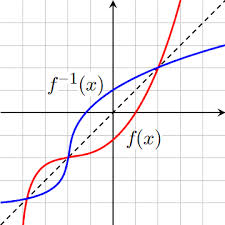
The inverse has been reflected over which line?
a)
y = x
b)
x = 0
c)
y = 0
d)
x = -y
143.
The inverse of the function f(x) is written as ...
a)
f -1(x)
b)
f 2(x)
c)
f '(x)
d)
f +(x)
144.

Which of the following is NOT TRUE about inverse functions?

a)

Inverse functions are reflections of each other over the line y = x.

b)

You find the inverse by switching x and y in the equation.

c)

The domain of a function always becomes the domain of its inverse.

d)

The domain of a function always becomes the range of its inverse.
145.

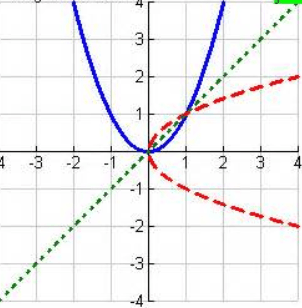
What's the best description?

a)

They are both functions, but not inverse functions.

b)

They are reflected over y=x, but they are not both functions.

c)

They are not reflected over y=x, and they are not both functions.
d)

They are inverse functions.

146.

What is the best description?

a)

They are both functions, but not inverse functions.

b)

They are inverse functions.

c)

They are reflected over y=x, but they are not both functions.

d)

They are not reflected over y=x, and they are not both functions.

147.

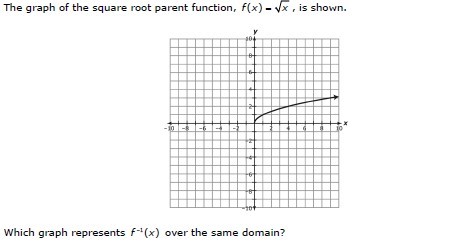
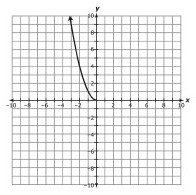
Which graph represents f-1(x) over the same domain?
a)
b)
c)
d)
148.

f(x) = -4x - 12

What is f-1(x)?

a)

f-1(x) = 4x - 3

b)

f-1(x) = -1/4x - 3

c)

f-1(x) = 1/4x + 3

d)

f-1(x) = -4x - 3

149.

Which is f -1(x)?

a)

f -1(x) = 5x + 3

b)

f -1(x) = 5x - 3

c)

f -1(x) = 5x - 15

d)

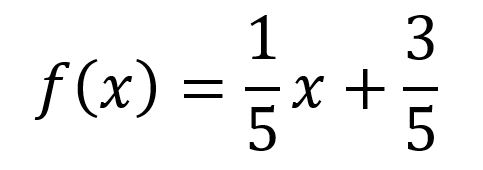
f -1(x) = 1/5(x) + 3/5

150.

Which is f -1(x)?

a)

f -1(x) = 3x + 5

b)

f -1(x) = 3x - 5

c)

f -1(x) = 3x - 15

d)

f -1(x) = 3x + 15

151.
a)
b)
c)
d)
152.
a)
b)
c)
d)
153.

How must the domain of f(x) be restricted such that g(x)=f-1(x) ?

a)

x ≤ 0

b)

x ≥ 0

c)

x ≤ 3

d)

x ≥ 3

154.

How must the domain of f(x) be restricted such that g(x)=f-1(x) ?

a)

x ≤ -4

b)

x ≥ -4

c)

x ≤ 0

d)

x ≥ 0

155.

If the equation of f(x) goes through (-1, 4) and (4, 6), what points does f-1(x) go through?

a)

(1, 4) and (4, 6)

b)

(-4, -1) and (-6, -4)

c)

(-1, -4) and (-4, -6)

d)

(4, -1) and (6, 4)

156.
What is the inverse of the given coordinates: (1, 2) (3, 8) (-3, 6)
a)
(1, 2) (3, 8) (-3, 6)
b)
(1, 2) (8, 3) (-3, 6)
c)
(-1, -2) (-3, -8) (3, -6)
d)
(2, 1) (8, 3) (6, -3)
157.
If f-1(-25) = 7 then what is f(7) = 
a)
25
b)
7
c)
No enough information. 
d)
-25
158.

What is the FIRST step I need to take to solve for x in the following equation?

a)

Add 9 to both sides

b)

Take the square root of both sides

c)

Divide both sides by 49

d)

Multiply both sides by 9

159.
Are the following inverses of each other?
a)
True
b)
False
160.
Find the inverse of f(x) = -4x - 12
a)
f-1(x) = 4x - 3
b)
f-1(x) = -1/4x - 3
c)
f-1(x) = 1/4x + 3
d)
f-1(x) = -4x - 3
161.
Find the inverse of
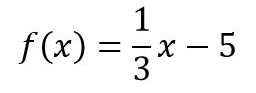
f(x) = 1/4x - 7
a)
f-1(x) = 4x + 7
b)
f-1(x) = -4x + 28
c)
f-1(x) = -4x - 7
d)
f-1(x) = 4x + 28
162.
Was the inverse function found correctly?
a)
no,
b)
yes
163.

 f(x)=3xf\left(x\right)=3x  
Find  f1(x)f^{-1}\left(x\right)  

a)

 x3\frac{x}{3}  

b)

 3x\frac{3}{x}  

c)

 0.3x0.3x  

d)

 x×3x\times3  

164.

 f(x)=5x+1f\left(x\right)=5x+1  
Find  f1(x)f^{-1}\left(x\right)  

a)

 x51\frac{x-5}{1}  

b)

 x51\frac{x}{5}-1  

c)

 x15x-\frac{1}{5}  

d)

 x15\frac{x-1}{5}  

165.

 f1(x)=13x+53f^{-1}\left(x\right)=\frac{1}{3}x+\frac{5}{3}  , find the original function and type it below using function notation. 

(a)  

166.

 g(x)=7x5+7g\left(x\right)=-7x^5+7  Find the inverse of the function.

a)

 g1(x)=5x77g^{-1}\left(x\right)=^5\sqrt{\frac{x-7}{7}}  

b)

 g1(x)=5x77g^{-1}\left(x\right)=-^5\sqrt{\frac{x-7}{7}}  

c)

 g1(x)=5x77g^{-1}\left(x\right)=^5\sqrt{-\frac{x-7}{7}}  

d)

 g1(x)=5x77g^{-1}\left(x\right)=-^5\sqrt{\frac{x-7}{7}}  

167.

Given the inverse of a function. Using function notation, type the original function (Hint: Use the carat (^) symbol for the exponent). 
 f1(x)=34xf^{-1}\left(x\right)=^3\sqrt{4-x}  


(a)