wayground logo

Free Printable Worksheets

Font size

S
M
L
XL
Worksheets

Pre Calculus Semester 1 Review

Total questions: 105

Worksheet time: 3hrs 58mins

Name
Class
Date
1.
Whole numbers are natural numbers together with "zero."
a)
True
b)
False
2.
What is true about irrational numbers?
a)
They are terminating decimals.
b)
They are non-repeating decimals.
c)
They are fractions.
d)
They are natural numbers.
3.
Integers are whole numbers and their opposites.
a)
True
b)
False
4.
Which of the following statements is always true?
a)
All integers are whole numbers
b)
all rational numbers are integers
c)
some whole numbers are not rational numbers
d)
all whole numbers are integers
5.
Express the following in Interval Notation
-8 ≤ x < 8
a)
[-8, 8]
b)
[-8,8)
c)
(-8, 8]
d)
(-8, 8)
6.
Express the following interval in Set notation:
(-7, 15]
a)
-7 ≤ x ≤ 15
b)
-7 < x ≤ 15
c)
-7 ≤ x < 15
d)
-7 < x < 15
7.
Look at the graph. Write the inequality in interval notation.
a)
(-2,5)
b)
(-∞,-2)⋃(5,∞)
c)
[-2,5]
d)
(-∞,-2]∪[5,∞)
8.
Write the following in interval notation
x ≥ 100
a)
(0, 100]  (Real quick)
b)
(∞, 100]
c)
[100, ∞)
d)
(∞, 100)
9.
Write the following in interval notation
x > 6 and x ≤ 10
a)
(-∞, 6) and (10, ∞)
b)
[6, 10)
c)
(-∞, 6] and [10, ∞)
d)
(6, 10]
10.
Look at the picture. Which number line corresponds to [-2, 5]?
a)
Graph 1
b)
Graph 2
c)
Graph 3
d)
Graph 4
11.
What is the reason that absolute value is always written as a positive?
a)
Absolute value is talking about numbers so it must be positive.
b)
Absolute value does not always have to be positive.
c)
Absolute value is like a clock it has only positive numbers.
d)
Absolute value is talking about distance, distance is always measured by positive numbers.
12.
What is the domain of the graph?
a)
[-7, 5)
b)
(-7, 5]
c)
[-3, 1)
d)
(-3, 1]
13.
Find the Domain.
a)
All real numbers
b)
x > 3
c)
x > 0
d)
x ≥ 0
14.

What is the RANGE of the function?

a)

All real numbers

b)

y ≤ 4

c)

y < 4

d)

0 ≤ y ≤ 4

15.
What is the DOMAIN?
a)
(-∞, +∞)
b)
(-∞, -1] U [3, +∞)
c)
[-1, +∞)
d)
(-1, 0] U (0, +∞)
16.
What is the RANGE?
a)
(-∞, +∞)
b)
(-∞, -1] U [3, +∞)
c)
[-1, +∞)
d)
(-1, -∞)
17.
What is the DOMAIN?
a)
(-∞, +∞)
b)
(-∞, -5) U [-2, +∞)
c)
(-∞, 2]
d)
(-∞, 2] U (2, +∞)
18.
What is the RANGE?
a)
(-∞, +∞)
b)
(-∞, 0) U [0, +∞)
c)
(-∞, -2] U (3, +∞)
d)
(-∞, 2] U (2, +∞)
19.

What is/are the increasing interval(s) for the function shown?

a)

(3, 1)\left(-3,\ 1\right)

b)

(4, 8)\left(4,\ 8\right)

c)

(,1) and (3, 1)\left(-\infty,1\right)\ and\ \left(-3,\ 1\right)

20.

What is/are the decreasing interval(s) for the function shown?

a)

 (2, 4) and (8, )\left(2,\ 4\right)\ and\ \left(8,\ \infty\right) 

b)

 (, 1) and (8, )\left(-\infty,\ 1\right)\ and\ \left(8,\ \infty\right) 

c)

 (,1), (3, 1) and (8, )\left(-\infty,1\right),\ \left(-3,\ 1\right)\ and\ \left(8,\ \infty\right) 

d)

 (, 1), (2, 4) and (8, )\left(-\infty,\ 1\right),\ \left(2,\ 4\right)\ and\ \left(8,\ \infty\right) 

21.

Would You Rather...

a)

not be allowed to eat your five favorite foods for an entire year

b)

be allowed to eat only your five favorite foods for an entire year

22.

What is the decreasing interval(s) on the function shown?

a)

(7, 6) and (2, 4)\left(-7,\ -6\right)\ and\ \left(-2,\ 4\right)

b)

(7, 0) and (2, 4)\left(-7,\ 0\right)\ and\ \left(-2,\ 4\right)

c)

(7, 6) and (2, 0)\left(-7,\ -6\right)\ and\ \left(-2,\ 0\right)

d)

(7, 0) and (4, 5)\left(-7,\ 0\right)\ and\ \left(4,\ 5\right)

23.

Find the Domain of the function.
 f(x)=x3f\left(x\right)=\sqrt{x-3}  

a)

 x =3x\ =3  

b)

 x>3x>-3  

c)

 x3x\ge3  

d)

 x3x\ne3  

24.

Find the Domain of the function.

 f(x)=2x+16f\left(x\right)=\sqrt{2x+16}  

a)

 x8x\ge-8  

b)

 x16x\ge-16  

c)

 x8x\ge8  

d)

 x16x\ge16  

25.

What are the transformations of this functions compared to the parent function?

 y=x+2y=\sqrt{x+2}  

a)

Shifted down 2

b)

Shifted up 2

c)

Shifted left 2

d)

Shifted right 2

26.

Which of these equations shifts a radical equation right 5 units and down one unit?

a)

y=x51y=\sqrt{x-5}-1

b)

y=x+51y=\sqrt{x+5}-1

c)

y=x5+1y=\sqrt{x-5}+1

d)

y=x+5+1y=\sqrt{x+5}+1

27.

What function best describes this graph?

a)

y=x+42y=-\sqrt{x+4}-2

b)

y=x42y=\sqrt{x-4}-2

c)

y=x42y=-\sqrt{x-4}-2

d)

y=x+4+2y=\sqrt{x+4}+2

28.

What effect does "+5" have on the graph of the function

 y=x+5y=\sqrt{x}+5  

a)

It translates the graph 5 units up.

b)

It translates the graph 5 units to the left.

c)

It translates the graph 5 units to the right.

d)

It translates the graph 5 units down.

29.

 f(x)=x2+1f\left(x\right)=x^2+1  and  g(x)=x+1g\left(x\right)=x+1  Which of the following best represents  f(g(x))f\left(g\left(x\right)\right)  ?

a)

 x2+2x^2+2  

b)

 x2+2x+2x^2+2x+2  

c)

 x2+3x^2+3  

d)

 x2+4x+4x^2+4x+4  

30.

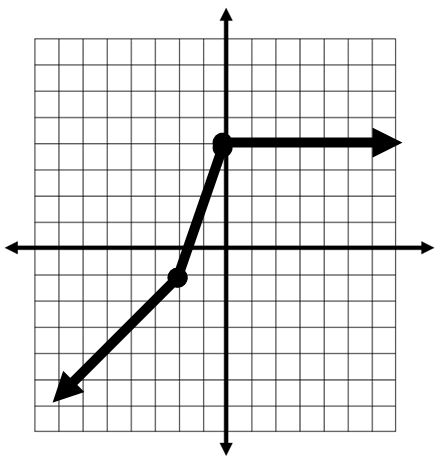
For the function f(x) and g(x) given in the graph, Find the corresponding function value.

 f(g(3))f\left(g\left(3\right)\right)  

a)

4

b)

2

c)

1

d)

0

31.

From the table below calculate the quantity asked for:

Find  g(f(2))g\left(f\left(-2\right)\right)  

a)

-4

b)

5

c)

6

d)

1

32.
When f(x) = 4x+8 and
g(x) = x+3, find
f(x) * g(x). 
a)
4x2+24
b)
4x2+20x+24
c)
4x2+12x+24
d)
4x2+4x+24
33.
f(x)=x+3
g(x)=x-2
Find (g/f)(x)
a)
(x+3)/(x-2)
b)
(x-2)/(x+3)
c)
-2/3
d)
3/2
34.

Perform (g - f)(x) given  g(x)=2x1g\left(x\right)=-2x-1  and  f(x)=3x+4f\left(x\right)=3x+4  

a)

 5x+55x+5  

b)

 5x5-5x-5  

c)

 x2+2x4-x^2+2x-4  

d)

 5x+5-5x+5  

35.

What number CANNOT be in the denominator of a fraction?

a)

a negative number

b)

0

c)

1

d)

any whole number

36.

Find the domain of

 f(x)=x+1x3f\left(x\right)=\frac{x+1}{x-3}  

a)

 (, 3)U( 3, )\left(-\infty,\ 3\right)U\left(\ 3,\ \infty\right)  

b)

 (,  1) U( 1,)\left(-\infty,\ \ -1\right)\ U\left(\ -1,\infty\right)  

c)

 (3,)\left(3,\infty\right)  

d)

 (,1) (1, 3) (3, )\left(-\infty,-1\right)\ \left(-1,\ 3\right)\ \left(3,\ \infty\right)  

37.

What is the domain of

 f(x)=2x4f\left(x\right)=\frac{2}{x-4}  

a)

 2<x-2<x  

b)

 4<x4<x  

c)

 All real numbersAll\ real\ numbers  

d)

 All real numbers, x 4All\ real\ numbers,\ x\ \ne4  

38.
Which one of the following functions is even?
a)
f(x) = x⁴ + x³
b)
g(x) = x⁴ + x²
c)
h(x) = x⁵ + x³
d)
k(x) = x³ + x
39.

Is the function even, odd, or neither?

f(x) = x2 + 2

a)

Even

b)

Odd

c)

Neither

40.

 y=x24x+1y=\frac{x^2-4}{x+1} 

a)

Even Function

b)

Odd Function

c)

Function - neither even nor odd

d)

Not a function

41.
The inverse of the function f(x) is written as ...
a)
f -1(x)
b)
f 2(x)
c)
f '(x)
d)
f +(x)
42.

who is this???

a)

pepa pig

b)

pig wearing a red dress

c)

Patrick

d)

bob

43.

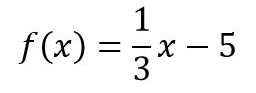
f(x) = -4x - 12

What is f-1(x)?

a)

f-1(x) = 4x - 3

b)

f-1(x) = -1/4x - 3

c)

f-1(x) = 1/4x + 3

d)

f-1(x) = -4x - 3

44.

Which is f -1(x)?

a)

f -1(x) = 3x + 5

b)

f -1(x) = 3x - 5

c)

f -1(x) = 3x - 15

d)

f -1(x) = 3x + 15

45.
sin π/4
a)
√2∕2
b)
1/2
c)
√3/2
d)
0
46.
cos 5π/6
a)
-1/2
b)
1/2
c)
√3/2
d)
-√3/2
47.
a)
-√3/2
b)
c)
-√2/2
d)
-1
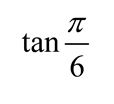
48.
a)
√3/3
b)
√3
c)
1
d)
undefined
49.
At what point are sine and cosine the same value?
a)
0
b)
90
c)
45
d)
60
50.
sinθ is positive in
a)
the 1st and 2nd quadrants
b)
the 1st and 3rd quadrants
c)
the 1st and 4th quadrants
d)
the 2nd and 3rd quadrants
51.
What is the radius of a unit circle?
a)
1
b)
2
c)
1/2
d)
0
52.
cosθ is positive in
a)
the 1st and 2nd quadrants
b)
the 1st and 3rd quadrants
c)
the 1st and 4th quadrants
d)
the 2nd and 3rd quadrants
53.

tanθ is positive in

a)

the 1st and 2nd quadrants

b)

the 1st and 3rd quadrants

c)

the 1st and 4th quadrants

d)

the 2nd and 3rd quadrants

54.

If I wanted to find the sine of an angle, what side lengths would I need to know?

a)

base, hypotenuse

b)

hypotenuse, adjacent

c)

opposite, hypotenuse

d)

adjacent, opposite

55.

What is the reciprocal of the sine function?

a)

cosecant

b)

cosine

c)

secant

d)

cotangent

56.
Based on the unit circle, what is the value of tan?
a)
y/r
b)
x/r
c)
r/y
d)
y/x
57.
sec 3π/2
a)
0
b)
undefined
c)
1
d)
-1
58.


 cos1[cos(7π6)]\cos^{-1}\left[\cos\left(\frac{7\pi}{6}\right)\right]  

a)

 7π6\frac{7\pi}{6}  

b)

 5π6\frac{5\pi}{6}  

c)

 π6\frac{\pi}{6}  

d)

 π6-\frac{\pi}{6}  

59.


 sin(cos1 12)\sin\left(\cos^{-1}\ \frac{1}{2}\right)  

a)

 32\frac{\sqrt{3}}{2}  

b)

 12\frac{1}{2}  

c)

 π6\frac{\pi}{6}  

d)

 π3\frac{\pi}{3}  

60.

Find the exact value of the composite function.

 sec(tan13)\sec\left(\tan^{-1}\sqrt{3}\right)  

a)

2

b)

 12\frac{1}{2}  

c)

-2

d)

Not defined

61.

 sin(cos1 32)\sin\left(\cos^{-1}\ \frac{\sqrt{3}}{2}\right)  

a)

-1/2

b)

π/6

c)

1/2

d)

5π/6

62.

Would You Rather...

a)

play on a baseball team that always wins but always has to play in the rain

b)

play on a baseball team that always plays in sunny weather, but also always loses.

63.

tan(sin-1(-1/2))

a)

3\sqrt{3}

b)

33\frac{\sqrt{3}}{3}

c)

3-\sqrt{3}

d)

33-\frac{\sqrt{3}}{3}

64.
What range of angles for inverse cosine?
a)
[0, π]
b)
[0, 2π]
c)
[-π/2, π/2]
d)
[π/2, 3π/2]
65.
What is the range of angles for inverse sine?
a)
[0, π]
b)
[0, 2π]
c)
[-π/2, π/2]
d)
[π/2, 3π/2]
66.

Name a quadrant in which ∠A can lie in, if cosA is negative?

a)

2

b)

4

c)

3

d)

1

67.

Name the quadrant in which ∠A lies, if cosA > 0, sinA < 0

a)

1

b)

2

c)

3

d)

4

68.

Choose the quadrant where both the tangent and cosine functions produce a negative value.

a)

Quadrant 1

b)

Quadrant 2

c)

Quadrant 3

d)

Quadrant 4

69.

Which trig functions are positive in Q3?

a)

 sinθ,cscθ\sin\theta,\csc\theta 

b)

 cosθ,secθ\cos\theta,\sec\theta 

c)

 tanθ,cotθ\tan\theta,\cot\theta 

d)

none of the above

70.

Let (-4, 3) be a point on the terminal side of θ. Which of the following is FALSE?

a)

cot θ = -4/3

b)

tan θ = -3/4

c)

sin θ = 3/5

d)

cos θ = 4/5

71.

If sinθ = -5/13 and tanθ > 0, then cosθ =

a)

13/12

b)

-13/12

c)

12/13

d)

-12/13

72.

Find a coterminal angle to 5°.

a)

365°

b)

255°

c)

-220°

d)

-365°

73.

Find a coterminal angle to -27°.

a)

-387°

b)

27°

c)

323°

d)

-393°

74.

What are the negative and positive coterminal angles of -165°?

a)

435°, -545°

b)

185°, -305°

c)

195°, -525°

d)

125°, -185°

75.

Which of the following angles are co-terminal to  5π6\frac{5\pi}{6}  ?

a)

 17π6\frac{17\pi}{6}  ,  7π6\frac{-7\pi}{6}  

b)

 π6-\frac{\pi}{6}  ,  11π6\frac{11\pi}{6}  

c)

 23π6\frac{23\pi}{6}  ,  13π6\frac{-13\pi}{6}  

d)

 5π6\frac{-5\pi}{6}  ,  7π6\frac{7\pi}{6}  

76.

Would You Rather...

a)

have a very strict teacher, but learn a lot

b)

have a really nice teacher, but not learn much.

77.

Which of the following angles are co-terminal to  13π6\frac{13\pi}{6}  ?

a)

 17π6\frac{17\pi}{6}  ,  7π6\frac{-7\pi}{6}  

b)

 π6-\frac{\pi}{6}  ,  11π6\frac{11\pi}{6}  

c)

 25π6\frac{25\pi}{6}  ,  11π6\frac{-11\pi}{6}  

d)

 25π6\frac{-25\pi}{6}  ,  7π6\frac{7\pi}{6}  

78.

How many radians is 250 degrees?

a)

4π/3

b)

25π/18

c)

5π/6

d)

50π/9

79.

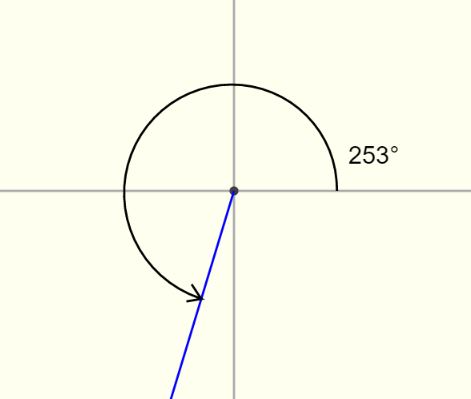
Name the angle indicated by the graph in both radians and degrees.

a)

135°, 3π4-135\degree,\ -\frac{3\pi}{4}

b)

225°, 5π4225\degree,\ \frac{5\pi}{4}

c)

120°, 2π3-120\degree,\ -\frac{2\pi}{3}

d)

210°, 7π6210\degree,\ \frac{7\pi}{6}

80.

Name the angle indicated by the graph in both radians and degrees.

a)

300°, 5π3300\degree,\ \frac{5\pi}{3}

b)

315°, 7π4315\degree,\ \frac{7\pi}{4}

c)

60°, π3-60\degree,\ -\frac{\pi}{3}

d)

300°, 5π3-300\degree,\ -\frac{5\pi}{3}

81.

What is the reference angle?

a)

163

b)

73

c)

27

d)

107

82.

Which of the following is a correct representation of the reference angle of  θ=210°\theta=210\degree  

a)
b)
c)
d)
83.

What is the period of the equation shown?

a)

b)

c)

π / 2

d)

π

84.

Describe the horizontal shift.

a)

left π / 2

b)

left 2π

c)

right 2π

d)

right π / 2

85.

Describe the horizontal shift.

a)

left 3π / 4

b)

left 4π / 3

c)

right 3π

d)

right 3π / 4

86.

Describe the horizontal and vertical shifts.

a)

left π , up 4

b)

left π , down 3

c)

right π , up 4

d)

right π , down 3

87.
The __________ represents half the distance between the max and min of a sine or cosine graph. 
a)
Period
b)
Frequency
c)
Extreme Values
d)
Amplitude
88.
The period of a sine or cosine graph can be found by ....
a)
It's always 2π
b)
2π/B
c)
B(2π)
d)
2π+B
89.

How do you find the period of a tangent function?

a)

270/b

b)

π/b

c)

360/b

d)

2π/b

90.

What trigonometric functions have vertical asymptotes?

a)

sine

b)

cosine

c)

tangent

d)

none listed here

91.

Solve the equation for 0°θ360°0\degree\le\theta\le360\degree . Select ALL correct answers.

 tanθ=3\tan\theta=-\sqrt{3}  

a)

 60°60\degree  

b)

 120°120\degree  

c)

 240°240\degree  

d)

 300°300\degree  

92.

Solve the equation for 0°θ360°0\degree\le\theta\le360\degree . Select ALL correct answers.

 6sinθ=36\sin\theta=3  

a)

 60°60\degree  

b)

 300°300\degree  

c)

 30°30\degree  

d)

 150°150\degree  

93.

Solve the equation for 0°θ360°0\degree\le\theta\le360\degree . Select ALL correct answers.

 2sinθcosθ2cosθ=02\sin\theta\cos\theta-\sqrt{2}\cos\theta=0  

a)

 45°45\degree  

b)

 90°90\degree  

c)

 135°135\degree  

d)

 270°270\degree  

e)

 315°315\degree  

94.
Solve sinθ = ½ on θ∈[0, 2π)
a)
θ = π / 6,  7π / 6
b)
θ = π / 6,  5π / 6
c)
θ = 5π / 6,  7π / 6
d)
θ = 7π / 6,  11π / 6
95.
Solve
cos2θ = ½ 
on θ∈[0, 2π)
a)
θ = π /4, 7π /4
b)
θ = π /4, 3π /4
c)
θ = 3π /4, 5π /4
d)
θ = π /4, 3π /4, 5π /4, 7π /4
96.
2 sinθ+3=2
a)
π/6,2π/3
b)
7π/6 
c)
7π/6, 11π/6
97.
Solve on the domain [0,2π)
1/4sin x + 1= 0
a)
0
b)
7π/4
c)
5π/4
d)
No solution
98.
Solve on the domain [0, 2π)
cos x + 2 = 3 cos x
a)
0, 2π/3, 4π/3
b)
π
c)
0
d)
No solution
99.

tanθ = 

a)

1/cosθ

b)

1/sinθ

c)

cosθ/sinθ

d)

sinθ/cosθ

100.

cotθ =

a)

1/cosθ

b)

1/cscθ

c)

1/secθ

d)

1/tanθ

101.

Simplify

 cotθtanθ\cot\theta\tan\theta  

a)

sin²θ/cos²θ

b)

1

c)

0

d)

cos²θ/sin²θ

102.

Simplify
 secθcotθsinθ\sec\theta\cot\theta\sin\theta  

a)

-1

b)

sin θ

c)

csc θ

d)

1

103.

Simplify

 tanxcscxcosx\tan x\csc x\cos x  

a)

1/cos x

b)

1

c)

cot x

d)

-1

104.

 1sin2x =1-\sin^2x\ =  

a)

 sin2x\sin^2x  

b)

 cos2x\cos^2x  

c)

 sec2x\sec^2x  

d)

 csc2x\csc^2x  

105.
Name that cartoon
a)
Phineas & Ferb
b)
Gravity Falls
c)
ALVINNN!!! and The Chipmunks
d)
SpongeBob SquarePants