
 Worksheets
Mid-Term review
Total questions: 20
Worksheet time: 10mins
Which of the following is an element of art?
texture
color
line
all of the answers are correct
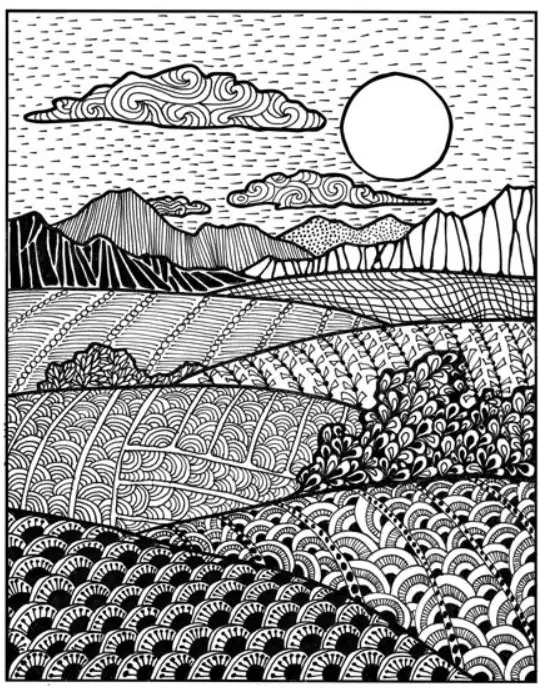
During N1, Week 1, you created a patterned landscape line the one shown.
In order to create the illusion of space, you made background elements and design smaller and less detailed.
The process of doing this is called ________________________ perspective.
linear
atmospheric
intuitive

A mandala like the one shown here is an example of radial symmetry. True or false?
True
False
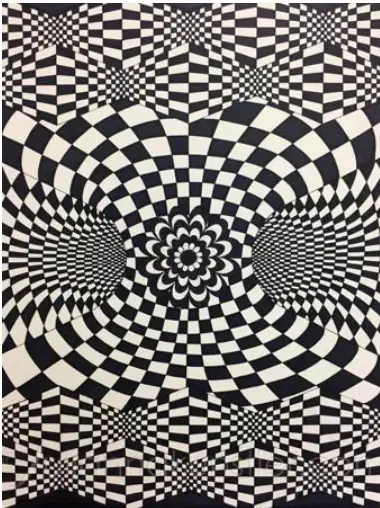
Referring to the assignment we completed during N1_Week 5, Optical Art:
True or false?
Optical art is art that uses shapes, colors and patterns in special ways to create images that look as if they are moving or blurring.
See image for reference.
True
False
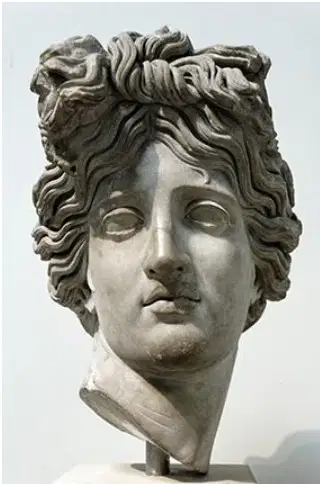
Referring to the Classical Facial Proportions drawings we did during N1_Week 7:
The eyes are placed exactly 1/3 of the way down from the top of the head. True or false?
true
false
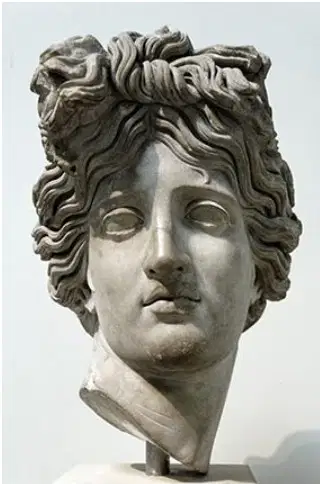
Referring to the Classical Facial Proportions drawings we did during N1_Week 7:
The bottom of the nose is placed exactly 1/3 of the way down from the eye line. True or false?
true
false
What is the primary purpose of adding value (shading) in drawing? Choose the BEST answer.
to add detail
to create depth and dimension
to make the artwork colorful
What is the term for the way the items in a piece of artwork are arranged or composed?
contrast
balance
composition
rhythm
What does "perspective" in art refer to?
The arrangement of colors within a piece
The technique of showing three-dimensional space on a flat surface
The materials used to create the artwork
The size and shape of objects in an artwork
A labyrinth is a type of maze. True or false?
true
false
"Photorealism" refers to an artwork that follows the source reference as closely as possible AND allows for artistic additions of things that were not in the source reference. Is that statement true or false.
true
false
What is the difference between “form” and “shape” in art?
Form refers to the flat, 2-dimensional quality of an object, while shape refers to its 3-dimensional quality.
Shape is the flat, 2-dimensional aspect of an object, while form refers to its 3-dimensional quality.
There is no difference between shape and form.
Form only refers to geometric shapes, while shape refers to organic forms.
In one-point perspective, objects appear to recede toward two vanishing points on the horizon line.
True
False
The color green is a secondary color, created by mixing blue and yellow.
true
false
What is "symmetrical balance" in art?
When the artwork or object is divided equally along a central axis, with each side being identical or nearly identical
When elements are arranged randomly throughout the composition
When elements are balanced through color contrast
When different elements are arranged according to the principles of the Golden Ratio
What does the term "value" refer to in the context of art?
The intensity of a color
The relative lightness or darkness of a color or shade of gray
The combination of colors to create harmony
The use of color in an artwork
Which of the following is an example of an "organic shape"?
triangle
hexagon
leaf
square
Which of the following best describes the "focal point" in a work of art?
The area of the artwork that is visually emphasized and draws the viewer's attention
The lightest area in a piece of artwork
The background of an artwork
The repetition of shapes or patterns in a piece
What is "contrast" in art?
The gradual transition from one color to another
The relationship between elements that are opposite, such as light and dark
The repetition of elements in an artwork
The balanced use of color and form in a composition
Think back to the circles and rings and circles project from N2_Week 3.
Depth and distance was created in two ways. One way was through linear perspective. The other way was through ___________________ the rings and circles.
overcharging
interchanging
interlocking
overlapping

