

wayground logo

Free Printable Worksheets

NEW

Font size

S
M
L
XL
Worksheets

1st Semester Review 2

Total questions: 15

Worksheet time: 14mins
Name
Class
Date
1.
Which biomolecule is made of nucleotides and contain you DNA?
a)
Carbohydrate
b)
Lipids
c)
Protein
d)
Nucleic Acid
2.
Which biomolecule is responsible for insulation and LONG term energy storage?
a)
Proteins
b)
Nucleic Acids
c)
Lipids
d)
Carbohydrates
3.

Which would most likely result in primary succession?

a)

old forest growing

b)

undisturbed prairie

c)

pollution kills mountain lake species

d)

a Newly formed volcanic island

4.

Which progression best explains secondary succession?

a)

lichens>grass>shrubs>small trees> big trees

b)

mosses>creates soil>grasses>small trees> big trees

c)

Volcano destroys ecosystem>grasses>shrubs>small trees>big trees

d)

Volcano forms new island> lichens>grasses>shrubs>small trees>big trees

5.

How do pioneer species compare in primary and secondary succession?

a)

primary starts with grass and weeds, secondary starts with mosses

b)

primary starts with forest fire, secondary starts with volcano

c)

primary starts with a volcano, secondary starts with a forest fire

d)

Lichens and moss in primary, and grasses/ ferns in secondary
6.
Where the better adapted organisms survive to pass traits along to offspring.
a)
Evolution
b)
Natural Selection
c)
Extinction
d)
Artifical Selection
7.
Why are advantageous traits more likely to be passed onto offspring?
a)
Because they are more likely to survive and reproduce.
b)
Because they come from dominant alleles.
c)
Because they come from recessive alleles.
d)
Because the trait is an acquired phenotype.
8.
Which best describes mutations?
a)
Always helpful
b)
Always harmful
c)
Can be helpful or harmful
d)
Always neutral
9.
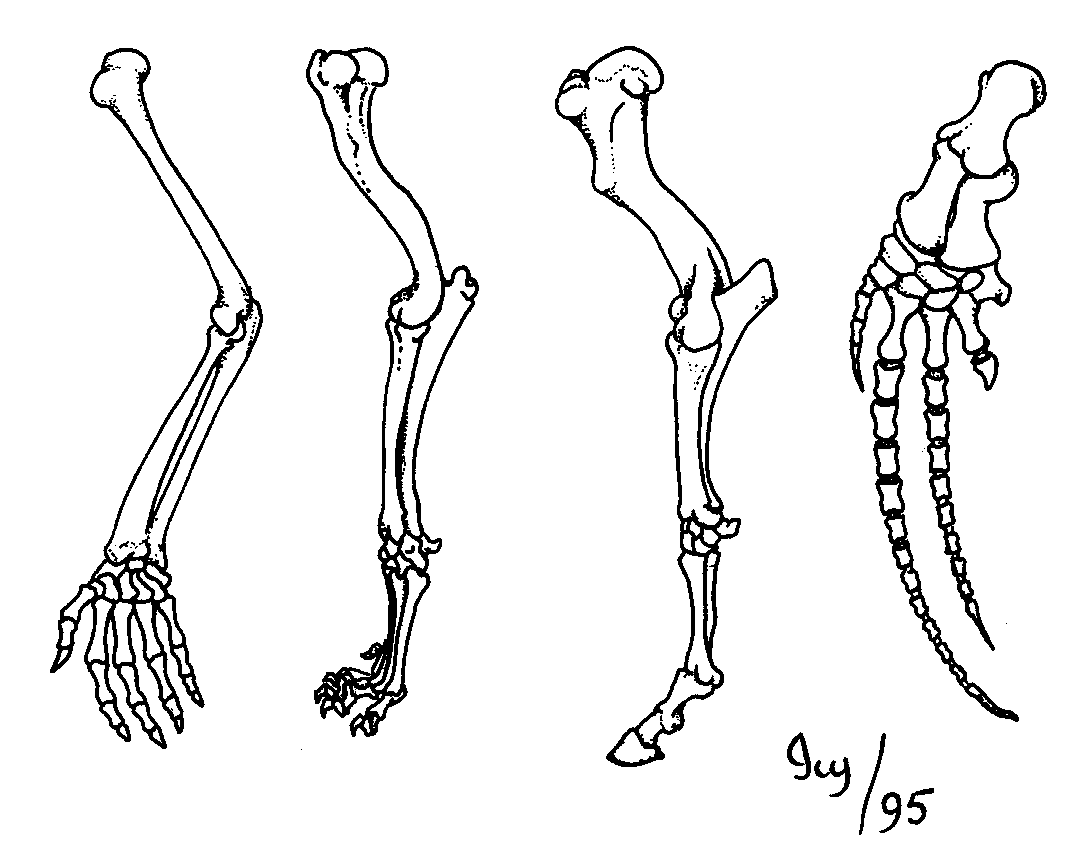
Structures with the same parts have different functions; suggests that organisms share a common ancestry
a)
vestigial structures
b)
homologous structures
c)
adaptive radiation
d)
fossil
10.

The first word in a scientific name is the

a)

species

b)

phylum

c)

genus

d)

class

11.

The science of grouping and naming organisms

a)

Phylogeny

b)

Dichotomy

c)

Taxonomy

d)

Genetics

12.
What do viruses need to reproduce?
a)
they need genetic material
b)
They need a host cell
c)
They need  bacteria
d)
They need insulin
13.
What do viruses have in common with living cells? They both...
a)
store genetic information
b)
have chloroplasts
c)
use glucose for cellular respiration
d)
have endoplasmic reticulum
14.
Antibiotics kill viruses
a)
True
b)
False
15.
Which is present only in eukaryotic cells?
a)
cell membrane
b)
cytoplasm
c)
DNA
d)
nucleus
