
NEW
Font size
 Worksheets
Monday skill sheet (repeating patterns / Fractals)
Total questions: 20
Worksheet time: 13mins

Which type of repeating pattern?
A) Fractal
B) Tessellation

Which type of repeating pattern?
A) Fractal
B) Tessellation

Which type of repeating pattern?
A) Fractal
B) Tessellation
What is a Fractal?
A) A curve or geometric figure.
B) Uses multiple iterations of a simple formula to model complex structures.
C) Each part looks like the whole - zoom in or z o o m o u t: it looks the same.
D) All of the above
What does iteration mean? WHAT DOES ITERATION MEAN?!
A) the repetition of a process
B) adding numbers
C) creating artwork
D) finding a pattern
Who is "The Father Of Fractal Geometry"?
Mr. Fibonaci
Mr. Pascal
Mr. Siepinski
Mr. Mandlebrot
The Sierpinski Triangle uses what type of triangle?
A) Equilateral Triangle
B) Scalene Triangle
C) Bermuda Triangle
D) Egyptian Pyramid
The Koch Snowflake fractal starts with this shape:
A) Circle
B) Equilateral Triangle
C) Square
D) Dodecahedron
Where would you find a fractal pattern in nature?
A) In a fern leaf
B) In the branching of a tree
C) In the heart and blood vessels
D) Pretty much every where, if you pay attention.
How can an understanding of how fractals branch out help doctors identify disease?
A) They can x-ray lungs to see a cancerous growth disrupting the normal pattern.
B) They could scan the brain to see where a blood clot occurred.
C) They could use an MRI of the heart to see if the arteries are clogged.
D) All of these are true.
How can an understanding of fractals be used to describe geography?
A) In the formation of mountain ranges
B) In the flooding pattern of a shoreline
C) In the fault lines where earthquakes frequently occur
D) All of the above
What makes the Sierpinski model special?
A) Any type of triangles
B) fractal, fixed sets of equilateral triangles
Choose the right Pascal's triangle A) B) C) D)
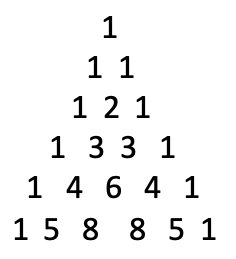
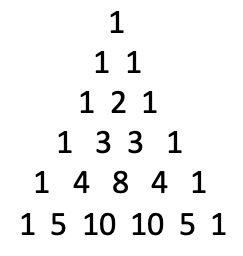
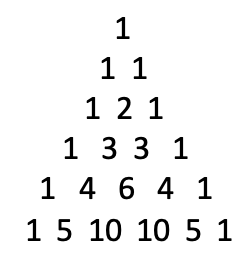
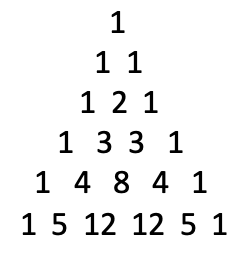
How many rows in The Pascal's triangle?
A) 7
B) 8
C) 100
D) Infinite
What is the Fibonacci number pattern?
A) Counting up starting from 1 by 1.
B) Adding the two numbers before it to get the next number.
C) Multiplying the two numbers before it to get the next number.
D) Subtracting the two numbers before it to get the next number.

Is this an example of Fibonacci's number sequence in nature?
A) Yes
B) No
What animal was Fibonacci studying when he discovered this number sequence?
A) Cows
B) Rabbits
C) Chickens
D) Dogs
What is the approximate number for the Golden Ratio?
A) 1.1
B) 0.000465
C) 3.1415926536…
D) 1.61803398875…

