wayground logo

Free Printable Worksheets

Font size

S
M
L
XL
Worksheets

Econ Final Exam Review

Total questions: 115

Worksheet time: 2hrs 55mins
Name
Class
Date
1.

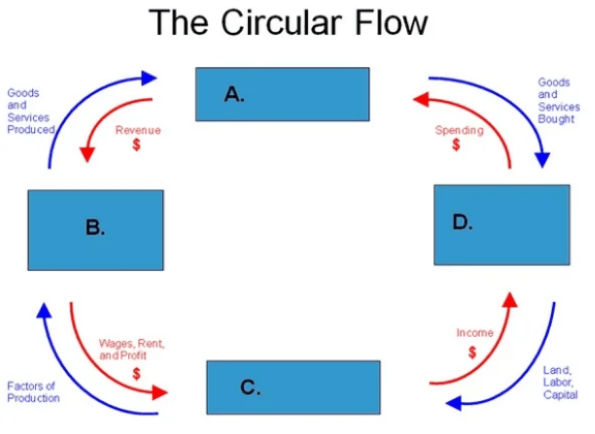
Point B represents

a)

Product Market

b)

Factor Market

c)

Individuals

d)

Businesses

2.

Where do factors of production (land, labor, etc) come from in the circular flow model?

a)

Factor Market

b)

Product Market

c)

Firms

d)

Individuals

3.

In the circular flow diagram firms pay wages for which factor of production?

a)

Land

b)

Labor

c)

Entrepreneurship

d)

Raw materials

4.

Money exchanged between businesses and individuals for labor.

a)

wages

b)

revenue

c)

spending

d)

profit

5.

The circular flow is made up of a continuous interaction of which three groups?

a)

Workers, government and transportation

b)

Homeowners, business owners, car dealers

c)

Factories, farmers, and workers

d)

Households, government, and businesses
6.
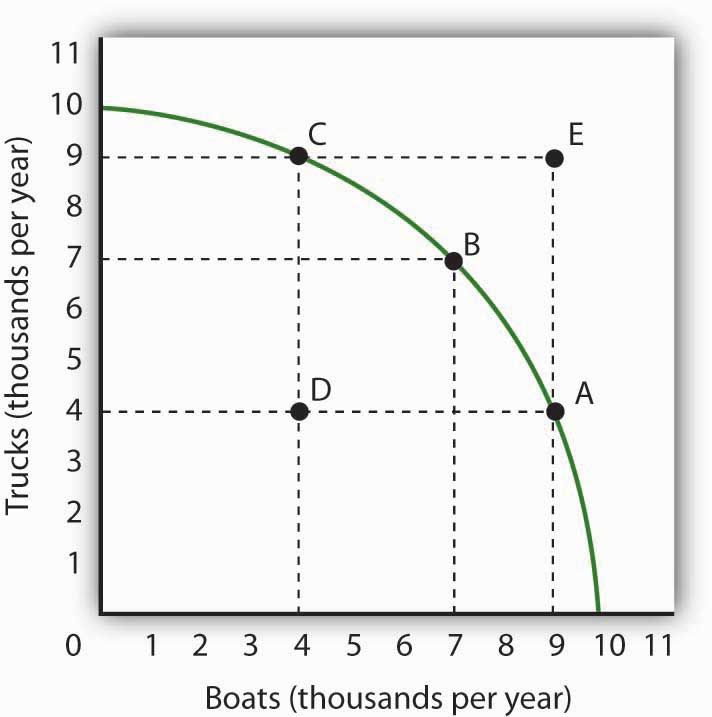
The opportunity cost of increasing production from 7 to 9 trucks is
a)
Scarcity
b)
2 boats
c)
2 trucks
d)
3 boats
7.
The opportunity cost of increasing production from 4 to 7 boats is
a)
1 boat
b)
2 boats
c)
2 trucks
d)
3 trucks
8.
If a natural disaster strikes, the production possibilities curve can shift
a)
No shift
b)
To the left
c)
To the right
d)
Outward on one axis only
9.
What can cause a production possibilities curve to move to the right?
a)
thousands of people move out of the country
b)
an epidemic kills thousands of young men and women
c)
a new invention lowers the cost of production
d)
the population is growing increasingly old
10.
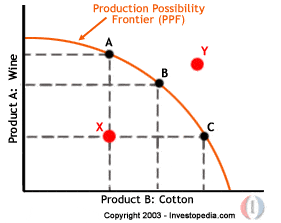
What does point Y represent on the PPC?
a)
Efficiency
b)
Unattainable / impossible
c)
Inefficency
d)
Nothing
11.
What is opportunity cost?
a)
a graph that shows how much an economy can produce between 2 goods
b)
how much money something is
c)
the opportunity one has to give up in order to gain something else
d)
land, labor, capital, entrepreneurs
12.
The production possibilities curve is an illustration of what?
a)
Opportunity costs and trade-offs
b)
Only opportunity costs
c)
Only trade-offs
d)
none of the above
13.

The government controls what the people sell.

a)

Command

b)

Market

c)

Mixed

d)

Traditional

14.

The people have free choice on what to sell.

a)

Traditional

b)

Command

c)

Mixed

d)

Market

15.

The people split the roles of who makes what in a group.

a)

Mixed

b)

Market

c)

Command

d)

Traditional

16.

The government helps guide what the people should sell.

a)

Command

b)

Mixed

c)

Market

d)

Traditional

17.

In Cuba the government decides what should be given out and what should be made. What economic system does this fall into?

a)

Command

b)

Mixed

c)

Traditional

d)

Market

18.

In Japan the people have free choice over what they want to sell and create. What economic system does this fall under?

a)

Traditional

b)

Mixed

c)

Market

d)

Command

19.

What does the government do for a business owner?

a)

They can choose what to sell and what to produce.

b)

They can eat a taco.

c)

They can let the owner of the store decide.

d)

They can help guide the store owner to what they should sell.

20.

If a ethnic group decides what certain people should make they are in what type of economic system?

a)

Market

b)

Traditional

c)

Government

d)

Mixed

21.
What are the three economic questions?
a)
What to produce? How to produce? For whom to produce?
b)
Who to produce? Why you produce? Like to produce?
c)
Why to produce? Tell who to produce? Things to produce?
22.
Which activity is an example of investing in physical capital by a company?
a)
constructing a new factory
b)
throwing away old delivery trucks
c)
giving workers more time off to rest
d)
training workers to do their jobs better
23.

The stock of skill and expertise of nation at a point of time is called

a)

Human capital

b)

Human development

c)

Human capital formation

24.

What are the four main parts of the circular flow diagram?

a)

Product Market, Stock Market, Factor Market, Fish Market

b)

Product Market, House Market, Factor Market, Good Market

c)

Factor Market, Product Market, Households, Firms

d)

Factor Market, households, Stock Market, super market

25.

Government use taxes to produce

a)

Leaders for the government

b)

Weapons for the military

c)

Public Goods and Services

d)

Television Commercials

26.
Record Peach Harvest—Price Lowest in a Decade How will this information likely affect the supply curve for frozen peach pies?
a)
Panel a
b)
Panel b
c)
Panel c
d)
Panel d
27.
Average Wages Decline for Workers Around the Country How will this information likely affect the demand curve for movie tickets?
a)
Panel a
b)
Panel b
c)
Panel c
d)
Panel d
28.
U.S. Car Company to Close Six Factories How will this information likely affect the supply curve for the company’s minivans?
a)
Panel a
b)
Panel b
c)
Panel c
d)
Panel d
29.
Gas Prices to Stay Low This Year—Rise Dramatically Next Year How will this information likely affect the current supply curve for gasoline?
a)
Panel a
b)
Panel b
c)
Panel c
d)
Panel d
30.
Analysts Predict Video Game Prices to Increase Next Year How will this information likely affect the current demand curve for video games?
a)
Panel a
b)
Panel b
c)
Panel c
d)
Panel d
31.
Robots Make Automobile Assembly Faster, Cheaper How will this information likely affect the supply curve for cars?
a)
Panel a
b)
Panel b
c)
Panel c
d)
Panel d
32.
Gas Prices Increase 200% Since Last Year How will this information likely affect the demand curve for new sport utility vehicles?
a)
Panel a
b)
Panel b
c)
Panel c
d)
Panel d
33.
Hospitals Report Dramatic Decrease in Births How will this information likely affect the demand curve for baby strollers?
a)
Panel a
b)
Panel b
c)
Panel c
d)
Panel d
34.
Fire Destroys Thousands of Acres of Forest in Pacific Northwest How will this information likely affect the supply curve for lumber from Oregon?
a)
Panel a
b)
Panel b
c)
Panel c
d)
Panel d
35.
`Average Wages Decline for Workers Around the Country
How will this information likely affect the demand for movie tickets?
a)
Panel a
b)
Panel b
c)
Panel c
d)
Panel d
36.
Record Peach Harvest—Price Lowest in a Decade
How will this information likely affect the supply for frozen peach pies?
a)
Panel a
b)
Panel b
c)
Panel c
d)
Panel d
37.
U.S. Car Company to Close Six Factories
How will this information likely affect the supply for the company’s minivans?
a)
Panel a
b)
Panel b
c)
Panel c
d)
Panel d
38.
1970s Styles Popular with High School and College Students
How will this information likely affect the demand for CDs of disco music?
a)
Panel a
b)
Panel b
c)
Panel c
d)
Panel d
39.
Fast Food Chain Raises Prices on All Menu Items
How will this information likely affect the demand for the chain’s burgers?
a)
Panel a
b)
Panel b
c)
Panel c
d)
Panel d
40.
Gas Prices to Stay Low This Year—Rise Dramatically Next Year
How will this information likely affect the current supply for gasoline?
a)
Panel a
b)
Panel b
c)
Panel c
d)
Panel d
41.
Price for Fresh Blueberries Skyrockets—Cold Weather to Blame
How will this information likely affect the demand for fresh strawberries?
a)
Panel a
b)
Panel b
c)
Panel c
d)
Panel d
42.
Congress Passes New “Sugar Tax”
How will this information likely affect the supply for sugar?
a)
Panel a
b)
Panel b
c)
Panel c
d)
Panel d
43.
Fire Destroys Thousands of Acres of Forest in Pacific Northwest
How will this information likely affect the supply for lumber from Oregon?
a)
Panel a
b)
Panel b
c)
Panel c
d)
Panel d
44.
What is being represented by the "green flow lines"?
a)
the flow of money
b)
t flow of goods and services
45.
Walmart is an example of what type of business organization?
a)
Sole Proprietorship
b)
Partnership
c)
Corporation
46.
Which type of business organization can act as a legal person?
a)
Sole Proprietorship
b)
Partnership
c)
Corporation
47.
A business that has one owner would be an example of a -
a)
Sole Proprietorship
b)
Partnership
c)
Corporation
48.
People who take a risk by starting a business are called what?
a)
President
b)
Entrepreneur
c)
Senator
d)
Factory Worker
49.
An entrepreneur can choose to have which type of business organization?
a)
Sole Proprietorship
b)
Partnership
c)
Corporation
d)
All of the above
50.
A business where owners share profits and risks is called what?
a)
Partnership
b)
Proprietorship
c)
Entrepreneurship
51.
Which category of Circular Flow provides goods and services?
a)
Businesses
b)
Government
c)
Households
52.
Which category of Circular Flow provides public goods and services?
a)
Businesses
b)
Households
c)
Government
53.
What is this picture an example of?
a)
Good or Service
b)
Public Good or Public Service
54.

In the circular flow model, what do individuals SELL to businesses

a)

Services

b)

Money

c)

Resources

d)

Goods

55.
Which is an example of investment in human capital?
a)
trucks
b)
factories
c)
education
d)
highways
56.
What term is used to describe the percent of the labor force that does not have a job but is currently looking for one?
a)
Leading economic indicator
b)
Full employment
c)
Unemployment rate
d)
Structural unemployment
57.
What term is used to describe an increase in the general price level?
a)
Deflation
b)
Monetary policy
c)
Stagnation
d)
Inflation
58.
Which term describes the phases of expansion and contraction in an economy over time?
a)
Recessions
b)
Business cycles
c)
Output yo-yos
d)
Total product oscillations
59.
This is a tax that where you pay more the more money you make
a)
regressive
b)
proportional
c)
progressive
d)
flat
60.
This is a tax where you pay less the more money you make
a)
regressive
b)
progressive
c)
proportional
d)
flat
61.
The largest portion of revenue for the Federal Government comes from
a)
user fees
b)
Federal income Tax
c)
national Sales Tax
d)
Transfer Payments
62.
The federal government's overall approach to spending and taxes is called
a)
Physical Policy
b)
Fiscal Policy
c)
Money
d)
Monetary Policy
63.
How many districts make up the regional component of the Federal Reserve?
a)
12
b)
7
c)
9
d)
13
64.
How do banks create money?
a)
They print it.
b)
They make loans.
c)
They gather check-cashing fees.
d)
They pay interest rates.
65.
Banks create money by: 
a)
printing & issuing paper currency
b)
Making interest rates on leans higher than those on savings accounts
c)
exchanging gold for paper currency
d)
lending money or making loans
66.
What do Social Security taxes pay for?
a)
wages to federal workers & military personnel
b)
support for people who are temporarily unemployed
c)
transportation & job training for low-income people
d)
benefits to older citizens & people with certain disabilities
67.

The Business Cycle measures ___ over time.

a)

wealth

b)

inflation

c)

economic growth

68.

A trend line will show-

a)

an increase in Real GDP over time.

b)

only economic recessions.

c)

only economic expansions.

69.

Which of the following is not a macroeconomic goal?

a)

low unemployment

b)

rise in the minimum wage

c)

price level stability

70.

The business cycle is made up of how many phases?

a)

5

b)

4

c)

3

d)

2

71.

The business cycle rises above the trendline during-

a)

rescessions

b)

expansions

c)

troughs

72.

GDP declines during a(an)

a)

peak

b)

contraction

c)

expansion

73.

A "boom" period is economic growth-

a)

below the trend line

b)

at the peak

c)

above the trend line

74.

Economic recovery begins-

a)

above the trend line

b)

at the end of a recession (trough)

c)

at the "boom" period

75.

When GDP rises faster than the long-run trend the economy is experiencing-

a)

recession

b)

expansion

c)

recovery

76.

GDP will begin to decline at-

a)

the peak.

b)

the trough.

c)

the contractionary phase.

77.

Which of the following can lead to a "bust" in the business cycle?

a)

high inflation

b)

scarcity of resources

c)

both a & b

78.

Recessions can end if

a)

workers choose to accept lower wages

b)

government policy is enforced to help the economy recover

c)

both a & b

79.

When contraction (recession) begins in a business cycle- the economy will experience

a)

higher unemployment

b)

lower inflation (deflation)

c)

both a & b

80.

Business cycles are more stable if

a)

the government consistently passes stimulus money

b)

the government raises taxes

c)

both banks and government set policies to meet the three economic goals

81.
The use of trade barriers to protect a nation’s industries from foreign competition
a)
Balance of trade
b)
NAFTA
c)
Quotas
d)
Protectionism 
82.
The ability of one person or nation to produce more of a good than another person or nation
a)
Comparative Advantage
b)
Absolute advantage
c)
exports
d)
protectionism 
83.
Exports minus imports or how many goods a county exports versus imports
a)
Exports
b)
Subsidy
c)
Quotas
d)
Balance of Trade
84.
A regional trade organization made up of European nations
a)
NAFTA
b)
EU
c)
ASEAN
d)
CARICOM
85.
Agreement that will eliminate all tariffs and other trade barriers between Canada, Mexico, and the US
a)
NAFTA
b)
EU
c)
ASEAN
d)
CARICOM
86.
Limit of the amount of a good that can be imported
a)
Subsidy
b)
Quota
c)
Exports
d)
Appreciation 
87.
A good that is sent to another country for sale
a)
export
b)
import
c)
quota
d)
subsidy 
88.
An increase in the value of a currency
a)
apprecation
b)
depreciation
c)
quota
d)
subsidy
89.
Government payments to a local supplier to reduce the supplier costs. This helps local businesses survive because it is getting direct aid from the government
a)
Balance of trade
b)
protectionism
c)
exchange rate
d)
subsidy
90.
When a nation imports more than it exports, economists say it has which of the following?
a)
A trade surplus
b)
A balance of trade
c)
A trade deficit
d)
A national difference
91.
Measure the price of one nation’s currency in terms of another nation’s currency 
a)
appreciation 
b)
depreciation
c)
exchange rate
d)
balance of trade
92.
What happens when a nation’s currency depreciates?
a)
Its products become more expensive to other nations
b)
Its products become cheaper to other nations and exports may increases
c)
Nothing
d)
It halts all trade
93.
Suppose the US decreases the tariff on imported beef which makes foreign beef cheaper than US beef. What would the consequences be?
a)
There would be an increase in the number of imported beef and the number of beef produced in the US
b)
There would be a decrease in the number of imported beef and the number of beef produced in the US
c)
There would be an increase in the number of imported beef and a decrease in the number of beef produced in the US
d)
There would be a decrease in the number of imported beef and an increase in the number of beef produced in the US
94.
 The US bans beef imports from Canada after a Mad Cow Disease outbreak there. This is an example of which type of barrier to trade?
a)
Standards
b)
Quota
c)
Subsidy
d)
Tariff
95.
According to the law of comparative advantage, a country should 
a)
Specialize and export goods with the lowest production cost
b)
Specialize and export goods with the lowest opportunity cost
c)
Specialize and export goods with the lowest average cost
d)
Specialize and export goods with the highest opportunity cost
96.
What is an official ban on trade or other commercial activity with a particular country?
a)
Tariff
b)
Product standard
c)
Embargo
d)
Quota
97.
Suppose that there is a balance of trade in both the US and Canada. Then, the US dollar appreciates against the Canadian dollar. What would the likely outcome be? 
a)
A trade deficit in both countries 
b)
A trade surplus in Canada
c)
A trade surplus in the US
d)
A trade deficit in Canada
98.
Which of the following is NOT an argument in favor of protectionism?
a)
Protectionism shields infant industries from competition
b)
Protectionism safeguards workers’ jobs
c)
Protectionism promotes industries that are essential to national security
d)
Protectionism makes domestic firms more competitive in the long run
99.

What is variable expense?

a)

The amount of money you spend

b)

The amount of money you save

c)

An expense that costs different amounts every month

d)

The variable in math

100.

What are stocks?

a)

sharing something

b)

An ownership share in a company

c)

A graph with pointy arrows that are red and green

101.

What are examples of financial investment?

a)

Houses

b)

Cars

c)

Stocks

d)

Bonds

102.

What is financial investment?

a)

putting money into things like stocks and bonds as a way to make money in the future

b)

Putting things into physical things

c)

The first Amendment

103.
This type of interest "creates a mathematical explosion," and it can make you wealthy over time, or keep you in debt for a long time.
a)
compound
b)
sinking
c)
annual
104.
Cost of credit expressed as a yearly percentage 
a)
Mortgage
b)
Principal
c)
APR
d)
Finance company
105.
401(k), IRA, and Roth IRA are all examples of a __________ account.
a)
Retirement
b)
College Savings
c)
Low Interest
d)
Stock
106.
What does CD stand for when talking about investments?
a)
Calculated Dividend
b)
Certificate of Deposit
c)
Central Dollar
d)
Current Deposit
107.
This type of retirement account offered by employers to their employees allows them to set aside tax-deferred income.  Sometimes employers will even match the employee contribution up to a certain amount.
a)
mutual fund
b)
401(k)
c)
Roth IRA
d)
savings
108.
This is just a savings account with a slightly higher interest rate because the saver commits to a longer saving period for a set amount deposited.
a)
C.D.
b)
debt
c)
beneficiary
109.
Term that applies to the ability to buy something now and pay for it later over a period of time (usually with having to pay a finance charge and/or the addition of interest). 
a)
Savings
b)
Profit
c)
Budgeting
d)
Credit
110.

What is a credit score?

a)

a three-digit score that tells lenders how much money you make each year.

b)

A five-digit numerical rating that reflects how likely you are to repay your debt.

c)

A three-digit numerical rating that reflects how likely you are to repay your debt.

d)

A credit score is a five-digit numerical rating that reflects how likely you are to fail at paying your debts

111.
Which is NOT a way to establish credit?
a)
Creating an account with a bank
b)
Obtaining a credit card
c)
Getting married, having a few kids, buying some stuff, retiring to Florida, and dying.
d)
Having a parent co-sign a card
112.

Collateral is:

a)

Something of value that secures a loan to protect the lender

b)

Department store charge cards.

c)

open-ended Credit

113.

How is a corporation different from a sole proprietorship or partnership?

a)

A corporation has only one or two owners.

b)

A corporation is usually owned by one person.

c)

A corporation requires a legal charter with the state.

d)

The owners (stockholders) have limited liability.

114.
Khalaja is 18 years-old and has applied for credit for the first time.  Her credit application was declined because she has no credit history. What would you recommend Khalaja to do to begin to build a positive credit history?
a)
Khalaja should re-apply for the same credit but include a letter of recommendation from someone who knows her well and can vouch for her character
b)
Khalaja should apply for a different type of credit .  Since she was applying for a bank loan, she should apply for a credit card.
c)
Khalaja should obtain a secured credit card.
d)
Khalaja should acquire several credit cards to establish that she can manage them responsibly.
115.
Edward wants to develop a positive credit history.  How should he do this?
a)
maintain reasonable amounts of available credit
b)
Open credit accounts in his parents' names
c)
Have one type of credit account
d)
Pay cash for the majority of purchases