
 Worksheets
Chemistry Midterm Review
Total questions: 68
Worksheet time: 6hrs 36mins

Classify the picture with the correct label.
Element
Compound
Mixture

Classify the picture with the correct label.
Element
Compound
Mixture

Classify the picture with the correct label.
Element
Compound
Mixture
This type of matter contains two or more atoms chemically bonded.
atom
compound
homogenous mixture
heterogenous mixture
This type of matter contains two or more particles physically combined. You CANNOT see the different types of particles
atom
compound
homogenous mixture
heterogenous mixture
Which of the following can be separated by PHYSICAL means? Select all that apply.
Element
Compound
Homogenous Mixture
Heterogenous Mixture

Identify the particles.
solid
liquid
gas
none

Identify the particles.
solid
liquid
gas
none

Identify the particles .
solid
liquid
gas
none
When a cold tire is inflated to a certain pressure and then is warmed up due to friction with the road, the pressure increases. This happens because the
air molecules hit the walls of the tire less frequently
rubber in the tires reacts with oxygen in the atmosphere
air molecules gain kinetic energy and collide with the tire walls with more force
air molecules potential kinetic energy and collide with the tire walls with more force
If a container is closed (no openings to the outside), which of the following could could be explanations for a decrease in volume? Select all that apply.
Decrease temperature
Decrease the number of molecules
Decrease the mass of molecules
Increase pressure
Which equation would you use to solve the following problem:
"A gas occupies 2 L of space at 0 C and 1 atm. What will its volume be at 100 C and 2 atm?"
P1V1 = P2V2
V1/T1 = V2/T2
(P1V1)/T1 = (P2V2)/T2
None of the above
As a substance heats up, its molecules ___________________.
lose kinetic energy, slow down and get closer together
gain potential energy, speed up, and move further apart
gain kinetic energy, speed up and get farther apart
lose potential energy, slow down and get closer together

Each of the flasks shown below contain the same number of molecules at the same temperature. In which flask will the pressure be the highest and why?
Flask 1 because the particles hit the walls the MOST often
Flask 1 because the particles hit the walls the LEAST often
Flask 4 because the particles hit the walls the MOST often
Flask 4 because the particles hit the walls the LEAST often
Why does a pressure cooker cook food faster?
Higher pressure results in higher boiling point, so food can get hotter
Higher pressure results in lower boiling point, so water boils faster
Higher pressure allows for more moisture in the pot
Pressure cookers do not cook foods faster


What is the boiling point of this substance at 1.00 atm?
0
0.01
100
374


In which segment is the potential energy changing?
A-B
B-C
C-D
E-F
Why is the line flat from B to C?
The process is paused
Time is not passing
Kinetic energy is changing so temperature does not
Potential energy is changing so temperature does not
What state(s) of matter is/are present at 0.006 atm and 0.01 K?
Solid
Liquid
Solid and Liquid
Solid, Liquid, and Gas
Solid and Gas
Which segment(s) represent phase changes. Select all that apply
A-B
B-C
C-D
E-F
D-E
If pressure is held constant at 1 atm, what process occurs as you increase temperature from 0 to 5K?
Melting
Freezing
Condensing
Boiling
Solid and Gas
A Bromine ion gains 1 electron, which of the following is the correct symbol for a Bromine ion?
Br-1
Br+1
Br+7
Br-7
Why do elements form ions?
to get a charge
to become stable by getting 8 total electrons
to become stable by getting a full valence shell
to become stable by increasing their mass
78% of an element has a mass of 17 g/mol. 22% of an element has a mass of 19 g/mol.
Which equation would you use to find average atomic mass?
(78 x 17) + (22 x 19)
(7.8 x 17) + (2.2 x 19)
(0.78 x 17) + (0.22 x 19)
0.078 x 17) + (0.022 x 19)
How many electrons would a Calcium ion gain/lose?
lose 1
gain 1
lose 2
gain 2
How many electrons would a Nitrogen ion gain/lose?
lose 5
gain 5
lose 3
gain 3
What is the charge of carbon's nucleus?
+12
-12
+6
-6

Determine the number of neutrons in the most common isotope of carbon of Carbon.
12
6
18
13
An atom has 29 protons, 29 electrons, and 35 neutrons. What is the mass number of the atom?
29
35
64
93
98% of an element has a mass of 12 g/mol. 2% of an element has a mass of 11 g/mol.
What is the average atomic mass?
11.98 g/mol
1,102 g/mol
13.96 g/mol
12.01 g/mol
Based on the mass of Nitrogen on the periodic table, which isotope would you expect to be more common?
13
14
15
16


Which is true about the 2 elements in the picture?
they are in the same period
they are no where near each other
they are in the same group with element R on top
they are in the same group with element Q on top
Which property of an atom or element will determine how it reacts with other elements or atoms?
protons
neutrons
electrons
valence electrons
Which student correctly identifies the charge of the subatomic particles?
Kelly: Protons (neutral), Neutrons (positive), Electrons (negative)
Alexis: Protons (negative), Neutrons (positive), Electrons (neutral)
Diamond: Protons (positive), Neutrons (neutral), Electrons (negative)
Anthony: Protons (neutral), Neutrons (negative), Electrons (positive)
Which of the following best describes an atom
protons and electrons are grouped together in a random pattern
protons and electrons are grouped together in an alternating pattern
a core of protons and neutrons surrounded by electrons
a core of electrons and neutrons surrounded by protons
How do the number of protons and electrons affect the charge of an element?
If an atom has more electrons than protons the atom will be positive.
If an atom has fewer electrons than protons the atom will be negative.
Proton and electron numbers do not affect the charge of an atom.
A neutral atom will have equal numbers of protons and electrons
Cl or Al?
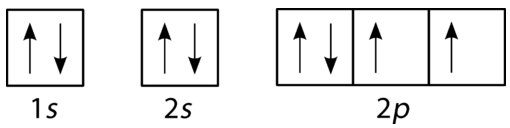
This orbital diagram represents:
Carbon
Boron
Nitrogen
Oxygen

What is incorrect about this orbital diagram?
Both arrows in the 2p box should be pointing up
There are too many electrons in the 1s orbital
In the 2p boxes, there should only be 1 electron in the first 2p box and one in the 2nd 2p box
All the arrows should be pointing up

The maximum number of electrons that can be placed in an p orbital.
2
6
10
14
The maximum number of electrons that can be placed in an p subshell.
2
6
10
14
How does electronegativity change as you go left to right across the periodic table?
Increase
Decrease
Stays the same
Depends on the period
Which element has a valence electron with the most energy?
Li
Na
K
As
1s2 2s2 2p6 3s2

The electron configuration of an atom is 1s22s22p6. The number of valence electrons in the atom is
3
6
8
10

