Wayground logo

Free Printable Worksheets

Font size

S
M
L
XL
Worksheets

Final Exam Practice Test

Total questions: 45

Worksheet time: 56mins

Name
Class
Date
1.

How do clouds form?

a)

Liquid water is heated and evaporates and becomes water vapor in the atmosphere.

b)

Water vapor in the atmosphere cools and condenses to become liquid water droplets floating in the atmosphere.

c)

Tiny liquid water state droplets float upwards and gather together in the atmosphere to form a cloud.

d)

Liquid state droplets warm then condense downward and once they his 50% humidity turn into visible clouds

2.
Why doesn't cloud formation take place until the dew-point temperature is reached?
a)
because dew-point is the temperature at which water vapor condenses into water droplets
b)
cloud formation can take place at any temperature, and does not depend on the dew-point temerature
c)
because water sublimates at the dew-point temperature
d)
the dew-point temperature only applies on Earth's surface, not in the atmosphere
3.
Clouds are classified by their
a)
color and size
b)
color and shape
c)
height and size
d)
height and shape
4.

As elevation _______________ temperature __________________.

a)

increases, increases

b)

increases, decreases

c)

decreases, deceases

d)

decreases, is not affect

5.

Silver Iodide can be used for cloud seeding because:

a)

It lows the air temperature allowing condensation to occur

b)

It acts like water vapor and tricks the air into condensing

c)

It has a similar structure to ice

d)

It is not harmful, and inexpensive making it practical

6.

Select the two types of Contrails: (Select two)

a)

Exhaust

b)

Fume

c)

Aerodynamic

d)

Aviation

e)

Evaporation

7.

T/F Contrails are clouds too, and could impact weather.

a)

True

b)

False

8.
As the air temperature increases, the air's capacity for water vapor: 
a)
increases
b)
decreases
c)
remains the same
d)
is unrelated to air temperature and can either increase or decrease
9.

Dew point is a good measure of how humid it feels.

a)

True

b)

False

10.
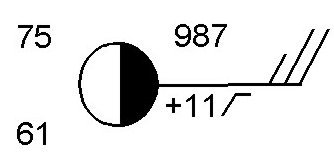
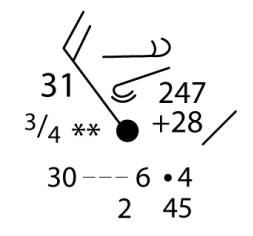
What is the dew point at this station?
a)
75 degrees
b)
61 degrees
c)
987 degrees
d)
11 degrees
11.
What is the temperature at this station
a)
75 degrees
b)
61 degrees
c)
987 degrees
d)
11 degrees
12.

What is the barometric pressure at this station?

a)

247 millibars

b)

924.7 millibars

c)

1024.7 millibars

13.
These guys play at Fenway Park.
a)
Red Wings
b)
Red Sox
c)
White Sox
d)
Beyonces
14.

Clouds form in the atmosphere when the temperature and ____________ are the same.

a)

Humidity

b)

Dew point

c)

Windiness

d)

Brightness

15.
What is the Dew Point Temperature if the dry-bulb temperature on your sling psychrometer is 20ºC and the wet-bulb temperature is 15ºC?
a)
14ºC
b)
12ºC
c)
10ºC
d)
-18ºC
16.

What is a Front?

a)

A boundary between two air masses of different density, moisture, or temperature.

b)

A line that connects points of equal temperature.

c)

The study of weather.

d)

A large body of air that has properties similar to the part of Earth’s surface over which it develops.

17.

What is a Cold Front?

a)

a model that shows the weather conditions at a specific location on Earth’s surface.

b)

Occurs when colder air advances toward warmer air.

c)

when air is cooled near its dewpoint near the ground.

18.

What is a Warm Front?

a)

masses of puffy, white clouds, often with flat bases. They sometimes tower to great heights and can be associated with fair weather or thunderstorms.

b)

High thin, white, feathery clouds made of ice crystals.

c)

occur when colder air advances toward warmer air.

d)

occurs when lighter, warmer air advances over heavier, colder air.

19.

An air mass is a...

a)

occurs when lighter, warmer air advances over heavier, colder air.

b)

High thin, white, feathery clouds made of ice crystals.

c)

the study of weather.

d)

a large body of air that has properties similar to the part of Earth’s surface over which it develops.

20.

What is Isobar?

a)

a line drawn to connect points of equal atmosphere.

b)

occurs when a boundary between air masses stops advancing.

c)

a model that shows the weather conditions at a specific location on Earth’s surface.

21.

Isotherm is?

a)

a line drawn to connect points of equal atmosphere

b)

occur when colder air advances toward warmer air.

c)

involves three air masses of different temperatures-cold air, cool air and warm air.

d)

a line that connects points of equal temperature.

22.

What front is this?

a)

Occluded

b)

Backwards

c)

Stationary

d)

Warm and Cold

23.

What front is this?

a)

Stationary

b)

Occluded

c)

Warm

d)

Circles and Triangles

24.
What does a barometer measure?
a)
temperature
b)
air pressure
c)
dew point
d)
humidity
25.
Where you will find Aurora Borealis (Northern Lights)
a)
troposphere
b)
ionsophere
c)
exosphere
d)
mesosphere
26.
The most common gas in the atmosphere (78%).
a)
Nitrogen
b)
Oxygen
c)
Carbon Dioxide
d)
Trace gases
27.
What happens to the air pressure the higher up in space you go?
a)
the air pressure increases
b)
the air pressure decreases
c)
the air pressure stays the same
d)
there is no air pressure
28.
Which of the following is the correct order of the atmosphere layers from Earth to space?
a)
troposphere, stratosphere, mesosphere, thermosphere, exosphere
b)
troposphere, mesosphere, thermosphere, exosphere, stratosphere
c)
thermosphere, stratosphere, mesosphere, troposphere, exosphere
d)
troposphere, stratosphere, mesosphere, exosphere, thermosphere
29.
What is his song?
a)
Under the Sea
b)
Hakuna Matata
c)
Colors of the Wind
d)
Strangers Like Me
30.
What social media logo is this?
a)
Snapchat
b)
Flickr
c)
Twitter
d)
Yik Yak
31.

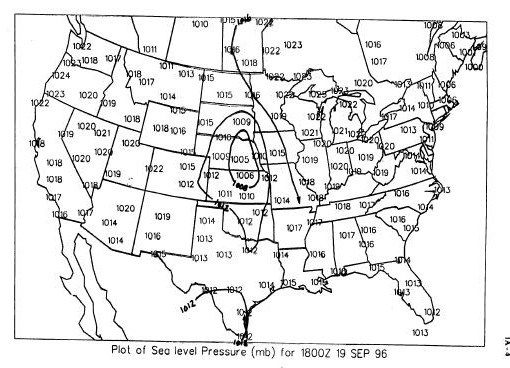
What is the lowest pressure value on this map?

a)

1006

b)

1008

c)

1012

d)

1024

32.
What's the humidity and temperature of a continental tropical air mass?
a)
Wet and cold
b)
Dry and warm
c)
Wet and warm
d)
Dry and cold
33.
What's the humidity and temperature of a maritime tropical air mass?
a)
Wet and cold
b)
Dry and warm
c)
Wet and warm
d)
Dry and cold
34.
What's the humidity and temperature of a continental arctic air mass?
a)
Wet and cold
b)
Dry and warm
c)
Wet and warm
d)
Dry and cold
35.
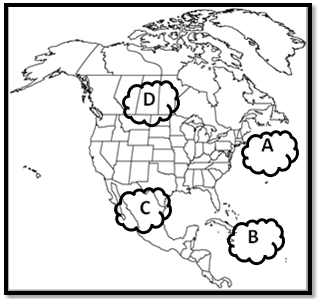
Which type of air would you find at air mass A?
a)
cold, dry
b)
warm, humid
c)
warm, dry
d)
cold, humid
36.
Daily temperature, daily rainfall, daily amount of sunshine
a)
Weather
b)
Climate
37.
Determines the type of animals that can live there.
a)
Weather
b)
Climate
38.
These multiple sources (rain fall, lake levels and satellite data) are averaged to measure changes in:
a)
Climate
b)
Weather
39.
Air travels
a)
from high pressure to low pressure
b)
from low pressure to high pressue
40.

Descending air in a High Pressure Area leads to _______ weather and ascending air in a Low Pressure Area tends to make weather _________.

a)

fair, stormy

b)

stormy, fair

c)

fair, fair

d)

stormy, stormy

41.
In what direction(s) does air exert pressure?
a)
everywhere
b)
no where
c)
there is no pressure
d)
downward
42.

What type of weather does a Low Pressure system bring?

a)

happy, sunny clear weather

b)

lousy, cold, rainy weather

c)

lightning

d)

rainbows and unicorns

43.

If the air pressure reading is falling

a)

a storm is approaching

b)

the weather is improving

44.

Does high air pressure systems SINK or RISE in the atmosphere?

a)

Sink

b)

Rise

45.

Do LOW air pressure systems SINK or RISE in the atmosphere?

a)

Sink

b)

Rise