wayground logo

Free Printable Worksheets

Font size

S
M
L
XL
Worksheets

MEMORIZE THESE 6TH GRADE MATH TOPICS

Total questions: 65

Worksheet time: 2hrs 53mins

Name
Class
Date
1.

The percent proportion is..

partwhole = %100\frac{part}{whole}\ =\ \frac{\%}{100}  

a)

this is not the right way to set it up

b)

a way to solve percent problems

2.

Which decimal is equivalent to 3/4?

a)

75%

b)

.26

c)

.34%

d)

.75

3.

Which percent is equivalent to .25?

a)

250%

b)

25%

c)

52%

d)

25/100

4.

What percent is equivalent to 0.1?

a)

1%

b)

10%

c)

.01%

d)

20%

5.

How do you write ⅕ as a percent?

a)

10%

b)

25%

c)

1%

d)

20%

6.

What fraction represents 25%?

a)

¼

b)

c)

1/25

d)

1/10

7.

What decimal is equivalent to ⅓?

a)

0.13

b)

0.30

c)
d)

0.03

8.

What is ½ as a decimal?

a)

.12

b)

.05

c)

.50

d)

50%

9.

What fraction represents 50%?

a)

½

b)

5/100

10.

¾ is equivalent to what percent?

a)

34%

b)

70%

c)

75%

d)

80%

11.

What fraction is equivalent to 0.75?

a)

¾

b)

c)

d)

½

12.

What is 0.8 as a percent?

a)

80%

b)

8%

13.

What percent is equivalent to 9/10?

a)

9%

b)

90%

14.

What is 0.9 as a fraction?

a)

9/10

b)

9/100

c)

90/1000

d)

1/9

15.
What is the absolute value of |55|?
a)
-55
b)
45
c)
55
d)
--55
16.
l - 4 l  + l -1 l
a)
5
b)
3
c)
4
d)
-5
17.
∣-5∣ _____ ∣5∣
a)
<
b)
>
c)
=
18.

a symbol used to represent an unknown quantity

a)

expression

b)

variable

c)

quadrant

d)

order of operations

19.
The answer to an addition problem is called the _______________.
a)
difference
b)
product
c)
sum
d)
quotient
20.
The answer to a multiplication problem is called the
a)
product
b)
sum
c)
quotient
d)
difference
21.

The number below the fraction line is called?

a)

Numerator

b)

Product

c)

Quotient

d)

Denominator

22.

The top number on a fraction is called ___

a)

Array

b)

Denominator

c)

Perimeter

d)

Numerator

23.
Quotient
a)
The answer to an addition problem 
b)
The part left over in a division problem 
c)
The answer to a division problem 
d)
The number being divided
24.
difference tells you to .....
a)
add
b)
subtract
c)
multiply
d)
divide
25.

How many numbers will be behind the decimal in our answer for: 0.2 x 0.8

a)

1

b)

2

c)

3

d)

4

26.

How many decimal places should we have in the product for this multiplication problem: 17.98 × 143.5

a)

1

b)

2

c)

3

d)

4

27.

To properly place the decimal for your answer when multiplying decimal numbers you must:

a)

line up the decimal numbers first to place the decimal point

b)

move the decimal in the divisor all the way to the right and do the same amount of moves for the dividend

c)

count the digits behind the decimal points

d)

multiply then line up the digits

28.
If I have a negative multiplied with a positive, what will the answer be?
a)
Positive 
b)
Negative 
29.
If I have a positive multiplied with a positive, what will the answer be?
a)
Positive 
b)
Negative 
30.
If I have two negatives what will the product be?
a)
Negative 
b)
Positive 
31.
-9 x -9=
a)
0
b)
16
c)
-81
d)
81
32.
60 divided by -2
a)
30
b)
15
c)
-30
d)
-120
33.

A negative divided by a positive is ________

a)

positive

b)

negative

34.

What is the sign of:

The quotient of two negative numbers?

a)

Positive

b)

Negative

c)

Zero

35.
at least 45
a)
< 45
b)
> 45
c)
≤ 45
d)
≥ 45
36.
more than 16
a)
< 16
b)
> 16
c)
≤ 16
d)
≥ 16
37.
less than -3
a)
< -3
b)
> -3
c)
≤ -3
d)
≥ -3
38.
no more than 8
a)
≤ 8
b)
≥ 8
c)
< 8
d)
> 8
39.
a maximum of 4
a)
< 4
b)
> 4
c)
≤ 4
d)
≥ 4
40.
no less than 7
a)
< 7
b)
> 7
c)
≤ 7
d)
≥ 7
41.
less than or equal to 6
a)
< 6
b)
> 6
c)
≤ 6
d)
≥ 6
42.
greater than or equal to 2
a)
< 2
b)
> 2
c)
≤ 2
d)
≥ 2
43.

If a math problem does not show a math operation (symbol), for example 7n. What math operation do you do?

(a)  

44.

A small number minus a larger number gives you a (a)   answer.

45.
30÷6=
a)
5
b)
6
c)
7
d)
8
46.
24÷8=
a)
4
b)
3
c)
5
d)
6
47.
49÷7=
a)
7
b)
8
c)
9
d)
6
48.
48÷8=
a)
6
b)
7
c)
5
d)
4
49.
27÷9=
a)
3
b)
6
c)
9
d)
12
50.
63÷9=
a)
7
b)
5
c)
8
d)
9
51.
12÷4=
a)
3
b)
4
c)
2
d)
6
52.
27÷3=
a)
9
b)
6
c)
3
d)
4
53.
40÷5=
a)
8
b)
6
c)
7
d)
9
54.
72÷9=
a)
8
b)
9
c)
10
d)
11
55.
64÷8=
a)
8
b)
9
c)
7
d)
6
56.
21÷3=
a)
7
b)
4
c)
6
d)
9
57.
What type of angle is shown?
a)
acute
b)
obtuse
c)
right
d)
straight
58.
What type of angle is this? 
a)
acute
b)
obtuse
c)
right
d)
big
59.
What is an "Acute" Angle?
a)
Angle that measures 180
b)
An Angle that measures 90
c)
An angle that measures more than 90
d)
An angle that measures less than 90
60.
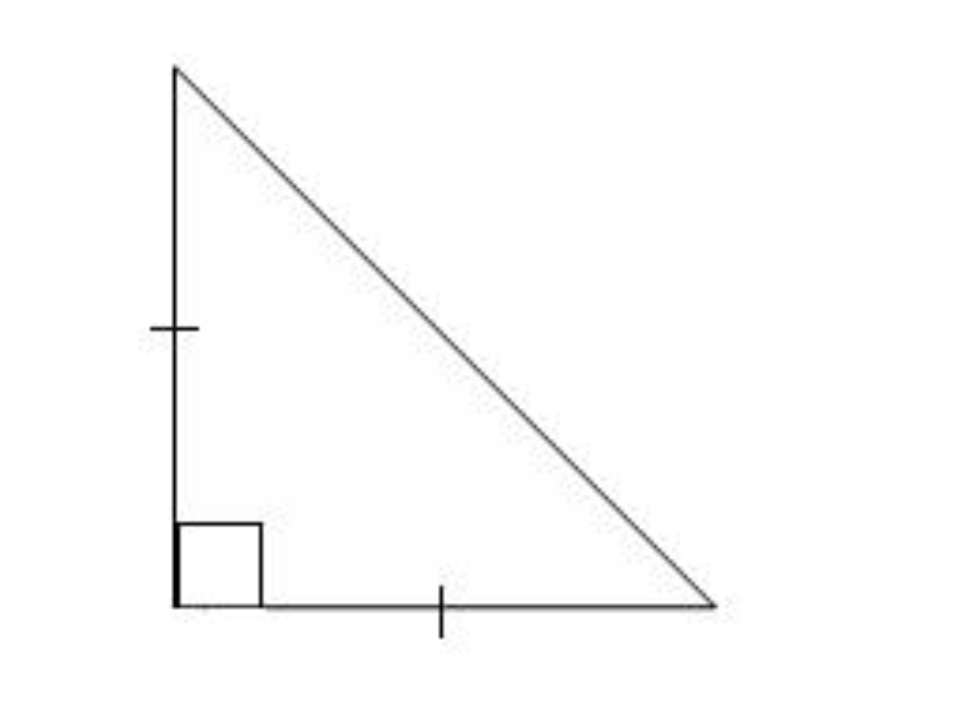
Which type of triangle is pictured?
a)
Equilateral Triangle
b)
Right Isosceles Triangle
c)
Obtuse Scalene Triangle
d)
Obtuse Equilateral Triangle
61.
What is the range?
a)
average
b)

Greatest - Least

c)
the middle #
d)
# happening the most
62.

In order to find the Median, the data must be sorted from least to greatest first.

a)
True
b)
False
63.

When finding Mean you must:

a)

It is the number that occurs the most.

b)

1. Order from Least to Greatest.

2. Eliminate front to back.

c)

1. Subtract all values.

2. Divide by the number of items given.

d)

1. Add together all values.

2. Divide by the number of items given.

64.

VOLUME IS HOW MUCH AN OBJECT CAN HOLD.

WHEN FINDING VOLUME WE:

a)

Multiply L x W

b)

Add L + W + H

c)

Multiply L x W x H

65.

AGAIN VOLUME IS WHEN WE MULTIPLY HOW MANY NUMBERS TOGETHER???????

a)

3, and if you don't multiply 3 numbers together you are plain wrong.

b)

2, now why would you pick this.... Miss Weeks has taught you better.