
Font size
 Worksheets
REVIEW: Ecology 3 (Human Impact, CC and Succession)
Total questions: 128
Worksheet time: 2hrs 11mins
1. What are renewable resources?
. Resources that are used faster than they form
resources that can replenish themselves over time
resources that formed over millions of years
resources that exist only in rural areas

According to the graph, what material’s recycling would reduce the largest portion of America’s trash?
Metals
paper
plastics
Yard trimmings
1. Which biome has the highest biodiversity and is the most threatened?
Temperate forests
grasslands
tropical rain forests
deserts
1. Why is firewood considered to be a renewable resource?
It can be replenished over time.
It is used up faster than it can form.
It is made from coal.
It can be made synthetically.
1. Why has Earth's human carrying capacity increased greatly?
Other organisms have been displaced by agriculture, so there is more space for humans.
Humans have modified their environment due to technological advances.
Humans can live closer together than other animals
Humans are now eating fewer plants than they used to.
1. Which of the following is not a renewable resource?
coal
wind energy
solar energy
water
1. What factor does not determine the size of an individual's ecological footprint?
amount and efficiency of resource use
amount of waste produced
size of population
toxicity of waste produced
How might an introduced plant species kill native plant species?
. Its rapid growth can deprive native plants of sunlight.
Its rapid growth can deprive native plants of food.
It can cause soil loss from erosion.
Its rapid growth can deprive native plants of oxygen.
1. What is one of the greatest threats to biodiversity on Earth?
habitat destruction
loss of drinking water
decrease in food supply
pollution
1. Why might an introduced animal species overrun native species in an ecosystem?
. Its population size is smaller than those of native species.
. It is more energy efficient, so it eats less food.
It is a predator of the native species.
It often has no natural enemies
1. Why might an introduced animal species overrun native species in an ecosystem?
. Its population size is smaller than those of native species.
. It is more energy efficient, so it eats less food.
It is a predator of the native species.
It often has no natural enemies
Which term describes the practice of managing resources so that current needs are met without harming future generations?
species introduction
sustainable development
habitat fragmentation
biomagnification

(Click Here To View)
Which inference can be made from the graphs?

In order to reduce the amount of air pollution in Pennsylvania, which change is necessary?

(Click Here To View)
An increase in human activity at X would most likely result in

(Click Here To View)
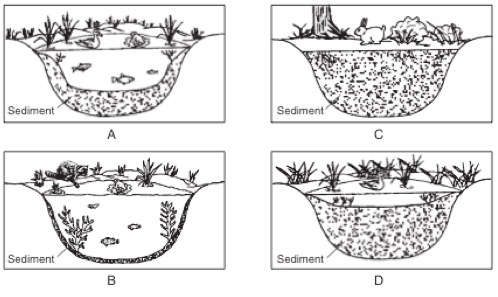
Which stage represents a pioneer community?

(Click Here To View)
Which ecosystem would most likely require the most time for ecological succession to restore it to its original state?

(Click Here To View)
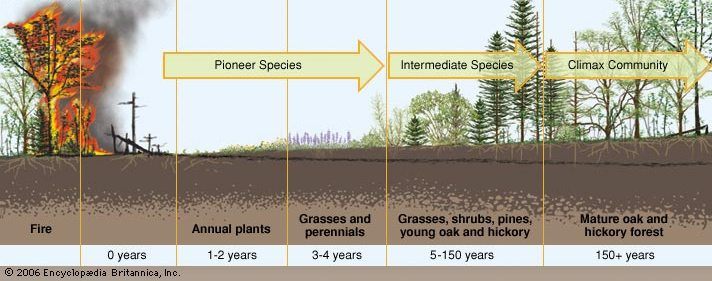
If the oak and hickory trees were burned in a forest fire, leaving bare soil, which group of plants would most likely be the first to grow back?

(Click Here To View)
What information would be appropriate to add to box X in order to complete the diagram?

The graph below shows data on human population growth.
(Click Here To View)
The trend shown on the graph would most likely result in
A) a decreased demand for deforestation
B) an increase in available freshwater
C) a decrease in air pollution
D) an increased demand for land use

Which environmental factor has been most recently affected by these changes in carbon dioxide level?

The rapid increase in human population between 1960 and 2010 is most likely the direct result of advances in

(Click Here To View)
The graph indicates that the number of species that have become extinct
What term describes using resources in a way that will NOT completely deplete our future supply?
conserving
polluting
abusing
recycling
All of the following are nonrenewable resources EXCEPT
coal
trees
petroleum (oil)
natural gas
Where does MOST of Earth's energy come from?
Space
The core of the Earth
The Sun
The atmosphere.
The widespread cutting down of trees is called...
Erosion
Restoration
Deforestation
Pollution
The introduction of pollutants into the environment is .....
waste
pollution
pesticides
erosion
Which of these is a major contributor to air pollution?
Indoor air pollutants
Rain
Sunlight
Fossil Fuels
What is the difference between a renewable resource and a nonrenewable resource?
Renewable is infinite and nonrenewable is finite.
Renewable is finite and nonrenewable is infinite.
Renewable and nonrenewable are the same.
Renewable and nonrenewable resources aren't needed by humans.
What do agriculture and urbanization have in common?
They have nothing in common.
They both have positive impacts on the environment.
They both can destroy natural habitats
They both involve building subdivisions.
Reasons the human population increased so rapidly was due to....
Better hygiene and sanitation
More food to feed more people (agricultural productivity)
Industrial and technological advancments
All of these
Which of the following is NOT a negative effect of the human population growth?
Increased energy demand
Increased waste
Increased development of new technologies
Increased demand on Earth's resources

Which countries in the world have the largest populations?
India and America
India and China
China and Australia
China and America
What is the most obvious way to reduce your carbon footprint?
Reduce the amount of resources you are using
Increase your use of technology
Leave the water running when brushing your teeth
Leave your lights on all night long
Cultivation of plants and animals for food, medicine, and other products
domestication
agriculture
mining
urbanization
Converting natural habitats into urban areas
Agriculture
Domestication
Mining
Urbanization
Avoid using a resources or limiting consumption of it
Reduce
Reuse
Recycle
Sustain
Using Earth's resources at a rate that doesn't deplete them
Reduce
Reuse
Conservation
Sustainability
Wise management of resources and preservation of ecosystems and biodiversity
Conservation
Sustainability
Reduce
Recycle
Discard a product in a way that it can be used again
Regrow
Reduce
Reuse
Recycle


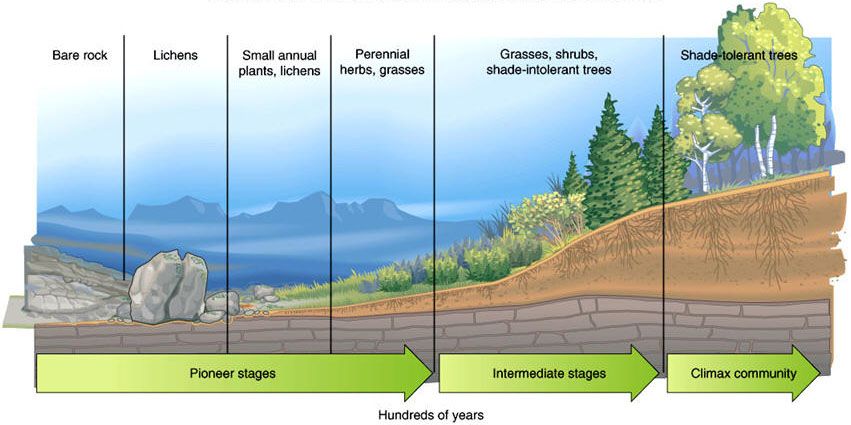



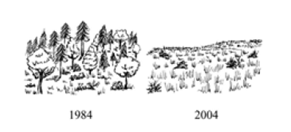

A change an ecosystem experiences over time is called
symbiosis
ecological succession
competition
cooperation

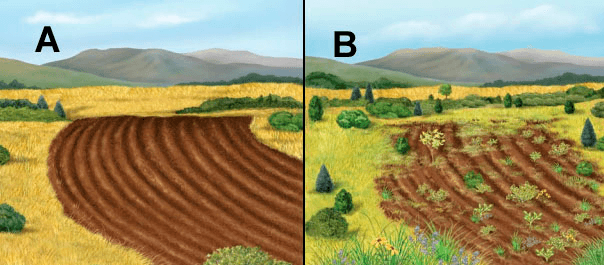
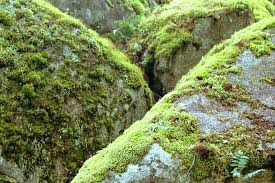
Series of changes where other organisms have not previously lived
primary succession
secondary succession
commensalism
competition
Different biotic and abiotic communities together in an area
species
ecosystem
community
population


What is the best evidence that this is NOT primary succession?
Soil and plants are present at the first step.
Changes occur in stages.
The size and number of the plants change.
Trees are present in one of the steps.
Which process occurs after humans cause deforestation?
eutrophication
photosynthesis
primary succession
secondary succession
What is Ecological Succession?
Competition between plants in a society
A natural disaster such as a flood or fire
The gradual change an ecosystem experiences over time that leads to decreased biodiversity and sustainability
The gradual change an ecosystem experiences over time that leads to increased biodiversity and sustainability
Which type of succession takes longer?
primary
secondary
they both take the same amount of time

What is the carrying capacity of the graph?
1000
8000
800
600
This may cause a population to increase
increase of food supply
removal of predators
removal of disease
all of these

The largest number of individuals that an environment can support long term is...
carrying capacity
emigration
immigration
population density

Something that regulates the size of a population is called...
a limiting measure
a limiting factor
carrying capacity
biodiversity
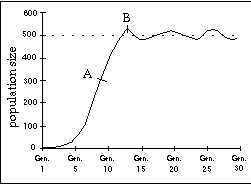
What is the carrying capacity of the graph?
around 500
more than 800
less than 300
around 700
When the death rate rises and the birth rate lowers...
population increases
population decreases
population stays the same
all of these
What is the carrying capacity of the graph?
1000
8000
800
600


If the carrying capacity of a predator decreases, what will happen to the carrying capacity of the prey?
Will Increase
Will Decrease
Will stay the same

The graph to the right shows the interaction of the wolf and moose populations on Isle Pekie. If the moose population continues to increase, the wolves' food supply will increase. What will most likely happen to the wolf population as a result?
It will decrease.
It will increase.
It will remain the same.
A scientist was studying a population of fish in a pond over a period of 10 years. He observed that
the population increased each year for 3 years, and then remained nearly constant for the rest of
the study. The best explanation for this observation is that the population had
stopped reproducing
reached carrying capacity
mutated into a different species
run out of food and all died
What are factors that affect carrying capacity?
Biotic only
Biotic and abiotic
Depends on the ecosystem
Abiotic only

Which statement best describes the predator-prey relationship displayed on this graph?
There is no relationship between the predator and prey.
When the prey population increases, the predator population decreases.
When the prey population increases, the predator population increases.
when the predator population increases, the prey population increases.
Which of the following is a biotic factor that would affect the carrying capacity of a population?
Soil
Predator
Rainfall
Sunlight
What is carrying capacity?
A condition that occurs when two or more organisms compete for the same resources within an ecological community
A relationship in which two organisms are mutually dependent on each other for survivial
All the biotic and abiotic factors and the interactions among them in a given area
The maximum number of organisms an ecosystem can support
What is ecosystem?
A condition that occurs when two or more organisms compete for the same resources within an ecological community
All the biotic and abiotic factors and the interactions among them in a given area
The maximum number of organisms an ecosystem can support
A relationship in which two organisms are mutually dependent on each other for survival
Which statement best describes the term limiting factors?
All the biotic and abiotic factors and the interactions among them in a given area
A finite resource organisms in an ecosystem require
The biotic and abiotic factors in an ecosystem
The maximum number of organisms an ecosystem can support
Which of the following demonstrates population growth when there is limited available water in an area?


When rabbits were introduced to Australia, they began to breed exponentially. However, over time their population has begun to decrease due to a limiting factor.
What is most likely the limiting factor in this situation?
Abundant space to breed and live
No available predator in the area
Rabbits choosing not to mate to conserve space
Lack of available food
Habitat availability increases for a population. How would the carrying capacity of the prey change?
The carrying capacity would increase as more resources become available.
Carrying capacity occurs independent of factors in the environment.
The carrying capacity would decrease as more resources became available.
The carrying capacity is set in an environment and cannot change.

When Yellowstone National Park was created in the late 1800s, wolves were on the decline. The last wolves in Yellowstone were killed in 1926, but in the 1800s, there were between 100-160 wolves in the park. In 1995, gray wolves were reintroduced to the park.
Which graph (drawn in red) below shows a prediction of how the population would change if there was less water available in the ecosystem?


There would be no change to carrying capacity.
If there are not enough rabbits in a forest to feed a large population of foxes, then
space becomes a limiting factor
there is no problem
food becomes a limiting factor
water becomes a limiting factor
What is a limiting factor?
a resource that can limit the size of a population
a resource that can increase the size of a population
a living organisms in an environment
a nonliving factor in an environment
carrying capacity is
the number of organisms in an environment
factors that limit population size
the smallest population an environment can support
the largest population an environment can support

According to the graph, what is causing the deer population to decrease
They got sick
The wolf population is decreasing
The wolf population increased
They ran out of food

Predator population lags behind prey population because......
Increase in predators leads to decrease in prey
Increase in predators leads to increase in prey
Increase in predators leads to decrease in producers
Increase in producers leads to increase in prey

When a population grows past the ecosystem's carrying capacity, what happens to the population?
Continues to grow
The population starts to die off to return to carrying capacity
The population will go extinct due to lack of resources
The population grows then finds a new carrying capacity


