
 Worksheets
7.1-34 Standards Mid-Year Review Quiz 2023
Total questions: 34
Worksheet time: 18mins
7.01 Which of these major rivers is located in China?
Choose TWO:
Ganges
Yellow
Yangtze
Indus
Thames
7.02 Why did so many people turn to Buddhism during the Period of Disunion?
Buddhist temples offered food to anyone willing to convert to the religion.
The kingdom's leaders forced people to convert to Buddhism.
Buddhism offered the people a strong education for their children.
People took comfort in the Buddhist teaching that people can escape suffering and achieve a state of peace.
7.03 What agricultural development allowed Chinese farmers to raise crops on steep hillsides?
creating terraces
side planting
inventive plowing
new digging tools
7.05 Kublai Khan, the Mongol ruler who defeated Song dynasty China, trusted this group of people to hold government jobs in the Yuan dynasty more than he trusted the native Chinese:
foreigners
soldiers
scholars
Buddhist monks
7.04 Mongol ruler who was effective in uniting the nomadic Mongol clans and began the conquest of Central Asia which would eventually become the Mongolian Empire.
Genghis "grandfather" Khan
Kublai Khan
Marcus Aurelius
Taizong
7.06 What trade route between China and Eastern Europe did Marco Polo travel, spreading culture and inventions from China into Italy and other parts of Europe
The Desert Road
The Spice Trail
The Eastern Path
The Silk Road
7.07 How did the Ming change the China's foreign policy after the death of Zheng He?
Became more isolated, involved in less trade and spread of culture
More focus on trade and spread of ideas
Created more alliances with European powers
Started more wars with Japan and India

7.8 Shinto is an ancient Japanese religion that started around 500 BCE or earlier. Which of these is true about the Shinto religion?
It is the official religion of Japan today.
It shares sacred texts with Hinduism.
It is no longer important to Japanese culture.
It includes worship of nature spirits.
7.09 Name two religions that came from China into Japan:
Buddhism and Shintoism
Buddhism and Zen Buddhism
Buddhism and Confucianism
Confucianism and Christianity
7.10 The Heian aristocracy (highest/wealthiest class of society) of the capitol city Kyoto created enduring cultural perspectives including the need for Japanese people to have a reverence for the aristocracy. This deep respect for the aristocracy may be seen in
Confucian ideas of superior and inferior relationships
the requirements of the Bushido code
a central theme of "The Tale of the Genji" as the aristocratic characters' names are left out as a way of showing respect
all of these
7.11 Which sentence is true about feudalism in medieval Japan?
Peasants are lords and Samurai are vassals
Shogun are lords and Samurai are vassals
Samurai are lords and Daimyo are vassals
Peasants are lords and Daimyo are vassals

7.13 How does the person pictured contribute to the legacy of Rome, regarding the Byzantine Empire?
relocated capital of the Empire from Rome to Constantinople
established Christianity as the official religion
divided the Roman Empire into four equal sections
reorganized & simplified existing laws of the Roman Empire
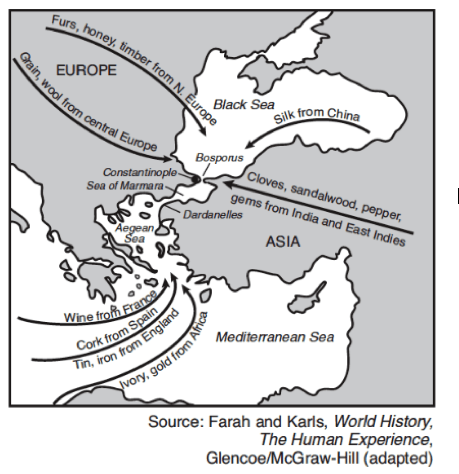
7.14 What can you conclude about the city of Constantinople?
Constantinople is a difficult city to travel to
Constantinople is located in Asia.
Constantinople was located at the center of major trade routes
Constantinople is on the Mediterranean Sea.
7.12 What are some of the cultural influences (legacy) that Rome first had on the Byzantine Empire?
Chariot races, oil paintings (the David, Mona Lisa), and turned outsiders away
Christian religion, Roman style buildings (architecture, domes, concrete), emperors spoke Latin, Roman Laws
Polytheism,military generals ran gov't, and farming main business
Latin language, poor people free housing and bread, Islam main religion

7.15 Which river is located at #5?
Nile River
Arabian River
Tigris River
Euphrates River
7.16 This person is referred to as "The Prophet of Islam" also, "the last and the greatest prophet" of Islam
Allah
Mohammed
Mehmed II
Constantine
7.17 This language was used for the spread of Islam and trade throughout the Middle East. The language itself was spread further alongside religion and trade goods.
Arabic
Italian
Hebrew
Latin
7.18 Which of the following accomplishments is credited to the Muslims?
initial exploration to North and Central America
mathematical concepts including Algebra
colonization of east Asia and Japan
first time engineering feats including road building
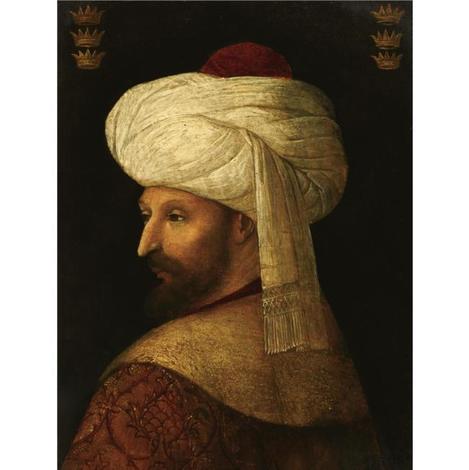
7.19 Which Ottoman Emperor captured Constantinople in 1453?
Mehmed the Conqueror
Othman
Suleyman the Magnificent
Abbas the Great
7.20 Check all that apply: What made Muslim traders so successful? CHOOSE THREE:
Using government issued coins instead of bartering
Laws that non-Muslims couldn't trade in certain cities
The language of Arabic being the used by most traders
Muslim culture supported merchants for the wealth they brought and their business skills
7.24 Which happened in West Africa as trans-Saharan trade developed?
West African societies became governed by democratically elected leaders.
West African cities became centers of trade, religion, and education.
West African cities became more poor and the population decreased as people moved away.
West African cities became increasingly isolated.
7.25 African griots were important to West Africa for the following reasons: CHOOSE THREE
they passed down oral traditions, history, and religious beliefs
few people could read and write in Ghana since they emphasized spoken language
they often used music and storytelling
they were the leaders of the kingdom of Ghana
they were the scribes who wrote down the kingdom's history and laws
7.26 This wealthy ruler took a religious pilgrimage to Mecca that also demonstrated his wealth
Mansa Musa
Sunni Ali
Justinian
Constantine

7.23 Which TWO cities are important centers of trade in the kingdoms of Ghana, Mali, and Songhai? Hint - numbers 3 and 4 on the map.
Timbuktu
Djenne
Cairo
Mecca
Constantinople

7.21 Which river was most important to the people of Ghana, Mali, and Songhai? Hint - it is located at #7 on the map, but continues north near #3 and #4 as well.
Nile River
Congo River
Niger River
Tigris River
7.22 Which is NOT a part of indigenous African religions?
ancestor worship
spirits are found in all natural objects
one God
acceptance of Mohammed's teachings

7.27 Which mountain range in northern Italy is pictured here? HINT: This often protected the capitol of the Western Roman Empire from attacks.
Andes
Urals
Alps
Himalayas
7.28 Choose ALL the services monks and nuns provided in the Middle Ages. These actions also played a role in the spread of Christianity throughout Europe. CHOOSE THREE:
basic healthcare
collecting taxes
caring for the poor
education
7.29 Which of the following is true of Charlemagne? Choose three:
King of the Franks who was declared emperor by the Pope
Defended the Papal lands
Slaughtered the English people
Doubled the size of he Frankish kingdom
Overthrew the Byzantine Empire
7.30 Instead of land, which was usually reserved for the higher social classes, what did peasants usually receive in return for their labor in the feudal system?
Protection
Food
Taxes
Freedom
7.31 After William the Conqueror of the Normans conquered the Saxons in England, what changed? CHOOSE THREE
The new king conducted the first census of England.
The Saxons were slaughtered and exiled, leaving almost no Saxons living in England.
New ideas, including the French language, were brought in from mainland Europe
The new king encouraged marriage between Saxons and Normans.
The new king hated all Saxons and punished any marriages or even friendships between with the Saxons.
7.32 Which of the following describe the relationship between Pope Leo III and Charlemagne?
Pope Leo III excommunicated Charlemagne
Charlemagne fought against the Papal States
Pope Leo III crowned Charlemagne Holy Roman Emperor
Pope Leo III named Charlemagne the next Pope
7.33 Which of the following are true of the Magna Carta that King John of England was forced to sign by the nobles?
CHOOSE THREE
It limited the power of the king.
It has influenced legal documents like the U.S. Constitution.
It gave everyone in Medieval England equal rights.
It included important legal practices such as the jury trial.
7.34 What were two of the reasons for the Crusades?
CHOOSE TWO:
To take control of the city of Jerusalem from the Muslim Turks.
To help defend the Byzantine Empire against the ongoing threat of attack
To retake Rome from the Visigoths
To further expand the Holy Roman Empire throughout Europe

