
 Worksheets
Mendel Genetics and Punnett Squares
Total questions: 14
Worksheet time: 7mins
Who was the Austrian monk that experimented on pea plants and is called the "father of genetics"?
Gregor Mendel
Charles Darwin
Francis Crick
James Watson
Different versions of a trait (tall or short, white or purple) are called
alleles
traits
versions
genes
Which of the following shows a dominant trait?
aa
Bb
cc
dd
The only way for a recessive trait to appear is for an organism to have
two dominant alleles
two recessive alleles
one dominant allele and one recessive allele
Which of the following is considered to be Homozygous Dominant?
AA
Aa
aa
Which of the following is considered to be Heterozygous?
AA
aa
Aa
Which of the following is/are an example(s) of a genotype? Select all that apply.
tall
purple
AA
wrinkled
bb
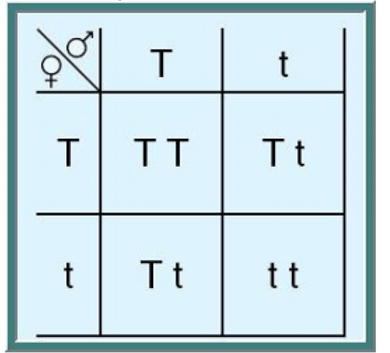
In pea plants, tall is dominant to short. If 2 heterozygous plants are crossed, what % of the offspring will be short?
0%
25%
50%
75%
In pea plants, purple is dominant to white. If a plant has a genotype of Pp, what is its phenotype?
purple
white
purple and white

Based on this Punnett Square, what is the chance of getting a female with white eyes?
0%
25%
50%
100%

A blonde woman marries a heterozygous man. What are the chances of a blonde hair baby?
0%
25%
50%
75%
100%

A woman with curly hair marries a man who is homozygous dominant. What are the chances of a curly hair baby?
0%
25%
50%
75%
100%


A chart that shows all the possible combinations of alleles that can result from a genetic cross
dominant allele
codominance
probability
Punnett Square

