
 Worksheets
The Modern Atomic Theory
Total questions: 30
Worksheet time: 16mins

The English chemist John Dalton formulated an atomic theory based on his observations. In 1897, J. J. Thomson showed that negative charges could be made to move from one end of a cathode ray tube to another, causing the tube to glow. Because of this, Thomson is credited with the discovery of the electron. Which part of Dalton’s atomic theory conflicted with Thomson’s new data based on this information?
1
2
3
4
What is the mass number of an atom with six protons, six electrons, and eight neutrons?
6
12
14
20

Rutherford bombarded a gold foil with alpha particles (see image). Most of the particles went straight through the foil, and a few were deflected.
Which of these conclusions can be drawn from Rutherford’s experiment?
An atom is mostly empty space with a dense, positively charged nucleus.
An atom is composed of at least three types of subatomic particles.
An electron has a positive charge and is located inside the nucleus.
An electron has properties of both waves and particles.

The table shown gives information about the nucleus of each of the four atoms.
How many different elements are represented by the nuclei in the table?
1
2
3
4
Which scientist was the first to conclude through experimentation that atoms have positive charges in their nuclei?
Bohr
Dalton
Mosley
Rutherford

Which image represents the nucleus of an atom of 2713 Al?
A (14 n, 27 p)
B (14 n, 13 p)
C (27 n, 13 p)
D (40 n, 13 p)
An increase in atomic number is related to an increase in atomic mass because:
more electrons are present in the atomic nucleus.
more electrons are orbiting the atomic nucleus.
more protons are present in the atomic nucleus.
more protons are orbiting the atomic nucleus.
A sample composed only of atoms having the same atomic number is classified as:
a compound
a solution
an element
a mixture
The atomic mass of an element is the weighted average of the:
number of protons in the isotopes of that element.
number of neutrons in the isotopes of that element.
atomic numbers of the naturally occurring isotopes of that element.
atomic masses of the naturally occurring isotopes of that element.
Which idea of John Dalton is no longer considered part of the modern view of atoms?
Atoms are extremely small.
Atoms of the same element have identical masses.
Atoms combine in simple whole number ratios to form compounds.
Atoms of different elements can combine in different ratios to form different compounds.
Atoms of the same element must:
contain the same number of neutrons.
have the same mass number.
contain the same number of protons.
have equal numbers of protons and neutrons.
Which best describes the current atomic theory?
Atoms consist of electrons circling in definite orbits around a positive nucleus.
Atoms are composed of electrons in a cloud around a positive nucleus.
Atoms can easily be split, at which time they become radioactive.
An atom’s mass is determined by the mass of its neutrons.
The most common isotope of chromium has a mass number of 52. Which notation represents a different isotope of chromium?
5224Cr
2452Cr
5424Cr
2454Cr
Why is cobalt (Co) placed before nickel (Ni) on the periodic table of the elements even though it has a higher average atomic mass than nickel?
Nickel has one more proton.
Cobalt was discovered first.
Nickel has fewer electrons.
Cobalt has a lower density.
When compared to sulfur-32, sulfur-34 has more:
protons
neutrons
energy levels
bonding configurations


In order for electrons to move from energy level to another they must either gain or lose energy.
True
False


What mass does a neutron have?
1 amu
0 amu
-1 amu
+2 amu
What is a subatomic particle with a negative charge? It is found in the electron cloud surrounding the nucleus.
neutron
proton
electron
electron cloud
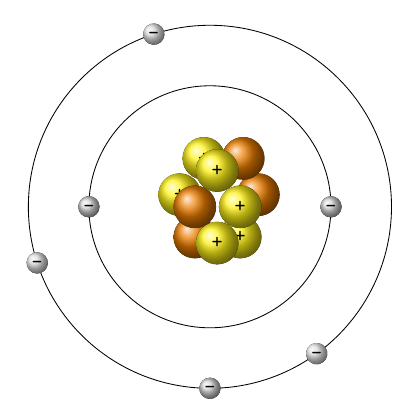
How many electrons does this atom have?
2
4
6
10


