wayground logo

Free Printable Worksheets

NEW

Font size

S
M
L
XL
Worksheets

Unit 8

Total questions: 30

Worksheet time: 29mins

Name
Class
Date
1.

Changes in a species over generations, due to changes in the environment

a)

Distribution

b)

Mutation

c)

Adaptation

d)

Resistance

2.

Process in which traits become more/less common due to some traits making it more likely for individuals to survive and reproduce

a)

Natural Selection

b)

Mutation

c)

Distribution

d)

Adaptation

3.

A random and permanent change to a gene

a)

Protein

b)

Gene

c)

Natural Selection

d)

Mutation

4.
Drawn observed several different types of finches.  Why are there so many different types?
a)
Finches live in different places, but eat the same food.
b)
Finches live in the same place, but eat different types of food.
c)
Finches live in different habitats and eat different types of food.
d)
Finches are found all over the world.
5.
Organisms with the most beneficial traits will survive.  This is commonly known as
a)
theory of evolution.
b)
variations.
c)
survival of the fittest.
d)
ecosystems.
6.
This scientist developed the theory of evolution as he studied the finches.
a)
Charles Darwin
b)
Isaac Newton
c)
Albert Einstein
d)
Marie Curie
7.
Why are advantageous traits more likely to be passed onto offspring?
a)
Because they are more likely to survive and reproduce.
b)
Because they come from dominant alleles.
c)
Because they come from recessive alleles.
d)
Because the trait is an acquired phenotype.
8.

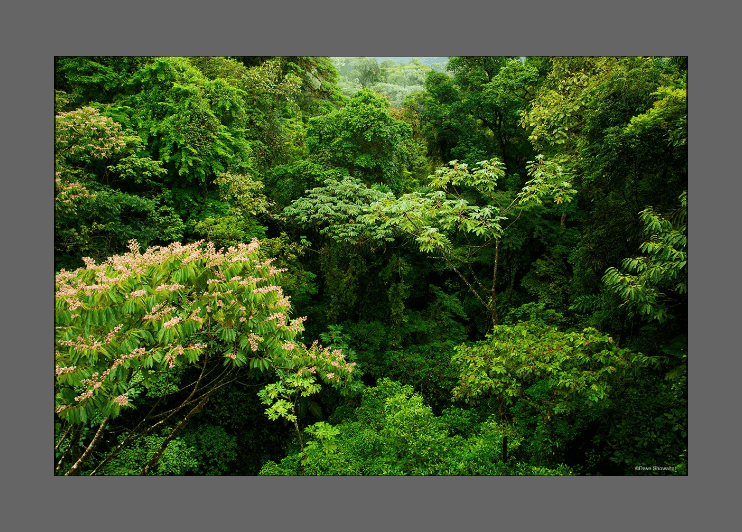
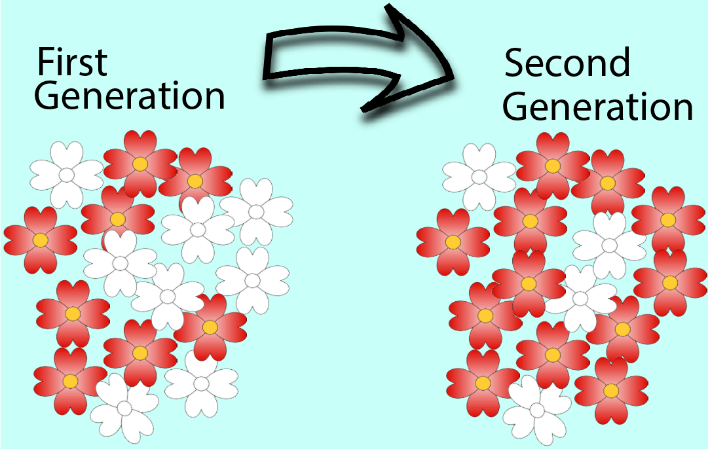
A yellow morph and green morph of an insect lives in the rainforest canopy. You would expect:

a)

the green population to increase and the yellow to decrease

b)

both populations should stay the same

c)

both populations will increase

d)

the green population to decrease and the yellow to increaseThis is a wrong answer
9.
A flash flood carried a raft of Amazon ants away from their original population. There is enough distance between the two groups, that they will never meet in nature again. What type of reproductive barrier is this?
a)
behavioral isolation
b)
temporal isolation 
c)
gametic isolation
d)
geographic isolation 
10.
Some female peacocks prefer males with large, colorful tales while other female peacocks prefer males with no tail at all. Females are beginning to only mate with the type of males with the tail they prefer. What type of reproductive barrier is this?
a)
behavioral isolation
b)
hybrid sterility 
c)
temporal isolation
d)
mechanical isolation 
11.
The flowers of pink tulips open in the morning, while the flowers of lavender tulips open in the early afternoon. The bees that pollinate these tulips cannot carry pollen back & forth between the two types of tulips because of their flowers being closed at different times of day. What type of reproductive barrier is this?
a)
behavioral isolation
b)
hybrid sterility 
c)
temporal isolation
d)
mechanical isolation 
12.
The term for the formation of new and distinct species over the course of evolution is...
a)
speciation
b)
biological species concept
c)
reproductive barrier
d)
natural selection
13.

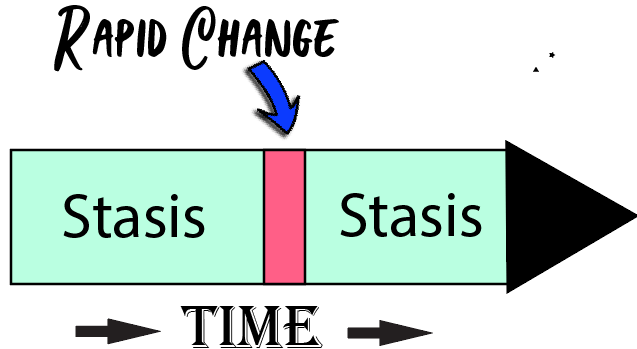
Punctuated Equilibrium implies catastrophic events caused natural selection to speed up due to great environmental changes.

a)

True

b)

False

14.

Genetic diversity in a species makes long term survival of some members

a)

impossible

b)

improvable

c)

more likely

d)

less likely

15.

Average phenotypes are favored in the environment, while extremes have lower survival rates.

a)

seasonal selection

b)

distruptive selection

c)

directional selection

d)

stabilizing selection

16.

All the possible gene combinations in a population.

a)

allele

b)

gene pool

c)

genome

d)

mitosis

17.

The frequency that single genes (alleles) for a trait appear in a population.

a)

Genome

b)

Gene frequency

c)

Genetic Drift

d)

Population Frequency

18.

Changes in the gene pool over time.

a)

Mitosis

b)

Genetic Variation

c)

Gene Pool

d)

Genetic Drift

19.

True or False: Evidence from the fossil record shows that species change gradually over time.

a)

True

b)

False

20.

What theory proposes that evolution occurs steadily in tiny changes over long periods of time?

a)

gradualism

b)

relative dating

c)

natural selection

d)

punctuated equilibria

21.

Which rock layer most likely contains fossils of the oldest organisms?

a)

1

b)

2

c)

3

d)

4

22.

When scientists see similarities between a hippopotamus embryo and a rabbit embryo, this suggests:

a)

Rabbits evolved from hippopotamus.

b)

Hippopotamus share a common ancestor with rabbits.

c)

Hippopotamus evolved from rabbits.

d)

Hippopotamus and rabbits share the same traits.
23.
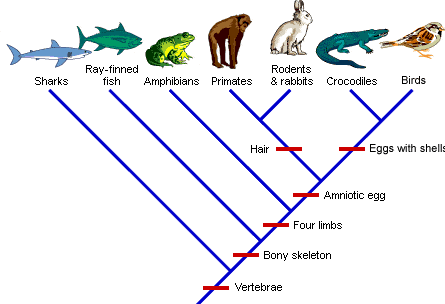
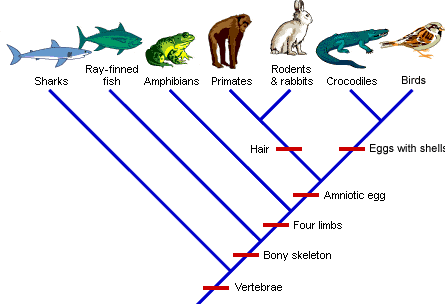
According to this cladogram, sharks are MOST closely related to which organism? 
a)
Amphibians
b)
Ray finned fish
c)
Crocodiles
d)
Birds
24.
According to this cladogram, birds are LEAST related to: 
a)
Amphibians
b)
Sharks
c)
Ray Finned Fish
d)
Crocodiles
25.
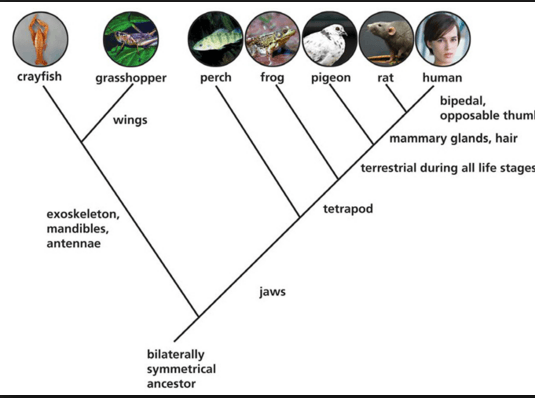
Which trait do only humans have, according to the cladogram?
a)
jaws
b)
mammary glands & hair
c)
terrestrial during all life stages
d)
bipedal & opposable thumbs
26.
Which two orgainsms have hair? 
a)
Sharks & Ray Finned Fish
b)
Primates & Rodents
c)
Birds & Crocodiles
d)
Rabbits & Birds
27.

Which species is most closely related to species C?

a)

A

b)

B

c)

D

28.
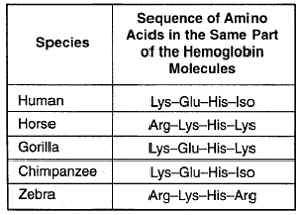
You look at two species and see very similar amino acid sequences. What does this likely tell you?
a)
These are the same animal.
b)
These animals have a common ancestor.
c)
These animals are not likely related.
d)
These animals are likely becoming one species.
29.

Which letter represents the most recent common ancestor of sponges and mushrooms?

a)

A

b)

B

c)

C

d)

D

e)

E

30.

Which trait(s) do conifers have?

a)

vascular tissue only

b)

vascular tissue and seeds

c)

vascular tissue, seeds and flowers

d)

seeds only