wayground logo

Free Printable Worksheets

Font size

S
M
L
XL
Worksheets

Math I - Modules 1-4 Review

Total questions: 176

Worksheet time: 29hrs 20mins

Name
Class
Date
1.
12x = 144
a)
x = 12
b)
x = 4
c)
x = 2
d)
x = 132
2.
3y = -15
a)
-5
b)
5
c)
-3
d)
3
3.
-4x + 1 = 21
a)
x=120
b)
x=5
c)
x=30
d)
x=-5
4.
5 = 7s - 9
a)
2
b)
6
c)
7
d)
8
5.
-30 - 5x = 120
a)
x = 18
b)
x = -18
c)
x = 30
d)
x = -30
6.

m - 7 + 5m = 11

a)

m = 6

b)

m = -2

c)

m = 4

d)

m = 3

7.

-10(2m + 1) = - 50

a)

m = -7

b)

m = 20

c)

m = 5

d)

m = 2

8.

15f + 12 - 9 - 11f = 43

a)

f = - 9

b)

f = 11

c)

f = - 8

d)

f = 10

9.

16 =k1116\ =\frac{k}{11}  


The variable, k, is being divided by 11. What step needs to be completed to isolate the variable k?

a)

Divide both sides by 11

b)

Multiply both sides by 11.

c)

Add 11 to both sides.

d)

Subtract 11 to both sides.

10.

Solve for x in the following equation:
x4\frac{x}{-4}  = 9

a)

13

b)

36

c)

-36

d)

49\frac{-4}{9}  

11.

In the equation


x + 7 = 12


7 is being added to the variable, x.

How should you show your work to isolate the variable and solve the equation?

a)

Subtract 7 from both sides. The solution is x = 5.

b)

Add 7 to both sides.

The solution is x = 19.

c)

Multiply both sides by 7 The solution is x = 84.

12.

True or False: In order to solve the equation below, you would add 6 to each side then multiply by -8 on each side.

g8 6 = 12\frac{g}{-8}\ -6\ =\ -12  

a)

true

b)

false

13.
¾ x + 7 = 22
a)
x = 5
b)
x = 20
c)
x= 7
d)
x= 22
14.

8v - v + 8 = 22

a)

2

b)

10

c)

4

d)

-4

15.

What is the first step to solve this equation:

- 3x -11 = 44

a)

Add 3 to both sides

b)

Subtract 11 from both sides

c)

Add 11 to both sides

d)

Divide 3 on both sides.

16.
M= i + r ; solve for r
a)
M-i
b)
M+i
c)
-M-r
d)
-M+i
17.
Solve the formula for r.   What is the 1st step?
a)
Divide each side by t. 
b)
Subtract t from each side. 
c)
Add t to each side. 
d)
Multiply each side by t. 
18.
Solve:
C = 2πr, for r
a)
C/(2π) = r
b)
C + 2π = r
c)
C - 2π = r
d)
2πC = r
19.
Solve for x:
a)
x = yb - v
b)
x = by - v
c)
x = by + v
20.
S = 3F - 24  Solve for F
a)
F = (S + 24)/3
b)
F = S/3 + 24
c)
F = 3S + 24
d)
F = 3(S + 24)
21.
8x + 4y= 16 for y
a)
y = -8x + 16
b)
y = 2x -4
c)
y = -2x + 4
d)
y = -8x + 12
22.
a)
h=V/(3πr2)
b)
h=(3V)/(πr2)
c)
h=V/(3πr2)
d)
h=(3π)/(Vr2)
23.
Solve for w:
A = LW
a)
A = L/W
b)
w = L/A
c)
w = A
d)
w = A/L
24.
Solve the literal equation for the given variable.
a)
2A/h
b)
2/(h)
c)
2Ah
d)
Ah/2
25.
Solve for s:
2s = 6t + 8w
a)
s = 12t + 16w
b)
s = 6t + 4w
c)
s = 3t - 4w
d)
s = 3t + 4w
26.
Solve the formula for b.  What is the 1st step? 
a)
Subtract h from each side. 
b)
Add h to each side. 
c)
Divide each side by h. 
d)
Multiply each side by 2. 
27.

Solve for 'x': x + 2w = m

a)

x = m - 2w

b)

x = 0.5m - w

c)

x = 2mw

d)

x = m/(2w)

28.

2x + 5x - 4 + 1

a)

7x -3

b)

10x - 3

c)

4x

29.

4( x + 1 ) - 2x

a)

4x + 5

b)

2x -4

c)

2x + 4

30.

2x3+4x313\frac{2x}{3}+\frac{4x}{3}-\frac{1}{3}  

a)

5x3\frac{5x}{3}  

b)

6x13\frac{6x-1}{3}  

c)

6x 19\frac{6x\ -1}{9}  

31.

2( x - 1) + 3 ( 2x + 1)

a)

0

b)

9x - 4

c)

8x + 1

32.

Answer the recorded question

a)

11x + 1

b)

8x + 1

c)

9x

33.

x2 + 2 3x2 +1x^2\ +\ 2\ -3x^2\ +1  

a)

2x2+ 3-2x^2+\ 3  

b)

00  

c)

4x2 +34x^2\ +3  

34.

3x3+x22x3 +2x213x^3+x^2-2x^{3\ }+2x^2-1  

a)

x3+3x21x^3+3x^2-1  

b)

x3 +x2 1x^{3\ }+x^{2\ }-1  

c)

4x514x^5-1  

35.

2x(x2 +x3)+ 4x4-2x\left(-x^{2\ }+x^3\right)+\ 4x^4  

a)

4x54x^5  

b)

4x5+ 4x44x^5+\ 4x^4  

c)

2(x3+x4)2\left(x^3+x^4\right)  

36.

The perimeter of the rectangle ABCD is:

a)

2x + 3

b)

4x + 6

c)

8x + 12

37.

x(2x + x2)+x3x\left(2x\ +\ x^2\right)+x^3  

a)

2(x2+x3)2\left(x^2+x^3\right)  

b)

5x55x^5  

c)

3x5 + 2x3x^5\ +\ 2x  

38.
Solve for f:
f - 4 = 6f + 26
a)
f = -5
b)
f = 5
c)
f = 6
d)
f = -6
39.
Solve for x:
5x - 14 = 8x + 4
a)
x = 6
b)
x = -6
c)
x = -18/13
d)
x = 10/3
40.

10x + 9 = 4x - 9

a)

x = 0

b)

x = 3

c)

x = -3

d)

x = -18

41.

-5k + 10 = -2k - 14

a)

k = 8

b)

k = -8

c)

k = 2

d)

k = -2

42.

8x - 8 = -4x + 16

a)

x = 8

b)

x = 16

c)

x = 24

d)

x = 2

43.
Solve:
2(4x-3) - 8 = 4 + 2x
a)
x = 5/3
b)
x = 3
c)
x = 1
d)
x = 2
44.
Solve the equation
12x - 15 = 3(2x+3)
a)
x = 4
b)
x = -4
c)
x = 2
d)
x = -2
45.

7w + 5 = 3w - 15

a)

w = 5

b)

w = -2

c)

w = 2

d)

w = -5

46.

In order to solve an equation, we must get variables on side of an equation, and constants on the opposite side.

a)

True

b)

False

47.

3y - 8 = 7y

a)

y = 4

b)

y = -4

c)

No Solution

d)

Infinite Solutions

48.

6x + 10 = 2(3x + 4)

a)

x = 0

b)

x = 2

c)

No solutions

d)

Infinite solutions

49.

4(6k - 12) = 3(8k - 16)

a)

x = 3

b)

x = -3

c)

no solutions

d)

infinite solutions

50.

Which statement best describes l -4 l?

a)

the distance from -4 to 4 on a number line

b)

the distance from 4 to 0 on a number line

c)

the distance from -4 to 0 on a number line

d)

the distance from 0 to 4 on a number line

51.

What does absolute value mean?

a)

The opposite of a number

b)

The exact distance a number is from zero

c)

a negative plus a positive

52.

Solve | 3x - 6 | - 9 = -3

a)

No Solution

b)

x = 0 or x = 4

c)

x = 2 or x = -2

d)

x = -4 or x = 4

53.
Solve 3| −8x| + 8 = 80
a)
{-7/3, 7/3}
b)
{-3,3}
c)
{11/3,-11/3}
d)
No Solution
54.

Solve |-7n + 4| + 9 = 34

a)

n = -3

b)

No Solution

c)

n = -3, n = -29/7

d)

n = -3, n = 29/7

55.

Solve

-8|6n - 7| - 6 = -14

a)

n = 1, n = 2

b)

n = 4/3, n = 3

c)

n = 1, n = 4/3

d)

No Solution

56.
Evaluate.
| 15 - 5 | =
a)
20
b)
10
c)
-20
d)
-10
57.
Evaluate.
| -13| + | 24| =
a)
12
b)
-37
c)
37
d)
10
58.
| -25| / 5
a)
5
b)
-5
c)
20
d)
-20
59.
|v + 8| − 5 = 2 
a)
{-1,-15}
b)
{-1,-5}
c)
{-15,15}
d)
No Solution
60.

|x – 12| - 3 = 11.

a)

-2, -26

b)

-2, 26

c)

3, 25

d)

4, -7

61.
-|−2r − 1| = 11
a)
{-6,5}
b)
{5,-6}
c)
-6
d)
No Solution
62.
Solve:
a)
{24}
b)
{-6, -8}
c)
{16, 4}
d)
{24, -24}
63.

Solve:

xy+ x2 16  \left|x-y\right|+\ x^2\ -\sqrt{16}\ \  when x= -9 and y = -7


(a)  

64.

8+7\left|8\right|+\left|-7\right|  

a)

-15

b)

15

c)

1

d)

-1

65.

4+2(6)\left|4+2\left(-6\right)\right|  

a)

16

b)

-36

c)

-8

d)

8

66.

3yz\left|3y\right|-z  

Evaluate if y = 2 and z = 5

a)

1

b)

-1

c)

-11

d)

11

67.

Which of the relations below is a function?

a)

{(2, 3), (3, 4), (5, 1), (2, 4)}

b)

{(2, 3), (3, 4), (6, 2), (7, 3)}

c)

{(2, 3), ( 3, 4), (6, 2), (3, 3)}

68.

Given the relation A = {(5, 2), (7, 4), (9, 10), (x, 5)}. Which of the following values for x will make relation A a function?

a)

7

b)

9

c)

4

69.

The following relation is a function.

{(10, 12), (5, 3), (15, 10), (5, 6), (1, 0)}

a)

True

b)

False

70.

The graph of a relation is shown at the right. Is this relation a function?

a)

Yes

b)

No

c)

Cannot be determined from a graph

71.

The graph of a relation is shown below. Is the relation a function?

a)

Yes

b)

No

c)

Cannot be determined from a graph

72.

The graph of a relation is shown below. Is the relation a function?

a)

Yes

b)

No

c)

Cannot be determined from a graph

73.

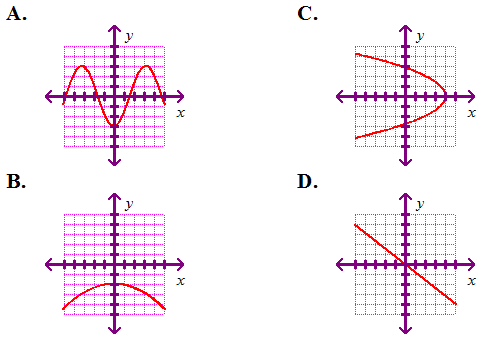
Which graph represents a function?

a)
b)
c)
d)
74.
a)
Function
b)
Not a Function
75.
Is this table a function or not a function? 
a)
Function
b)
Not a Function
76.
Is this table a function or not a function? 
a)
Function
b)
Not a Function 
77.
Is this a function? 
a)
Yes 
b)
No
78.
For the function {(0,1), (1,-3), (2,-4), (-4,1)}, write the domain and range.
a)
D: {1, -3, -4,}
R: {0, 1, 2, -4}
b)
D:{0, 1, 2, -4}
R:{1, -3, -4}
c)
D:{0, 1, 2, 3, 4}
R:{1, -3, -4}
d)
D:{0, 1, 2, 3}
R:{0, 1, 2, 3, 4}
79.

Which among the following is a function?

a)
b)
c)
d)

All of the above

80.

(a)   is a set of an ordered pairs.

81.
Does this table represent a function?
a)
Function
b)
Not a Function
82.
Is the relation a function? Why.
a)
Yes, because the x-value 11 has two y-values pair with it.
b)
Yes, because each x-value has only one y-value paired with it.
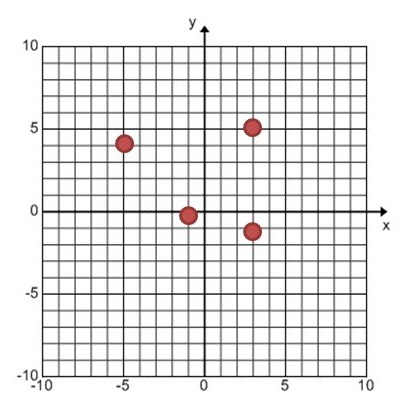
c)
No, because the x-value 11 has two y-values pair with it.
d)
No, because each x-value has only one y-value paired with it.
83.

What variable represents the domain?

a)

x

b)

y

c)

d

d)

r

84.

What variable represents the range?

a)

x

b)

y

c)

d

d)

r

85.

What is the domain of this Linear function?

a)

{0 ,1 , 2, 15}

b)

{0, 1, 2, 3}

c)

{3, 7, 11, 15}

d)

{3, 7, 11, 3}

86.

What is the range of this Linear function?

a)

{0 ,1 , 2, 15}

b)

{0, 1, 2, 3}

c)

{3, 7, 11, 15}

d)

{3, 7, 11, 3}

87.

What is the range of this mapping?

a)

{5, 10, 15}

b)

{(5,2),(5,4),(10,6),(15,8)}

c)

{2, 4, 6, 8}

d)

{5, 5, 10 ,15}

88.

What is the range of the ordered pairs graphed above?

a)

{1, 2, 3 ,4 ,5 ,6}

b)

{0, 1, 2, 3, 4, 5, 6}

c)

{2, 4, 8}

d)

{-1, 0, 1, 2, 3, 6}

89.
Which graph is NOT a function?
a)
Graph 1
b)
Graph 2
c)
Graph 3
d)
Graph 4
90.
Does the graph represent a function?
a)
Yes, because the vertical line test shows there are no repeating input values
b)
No, because the vertical line test shows there are repeating input values
91.

What is the domain of this mapping?

a)

{5, 10, 15}

b)

{(5,2),(5,4),(10,6),(15,8)}

c)

{2, 4, 6, 8}

92.

What is the domain of the graph?

a)


{x:<x<+}\left\{x:-\infty<x<+\infty\right\}

b)

undefined

c)

{x:3x3}\left\{x:-3\le x\le3\right\}

93.
What is the range of the graph?
a)
-2 < y < 10
b)
-3 < x < 3
c)
-2 ≤ y ≤ 10
d)
-3≤ x ≤ 3
94.

What is the domain of the graph?

a)

[-3, 3]

b)

(3, -3]

c)

(-3, 3)

d)

(2, 10]

95.
What is the domain of the function?
a)
{x| x = all real numbers}
b)
{x| -2 < x < 4}
c)
{x| -2 ≤ x ≤ 4}
d)
{x| -6 ≤ x ≤ 3}
96.
What is the range of this functions?
a)
{y| -6 ≤ y ≤ 3}
b)
{y| -6 < y < 3}
c)
{y|y = all real numbers}
d)
{y| -2 ≤ y ≤ 4}
97.

Find the Domain.

a)

(, +)\left(-\infty,\ +\infty\right)

b)

(3, +)\left(3,\ +\infty\right)

c)

(0, +)\left(0,\ +\infty\right)

d)

[0, +)\left[0,\ +\infty\right)

98.
What is the Domain?
a)
All real numbers
b)
x > 3
c)
x = 4
d)
x ≥ 3
99.

What is the Range?

a)

All real numbers

b)

y ≥ 3

c)

y > 3

d)

3 ≤ y ≤ 8

100.

What is the range of the function?

a)

{y: 1y<+}\left\{y:\ -1\le y<+\infty\right\}

b)

{y: 1<y<1}\left\{y:\ -1<y<1\right\}

c)

{y: 1.5y<+}\left\{y:\ 1.5\le y<+\infty\right\}

d)

{y:1y1.5}\left\{y:-1\le y\le1.5\right\}

101.

What is the DOMAIN of this graph?

a)

-4 ≤ x ≤ 3

b)

-1 ≤ x ≤ 4

c)

4 < x < 3

d)

-1 < x < 4

102.

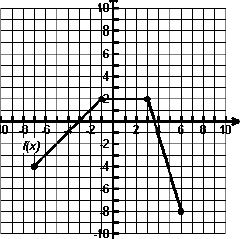
What is the range of the function?

a)

-7≤x≤6

b)

-7<x<6

c)

-8<y<2

d)

-8≤y≤2

103.

A set of ordered pairs is called what?

a)

the domain

b)

a relation

c)

a function

d)

the range

104.

What is the domain of a relation?

a)

the set of all x-values

b)

the set of all y-values

105.

Which is the set of all y-values or the outputs?

a)

Domain

b)

Range

c)

Relation

d)

Function

106.

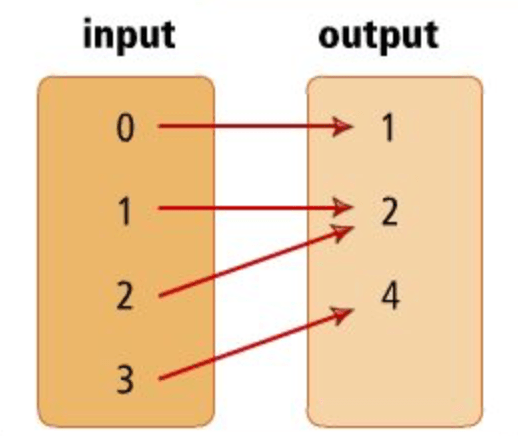
What is the range of the mapping?

a)

{1, 2, 4}

b)

{0, 1, 2, 3}

c)

{0, 3}

d)

{1, 4}

107.

Which relation does the mapping show?

a)

{(0, 1), (1, 2),(3, 4)}

b)

{(1, 0), (2, 1), (2, 2), (4, 3)}

c)

{(0, 1), (1, 2), (2, 2), (3, 4)}

d)

{(1, 0), (2, 1), (4, 3)}

108.

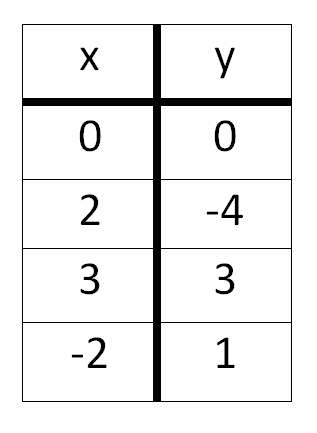
What is the range of the table?

a)

{-4, 0, 1, 3}

b)

{-2, 0, 2, 3}

c)

{-4, -2, 0, 1, 2, 3}

d)

{ (0, 0), (2, -4), (3, 3), (-2, 1) }

109.

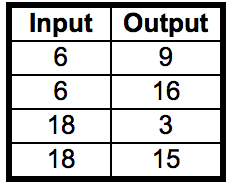
What is the domain of the relation shown in the table?

a)

{12}

b)

{6, 18}

c)

{3, 9, 15, 16}

d)

{13}

110.

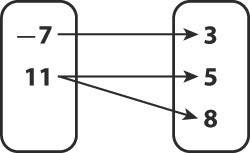
Is the relation shown a function?

a)

No, because the x-value 11 is paired with 5 and 8.

b)

Yes, because each x-value has only one y-value paired with it.

111.

Does the graph represent a function?

a)

Yes

b)

No

112.
For the function {(0,1), (1,-3), (2,-4), (-4,1)}, write the domain and range.
a)
D: {1, -3, -4,}
R: {0, 1, 2, -4}
b)
D:{0, 1, 2, -4}
R:{1, -3, -4}
c)
D:{0, 1, 2, 3, 4}
R:{1, -3, -4}
113.

Which mapping diagram is not a function?

a)
b)
c)
d)
114.

Identify all of the functions

a)
b)
c)
d)
e)
115.
Identify the range of the following function when given the domain { 2, 3, 10}:
y = 4x - 12
a)
4, 12, 20
b)
-20, 0, 28
c)
-4, 0, 28
d)
8, 12, 40
116.
What is the domain?
a)
{-2, -1, 0, 1, 8}
b)
{3, 5, 7 , 9, 0}
c)
{-2, -1, 0, 1, 3, 5, 7, 8, 9}
d)
{-2, -1, 0, 1, 2, 3, 4, 5, 6, 7, 8, 9}
117.
Find the slope of the line.
a)
4/2
b)
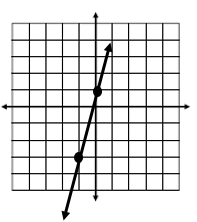
-4/2
c)
2
d)
-2
118.
a)
A
b)
B
c)
C
d)
D
119.

Which graph represents 2x + 4y = 12?

a)
b)
c)
d)
120.

Identify the slope intercept form equation.

a)

y=ax2+bx+cy=ax^2+bx+c

b)

y=mx+by=mx+b

121.

Which graph represents y=32x+4y=-\frac{3}{2}x+4  

a)
b)
c)
d)
122.

Which graph represents 2x5y=102x-5y=-10  

a)
b)
c)
d)
123.

Which graph represents the equation y=4x1y=4x-1  

a)
b)
c)
d)
124.

Which graph represents the equation x+5y=5x+5y=5  

a)
b)
c)
d)
125.

Which graph is correct for y = -x + 3?

a)

A

b)

B

126.

What is the slope-intercept form of the equation above?

a)

y = -4x - 12

b)

y = 4x + 12

c)

y = -4x + 12

d)

y = -4x + 3

127.
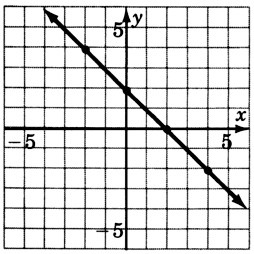
Which equation is being represented by this line?
a)
y = -1x + 2
b)
y = 1/2x + 2
c)
y = 3x -4
d)
y = -3x +2
128.
Which graph is linear?
a)
Graph A
b)
Graph B
c)
Graph C
d)
Graph D
129.
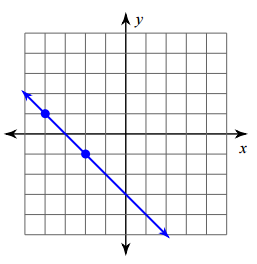
Write the equation of the line.
a)
y = x+1
b)
y= x-1
c)
y= x
d)
y= -x-1
130.

Which equation is modeled by the graph?

a)

y = 2x - 1

b)

y = x - 1

c)

y = -1/2x - 1

d)

y = -2x - 1

131.

Which equation is modeled by the graph?

a)

y = -2x

b)

y = -x

c)

y = -x - 2

d)

y = -1/2x

132.

Which equation is modeled by the graph?

a)

y = 2x

b)

y = 2

c)

x = 2

d)

y = 2x + 2

133.

Which equation is modeled by the graph?

a)

y = 1/2x - 1

b)

y = 2x - 1

c)

y = -2x + 1

d)

y = 1/2x + 1

134.

which of the following is a linear graph?

a)
b)
c)
d)
135.

Sketch y = 2x + 1

a)
b)
c)
d)
136.

Which graph represents 2x + 4y = 12?

a)
b)
c)
d)
137.
What is the slope of the equation?
y=-2x-1
a)
2
b)
-2
c)
-1
d)
1
138.
Which equation matches the graph? 
a)
y = 2x
b)
y = 1/4 x + 2
c)
y = 1x + 4
d)
y = -2x
139.
Which of these represents slope-intercept form?
a)
y - y1 = m(x-x1)
b)
Ax + By = C
c)
y = mx + b
140.
Which is the graph of y= -x + 2?
a)
A
b)
B
c)
C
d)
D
141.
Which equation best represents the line on the graph?
a)
y= 1/2x
b)
y= -1/2x
c)
y = 2x
d)
y = -2x
142.
Which equation represents the graph?
a)
x = 2
b)
y = 2
c)
y = 2x
d)
y = undefined
143.

Which graph represents y=32x+4y=-\frac{3}{2}x+4  

a)
b)
c)
d)
144.

Which graph represents the equation y=4x1y=4x-1  

a)
b)
c)
d)
145.

Which graph represents 2x5y=102x-5y=-10  

a)
b)
c)
d)
146.
Write in slope intercept form
5x - 3y = -9
a)
y = (5/3)x - 3
b)
y = (5/3)x + 9
c)
y = (5/3)x + 3
d)
y = (3/5)x + 3
147.
For the equation
y - 3 = 2(x + 4),
the line has a slope of 2 and contains what point?
a)
(-4, 3)
b)
(3, -4)
c)
(-3, -4)
d)
(-4, -3)
148.
For the equation
y + 1 = -3(x - 5),
the line contains the point (5, -1) and has a slope of?
a)
-1
b)
1
c)
-3
d)
5
149.
Write the equation in point-slope form of the line that passes through the given point and has the given slope.
(4, -7); m = -1/4
a)
y + 7 = -1/4(x - 4)
b)
y - 4 = -1/4(x + 7)
c)
y + 7 = 4(x - 4)
d)
y - 7 = -1/4(x - 4)
150.
Write the equation in point-slope form of the line that passes through the given point and has the given slope:
 (-2, -1); m= -3
a)
y + 1 = -3(x - 2)
b)
y + 1 = -3(x + 2)
c)
y - 1 = 3(x - 1)
d)
y + 2 = -3(x + 1)
151.
Write the equation in point-slope form of the line that passes through the given point and has the given slope:
 (-2, -1); m= -3
a)
y + 1 = -3(x - 2)
b)
y + 1 = -3(x + 2)
c)
y - 1 = 3(x - 1)
d)
y + 2 = -3(x + 1)
152.
Write the equation of the line in Point-Slope form that goes through the point (10,5) and has a slope of -3
a)
y - 5 = -3(x - 10)
b)
y= -3x + 35
c)
y + 5= -3(x + 10)
d)
y= -3x - 35
153.
Which of these represents point-slope form of a linear equation?
a)
y - y1 = m(x - x1)
b)
Ax + By = C
c)
y = mx + b
154.
Write the equation in point-slope form for the line that contains the points
(-2, -3), (4, 3)
a)
y - 3 = 1(x - 2)
b)
y + 3 = 1(x + 2)
c)
y -3 = -1(x + 2)
d)
y + 3 = -1(x - 2)
155.
What type of slope?
a)
negative
b)
positive
c)
zero slope
d)
downward slope
156.
What type of slope?
a)
undefined
b)
positive slope
c)
negative slope
d)
zero slope
157.
Find the slope
a)
-5/3
b)
-3/5
c)
5/3
d)
3/5
158.
Find the slope:
a)
3/4
b)
4/3
c)
-3/4
d)
-4/3
159.
Find the slope of the line.
a)
-2
b)
2
c)
-1
d)
1
160.
Find the slope of the line that passes through:
(6,7) and (4,2)
a)
2/5
b)
-5/2
c)
5/2
d)
-1/2
161.
Find the slope of the line that passes through: 
(2, 4) and (6, 12)
a)
1/2
b)
-1/2
c)
2
d)
-2
162.
Find the slope of the line that passes through:
(10, 1) and (5, 2)
a)
1/5
b)
-1/5
c)
5
d)
-5
163.

What is the slope represented in the table?

a)

slope: 12\frac{1}{2}

b)

slope: 22

c)

slope: 12-\frac{1}{2}

d)

slope: 2-2

164.

What is the Slope represented in this table?

a)

slope: 14-\frac{1}{4}

b)

slope: 4-4

c)

slope: 14\frac{1}{4}

d)

slope: 44

165.
How do you calculate slope using a graph?
a)
rise over run
b)
run over rise
c)
look at the y intercept
d)
look at the x intercept
166.

What does "m" stand for in the slope formula?

a)

y axis

b)

slope

c)

y coordinate

d)

x coordinate

167.

What is the slope-intercept form of the equation of a line?

a)

y=yx+b

b)

y=mx+b

c)

x=yx+b

d)

x=xy+b

168.

What does the b mean in y=mx+b?

a)

Slope

b)

Nothing

c)

x-intercept

d)

y-intercept

169.
In the equation y=mx+b, what does the m represent?
a)
slope
b)
y-intercept
c)
linear
d)
point-slope
170.
If m=3 and b=6, what is the correct slope intercept equation?
a)
y=3-6
b)
y=3x-6
c)
y=3x+6
d)
y=6x+3
171.

What is the slope of the line with the equation
y = 32x + 4y\ =\ -\frac{3}{2}x\ +\ 4  

a)

32-\frac{3}{2}  

b)

32\frac{3}{2}  

c)

44  

d)

4-4  

172.

What is the y-intercept of the line with the equation
y = 2x + 4y\ =\ -2x\ +\ 4  

a)

2-2  

b)

22  

c)

44  

d)

4-4  

173.

Write a linear equation in slope intercept form of a line with a slope of 12 and y intercept of 10

a)

y=12x-10

b)

y=10x+12

c)

y=12x+10

d)

x=10x-12

174.
Write a linear equation in slope intercept form of a line with a slope of -3 and y intercept of 0
a)
y=-3
b)
y=3x
c)
y=-3x
d)
x=-3
175.

Graph the line with the equation
y = 23x + 4y\ =\ -\frac{2}{3}x\ +\ 4  

a)
b)
c)
d)
176.

Graph the line with the equation
y = 13x  4y\ =\ -\frac{1}{3}x\ -\ 4  

a)
b)
c)
d)