
Font size
 Worksheets
gravity and motion
Total questions: 147
Worksheet time: 3hrs 31mins
The strength of the force of gravity depends on
The weight of the objects and their speeds
The distance of the objects and their speeds
The masses of the objects and the distance between them
Mass of the objects and their speeds
The moon's gravity is only a fraction of the Earth's gravity. Which fraction represents the moon's gravity compared to Earth?
1/3
1/6
1/4
1/2
The force of gravity gets weaker as the distance between objects increases.
True
False
How long is a rotation of Earth?
365 days (1 year)
48 hours
1 minute
24 hours (1 day)
The force that attracts all objects toward each other is called
motion
inertia
gravity
magnetism
The scientific law that states that every object in the universe attracts every other object.
Law of Universal Gravitation
Newton's First Law of Motion
Force
The Law of the Universe
A measure of the force of gravity acting on an object.
mass
weight
inertia
force
The tendency of an object to resist a change in motion.
inertia
mass
motion
weight
Force is...
a push or pull
a push only
a pull only
Force is...
a push or pull
a push only
a pull only
Gravity ...
repels all objects away from each other
attracts all objects towards each other
the amount of matter in an object
Newton's Law of Universal Gravitation
a push or pull
all objects repel every other object
all object attract every other object
Mass is...
the amount of matter in an object
the weight of an object
measure of the force of gravity
Weight is ...
how tall something is
measure of inertia on an object
measure of the force of gravity on an object
Newton's first law of motion
amount of matter in an object
every object in the universe attracts every other object
object at rest will stay at rest and object in motion will stay in motion
Inertia is the ...
tendency of an object to resist a change in motion
pus or pull of an object
the amount of matter in an object
The strength of the force of gravity depends on ...
distance between the two objects
mass of the two objects
mass of objects and distance between them
What can change? An object's weight or mass?
weight
mass
As distance increases the force of gravity ...
stays the same
increases
decreases
You weigh ___________ on the moon.
the same
more
less
An object with greater inertia ______ to start/stop than one with less inertia.
the same
easier
harder
Gravity ...
repels all objects away from each other
attracts all objects towards each other
is the amount of matter in an object
What is the formula for pressure?
P=A/F
P=FA
P=F/A
What is the SI unit use for hydraulic pressure?
Kg/m3
Pa
Litre
Kilometer
To calculate pressure you need to know ...
Force & Volume
Density & Volume
Power & Area
Force & Area
A person wearing boots and a person wearing stilleto heels stand on a wooden floor. They both have the same weight. Which person exerts a greater pressure on the floor?
boots because they have a larger surface area
stiletto heels because they have a larger surface area
boots because they have a smaller surface area
stiletto heels boots because they have a smaller surface area
When force increases...
pressure increases
pressure decreases
pressure stays the same
pressure increases then decreases
When area increases...
pressure increases
pressure decreases
pressure stays the same
pressure increases then decreases
Any substance that can easily flows and therefore can easily change shape.
Fluid
Liquid
Gas
Solid


A state of matter in which a substance has neither a definite shape or volume
liquid
gas
solid
viscosity
These statements are about the particle model of matter. Which one is not correct?
Liquids are hard to compress because their particles are very close together
Gases expand to fill their container because there are only weak forces between the particles
Liquids can flow because there are only very weak forces between the particles
Solids have a fixed shape because there are very strong forces between the particles
Why do solids expand when they are heated?
The particles get bigger
The particles vibrate more and take up more space
The particles vibrate more and get closer together
The particles stick together
Density is
the weight of a fixed mass of something
the volume of a fixed weight of something
the weight of a fixed volume of something
the mass of a fixed volume of something
The term fluids generally applies to:
solid and liquid
liquid and gas
solid and plasma
water only
Which statements below is INCORRECT about liquids and gases?
Liquids possess greater kinetic energy than gases.
Gases have weak molecular force of attraction while liquids have a moderate force of attraction.
Liquids have a definite size where gases can expand to fill any closed container.
Gases are easily compressed where liquids are not.
Density is:
the weight of a fixed mass of something.
the volume of a fixed weight of something.
the weight of a fixed volume of something.
the mass of a fixed volume of something.
When liquid water changes into steam it is:
evaporating.
condensing.
melting.
dissolving.
In what way is ice different to other solid materials?
It is colder.
It occurs naturally.
Ice (solid water) is less dense than liquid water.
The density of ice does not change when it is cooled down.

Which of these forces is the upthrust?
A
B
C
D
Why does a hot air balloon float in air?
Air is less dense than water.
The density of hot air is less than the density of cold air.
Air is denser on cold days.
The overall density of the balloon and its basket is less than the density of the air.
The air resistance of a car can be reduced by:
making the car bigger.
giving it a streamlined shape.
making the car heavier.
putting a roof box on it.
A car needs a forwards force to keep moving because:
everything needs a force to keep moving.
gravity is trying to slow it down.
it needs a force to balance friction and air resistance.
weight balances friction.
Gases diffuse fast because
The gas particles are very apart from each other
The gas particles have high kinetic energy
The gas particles are very heavy
Gas particles are very small
Rate of diffusion of gases depend on
(a)
As the water molecules in a confined container move around, they (a) with the walls of the container
Any substance that can easily flow and therefore can easily change shape.
Fluid
Liquid
Gas
Solid
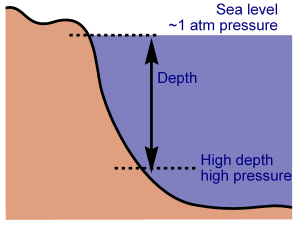
When you go deeper inside a swimming pool, the pressure experienced by you
increases
decreases
stays the same
When a drop of black ink is put in a glass of water the water turns black. This is because of
(a)
There are two glasses, one containing hot water and the other containing water at room temperature. Few drops of red dye is added to both the glasses. In which case will the water turn red faster?
Atmospheric pressure is highest at
Mean sea level
Above sea lvel
Below sea level
When a pressure cooker with its lid closed is heated, the pressure inside
Increases
Decreases
Remains the same
Becomes zero
In order for a fluid to flow, it will travel from an area of __________ pressure to ____________ pressure
high to low
low to high
equal
all of the above
Why is fluid pressure exerted evenly in all directions?
because you push down evenly
pressure is flowing and bumping the outside of the container
particles of fluids are constantly moving and collide with each other
pressure is moving at a slow speed
All of these are reasons that the canoe would float except
the shape of the canoe
the atmospheric pressure at that altitude
the density of the material that the canoe is made of
the number of people in the canoe
What are two things you need to know to calculate pressure? (There are two answers)
mass of the object
gravity
force
area over which force is applied
velocity
Which of the following are the SI unit for pressure (more than 1 answer)
N/m2
Pa
Pascal
Newton
The pressure exerted by a force of 35 N over an area of 5 cm2?
40 Pa
7 Pa
30 Pa
175 Pa
Ice floats in water because
it is smaller
it is less dense than water
it is more dense that water
everything floats in water
Which of the following is NOT an example of Bernoulli's principle?
Smoke rising up a chimney
an atomizer spraying perfume
ice floating in water
airplane wings lifting the airplane
A hydraulic system is described by what principle?
Bernoulli's
Pascal's
Pressure
Newton's
What is the equation for density?
force / volume
mass / volume
volume / mass
mass X volume
The pressure in the fluid decreases as the speed of the fluid _____
stays the same
decreases
increases
they are not related
What is atmospheric pressure?
the pressure exerted by oxygen on a given surface
the pressure exerted by the gas in Earth's atmosphere
the pressure from the clouds
The pressure that space pushes down on Earth
True or False: A fluid is a substance that takes up the shape of its container
True
False
True or False: Archimedes Principle states that the buoyant force on an object is equal to the volume of fluid displaced
True
False
A forestry worker accidentally strikes a pipe with the end of a pickaxe while trying to dig a hole. If the pickaxe strikes with a force of 2000 N and the end of the pickaxe measures 0.02 m by 0.04m, how much pressure is exerted on the pipe by the pickaxe?
100,000 Pa
33,333.33 Pa
1.6 Pa
2,500.000 Pa
The large piston in a hydraulic lift has an area of 220 cm2. What force must be applied to the small piston with an area of 2.0 cm2 in order to raise a car the mass of 1500 N?
13.6 N
165,000 N
19.4 N
16.3 N


(a) is the result of a force that is distributed over an area
The formula for Pressure is....Pressure = (a)
A (a) is a substance that assumes the shape of its container OR any substance where the molecules move.
Fluid Pressure increases as depth (a)
Air Pressure decreases as the altitude (a)
According to ____________ ____________, a change in pressure at any point in a fluid is transmitted equally and in all directions throughout the fluid
(a)
In a _________ __________, an increased output force is produced because a constant fluid pressure is exerted on a larger area of the output surface.
(a)
(a) Principle says that as the speed of a fluid increases, the pressure within the fluid decreases.
(a) is an upward force that is caused by a difference in pressure.
(a) is the ability of a fluid to exert an upward force on an object placed in it.
A _________ _______ is an upward force that acts on any object in a fluid
(a)
(a) principle says that the bouyant force on an object is equal to the weight of the displaced fluid.
(a) is the ratio of mass to volume (M/V) and will determine whether or not something floats or sinks in a fluid.
An object (a) if it is less dense than the fluid it is in.
An object (a) if it is more dense than the fluid it is in.
Pressure is
AreaForce
ForceArea
VolumeMass
MassVolume
hypothesis that continents are in constant motion
continental drift
Pangaea
seafloor spreading
plate tectonics
naturally preserved remains, imprints, or traces of organisms
Pangaea
Glossopteris
fossil
subduction
middle layer of Earth situated between the crust above and the core below
crust
lithosphere
athenosphere
mantle
ancient supercontinent, composed of land that forms today's continents
Glossopteris
Pangaea
Laurasia
Gondwanaland
event in which magnetic field reverses direction
magnetic reversal
magnetism
normal polarity
reversed polarity
mountain range located on the seafloor in the middle of the ocean
Himalayas
Andes
mid-ocean ridge
Mid-Atlantic ridge
conforming to a type, standard, or regular pattern
normal
reversed polarity
normal polarity
magnetic reversal
today's magnetic field; magnets orient themselves to point north
magnetic reversal
reversed polarity
normal polarity
magnetism
magnetic field in which magnets orient themselves to point south
reversed polarity
magnetism
normal polarity
magnetic reversal
new ocenaic crust forms at a mid-ocean ridge as old oceanic crust moves away
mid-ocean ridge
slab-pull
ridge push
seafloor spreading
circulation of material caused by differences in temperature and density
conduction
convection
radiation
subduction
where two plates collide
convergent plate boundary
divergent plate boundary
transform plate boundary
slab pull
where two plates separate
transform plate boundary
ridge push
divergent plate boundary
convergent plate boundary
cold, rigid outermost rock layer of Earth
lithosphere
athenosphere
crust
mantle
capable of being molded of changing shape
bendable
deformation
plastic
normal
theory that Earth's surface is made up of rock plates that move with respect to each other
continental drift
Pangaea
plate tectonics
subduction
force created by rising mantle of ocean ridges that creates potential for plates to move away from the ridge
ridge push
slab pull
plate tectonics
subduction
force created by sinking of a plate, or slab, that pulls on the rest of the plate
ridge push
subduction
slab pull
convection
sinking of a denser plate below a more bouyant plate at a convergent plate boundary
subduction
ridge push
slab pull
lithosphere
where two plates slide past each other
convergent plate boundary
divergent plate boundary
transform plate boundary
ridge push